Skip to the content of the web site.

History of the University of Waterloo

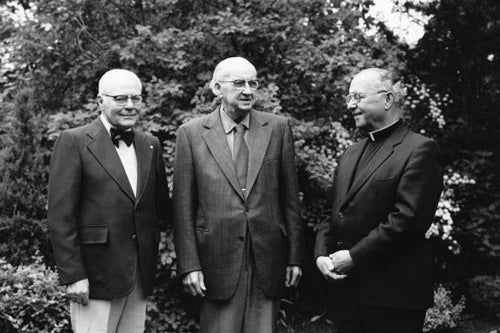
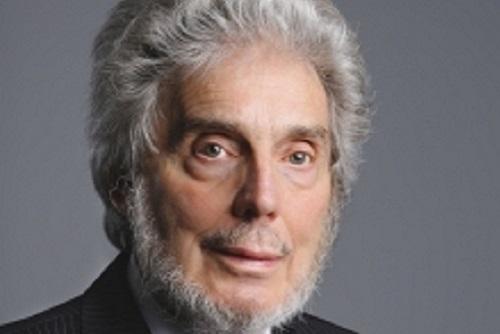
Gerald HageyThe University of Waterloo celebrated its 50th anniversary in 2007, harking back to the first applied science classes offered starting July 1, 1957, by the temporary “Waterloo College Associate Faculties.” Gerald Hagey (left), president of the Lutheran-affiliated Waterloo College, had enlisted support from business leaders in Kitchener-Waterloo, a modest industrial city in midwestern Ontario: they would create a program to train engineers and technicians who were desperately needed for Canada’s growing postwar economy.

The cold war, the space race, and medical and scientific progress presented new needs for trained manpower and technical knowledge. For Hagey and his colleagues, the solution was not just classroom instruction but “the co-operative program,” which offered students alternating terms of paid work in industry to get practical experience.

Becoming a university

By the time that first class of engineers graduated in 1962, the Associate Faculties had become the University of Waterloo, and its board of governors, led by business veterans such as Ira Needles, had taken the ambitious step of buying a 237-acre parcel of farmland on the edge of Waterloo to build a new campus. (Subsequent purchases would expand the total campus to about 1,000 acres, or 400 hectares.)

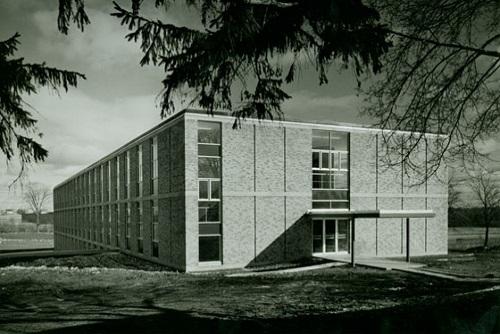
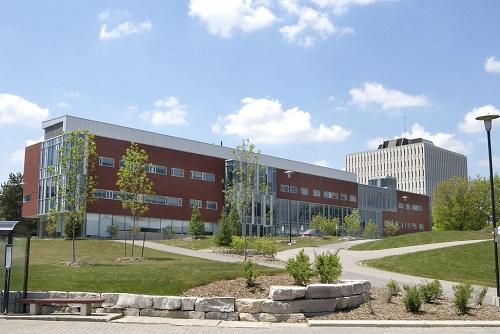
The first building, dedicated to chemical engineering and chemistry (right, next to Schneider farmstead), opened in 1958, with a “physics and mathematics” building coming in 1959 and the first arts building in 1962. As low-rise brick structures were built, they began to define a series of quadrangles in which the founders were confident that academic life would flourish.

Following independence from Waterloo College (which was founded in 1911, and which later evolved into the present-day Wilfrid Laurier University), the new University of Waterloo quickly diversified its academic offerings.

To engineering and science, it added a faculty of arts as early as 1960. Mathematics, originally part of arts, became the world’s first faculty of math in 1967. Two more faculties, applied health sciences and environment, were created. The College of Optometry of Ontario moved from Toronto in 1967 to become part of the growing university. Enrolment boomed, and by the university’s 10th anniversary that year it was a cliché to speak of “mud and dreams” amid bustling construction.

three principal foundersThe university, which adopted “UW” as its abbreviation and was beginning to make the name of Waterloo internationally known, developed in another distinctive direction as well. The University of St. Jerome’s College, founded in 1865 and flourishing in Kitchener as a Catholic liberal arts college, became “federated” with UW in 1959 and built its own miniature campus across Laurel Creek from the main university. Anglican, Mennonite and United Church bodies established their own colleges — Renison, Conrad Grebel and St. Paul’s — with “affiliated” status.

Thus the three principal founders of the university were (above, from left) J. Gerald Hagey (founding president), Ira G. Needles (first chairman of the board of governors), and Rev. Cornelius Siegfried, who brought St. Jerome's into federation with UW.

A hotbed of innovation

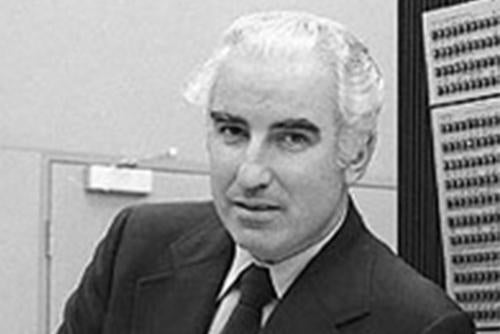
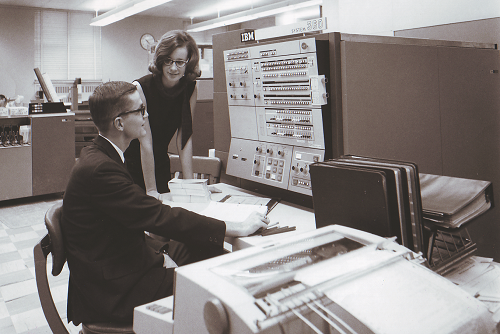
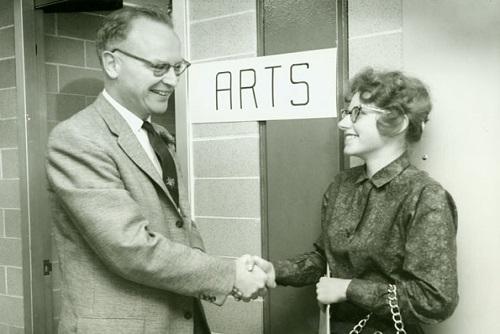
Wes GrahamIn the early 1960s, mathematics professor Wes Graham (right) led the way in introducing computers, and not only for research: almost uniquely in the world, Waterloo gave undergraduate students access to the room-sized machines that were the early state of the art. Enthusiastic students played a role in developing computer languages designed for classroom use, and Waterloo’s reputation spread further with the worldwide marketing of Watfor and Watfiv. A department of “applied analysis and computer science” was created, eventually to become the David R. Cheriton School of Computer Science.

As Hagey retired in 1969 and was succeeded as president by Burt Matthews in 1970, the number of distinctive — sometimes unique — and outstanding academic programs kept growing. Waterloo earned a reputation in kinesiology, clinical psychology, architecture, earth sciences (with an emphasis on groundwater studies), accounting, actuarial science, and many more, as well as the fields of engineering which it had claimed since the beginning. Part-time as well as full-time students were welcomed in many disciplines, and a large “correspondence” program developed in the 1970s using audiotaped lectures, to be reborn three decades later as “distance education” based largely online.

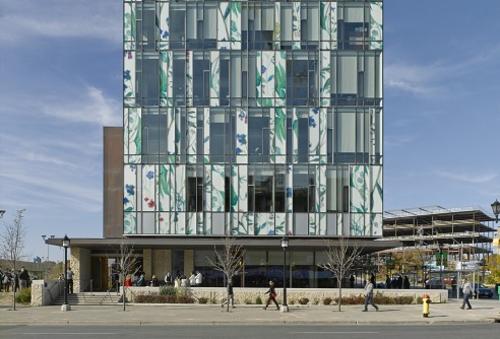
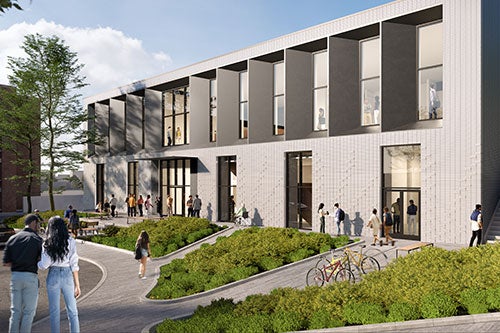
Campus growth slowed, then began again with the William G. Davis Centre for Computer Research in 1988. A combination of government and private funding made the Centre for Environmental and Information Technology, at the heart of campus and linked to half a dozen existing buildings, a reality in 2003. Work began in 2008 on the Mike and Ophelia Lazaridis Quantum-Nano Centre.

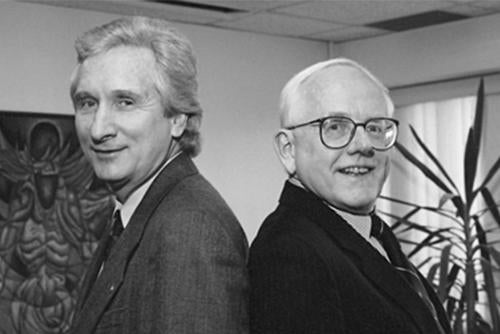
Doug Wright and James DowneyMillions of dollars for research came from governments, from non-profit granting agencies, from industry, to support laboratories and thinkers. Spinoff companies founded by recent graduates, or moonlighting professors, began distributing software and building hardware. The phrase “technology transfer” became a Waterloo staple.

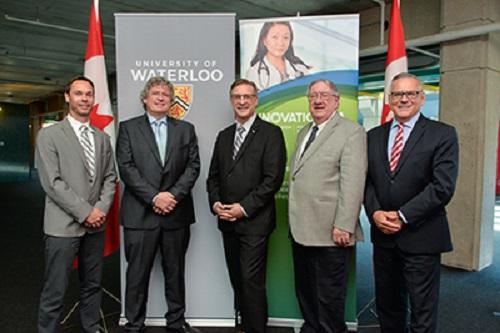
A powerful spokesman for such activity was Doug Wright (near left), who came in 1981 as the university's third president, and incessantly travelled to tell governments, corporate leaders and international industrialists that what the world needed was more highly trained workers, as many of them as possible to come from Waterloo.

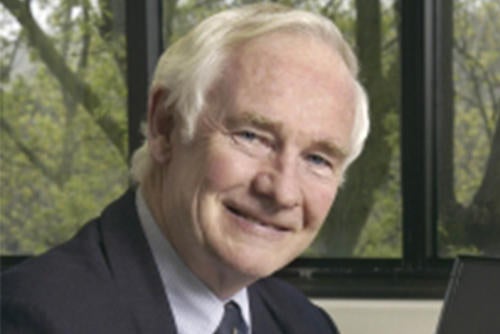
James Downey (above, far left) served as president 1993-99, and was followed by David Johnston, whose term saw the multi-million dollar Campaign Waterloo and a new emphasis on major projects involving “partnerships” with industry, governments and alumni. The long-anticipated research and technology park on the north campus opened, and private and civic support provided a campus for the architecture school in Cambridge, 30 kilometres from the main Waterloo site.

As 2009 began, a health sciences campus, home to a new school of pharmacy, opened in downtown Kitchener. A campus is in development in nearby Stratford and another in the United Arab Emirates. In the Sixth Decade Plan for the years 2007-17, the university anticipates a still greater presence outside Canada, in cooperation with international governments and business.

Chris Redmond
Communications & Public Affairs
credmond@uwaterloo.ca
2 February 2009

More web pages of historical interest