'With a pinch of art and humour'
Engineering professor and his students celebrate an Ig Nobel win on the world stage for their design of a splash-free urinal
It was such good news, the engineering professor and his student celebrated by sipping blueberry wine from espresso cups in his office at the University of Waterloo.
Sweet and unconventional, it was a fitting choice for two researchers who had just been informed they were winners of the 2026 Ig Nobel Physics Prize for their work on a splash-free urinal design.
A light-hearted parody of the prestigious Nobel Prizes, the annual Ig Nobels celebrate unusual and imaginative academic achievements that make people laugh, then think.
The professor, Dr. Zhao Pan, and the student, Kaveeshan Thurairajah, were all-in on the spirit of the international contest – organized by the magazine Annals of Improbable Research – as they attended the sold-out awards ceremony in Zurich, Switzerland last week wearing bright yellow raincoats and even signed some autographs.
Pan, a professor of mechanical and mechatronics engineering, embraces his broad sense of humour, as well as an appreciation of art, in both the lab and the classroom.
“Without physics and math, we cannot design a humble urinal, let alone anything more complex,” he says. “With a pinch of art and humour, our ordinary, everyday lives can be just a bit better.”
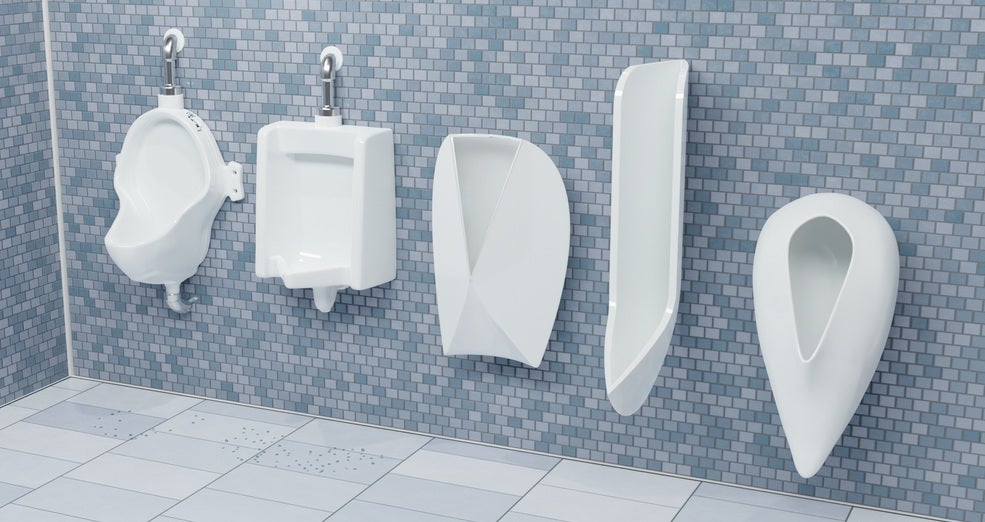
Researchers tested several urinals before determining their Nautilus deign (second from right) minimized splash-back the best.
Pan is particularly proud of the fact that most of the work on the urinal project, which culminated in publication of a journal paper in 2025, was done by his undergraduate students, including Mabel Song and JD Zhu.
Now working on a PhD in mechanical engineering, Thurairajah was also still an undergrad when he spearheaded the study and triggered a wave of media coverage by presenting early findings at a conference in the United States in 2022.
The research team recognized by the Ig Nobles also featured engineering professors Dr. Randy Hurd of Weber State University in Utah and Dr. Tadd Truscott of King Abdullah University of Science and Technology in Saudi Arabia.
Puns, cracks and kidding aside, more than a decade of thought and serious, off-and-on research went into the final urinal design, which was dubbed Nautilus (pronounced Nauti-loo).
Long and sleek, the design all but eliminates splatter on floors, pants and shoes by ensuring the angle at which a urine stream hits the urinal wall doesn’t exceed about 30 degrees, which was determined via theoretical modeling and validated by careful physical experiments.
Developing it required the use of a bit of everything, including fluid mechanics, sustainability, differential equations, manufacturing, prototyping, art, industrial design, bio-mechanics – and a healthy dose of playful, wide-eyed curiosity.
“This prize is kind of a symbol of that, of learning things just to be learned,” Thurairajah says. “Even if it seems a little silly or funny, it's beautiful to know about how the world works.”
Ten prizes were awarded in all, including for research on the evolutionary history of kissing, the science of blowing your nose and how critters helped decompose 1,000 pairs of underwear buried in more than 25 countries.
Feature photo: (l-r) Dr. Tadd Truscott, Dr. Zhao Pan, Kaveeshan Thurairajah and Dr. Randy Hurd celebrate their Ig Nobel Physics Prize for a splash-free urinal design.