Collaborating on quantum research from Germany to Canada
Quantum field researcher Dr. Paul-Hermann Balduf will join Waterloo this October thanks to Feodor Lynen Research Fellowship
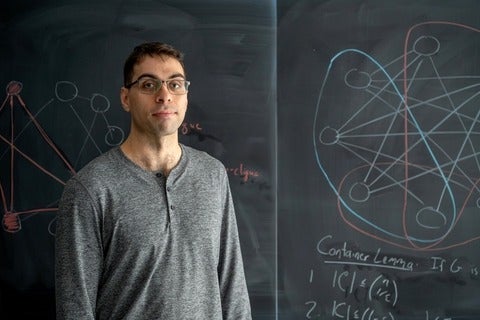
New research from the University of Waterloo is making inroads on one of the biggest problems in theoretical computer science. But the way to do it, according to Cameron Seth, a PhD researcher working in the field of algorithmic approximation, is by breaking the problem down into smaller pieces.
“Everyone working in computer science and mathematics knows about the ‘P vs. NP’ problem,” Seth says. “It’s one of the notorious Millennium Prize Problems: so famous and so difficult that solving one will earn you a million dollars.”
Dr. Edward Doolittle, Kanyen’kehake (Mohawk) nation and associate professor of mathematics at First Nations University of Canada, is the first Indigenous mathematics PhD in Canada.
This year’s Hagey Lecturer has worked for decades to advance educational opportunities for Indigenous people and rethink what mathematics — and math education — look like for everyone.
Dr. Roberto Hernández Palomares grew up in a working-class family in the central Mexican state of Guanajuato, where a career in mathematics often felt like an impossible dream.
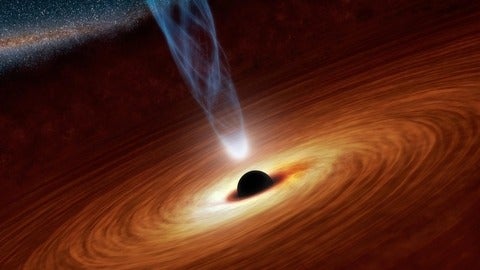
For the last seven decades, astrophysicists have theorized the existence of “kugelblitze,” black holes caused by extremely high concentrations of light.
These special black holes, they speculated, might be linked to astronomical phenomena such as dark matter, and have even been suggested as the power source of hypothetical spaceship engines in the far future.
However, new theoretical physics research by a team of researchers at the University of Waterloo and Universidad Complutense de Madrid demonstrates that kugelblitze are impossible in our current universe.
Whenever you walk past Dr. Matthew Satriano’s office, it seems like two or three people are inside, scribbling equations on his whiteboard and chatting in animated tones. Even the notice board next to his door reflects this spirit of constant collaboration: it features a caricature portrait of Satriano grinning and gesturing to his next-door neighbor, Matthew Kennedy, whose front door features a matching portrait.

Cheriton School of Computer Science professor N. Asokan has been named a 2023 Fellow of the Royal Society of Canada, the highest national honour a researcher in the arts and humanities, social sciences and sciences can achieve.
“Trying to answer important health questions often requires the collection and ultimately the analysis of human health data,” says Joel Dubin, an associate professor of statistics and actuarial science who is cross appointed in the School of Public Health Sciences.
The Natural Sciences and Engineering Research Council of Canada (NSERC) announced close to $51 million in funding today for projects that will strengthen Canada’s quantum research and innovation capacity in alignment with the National Quantum Strategy.