
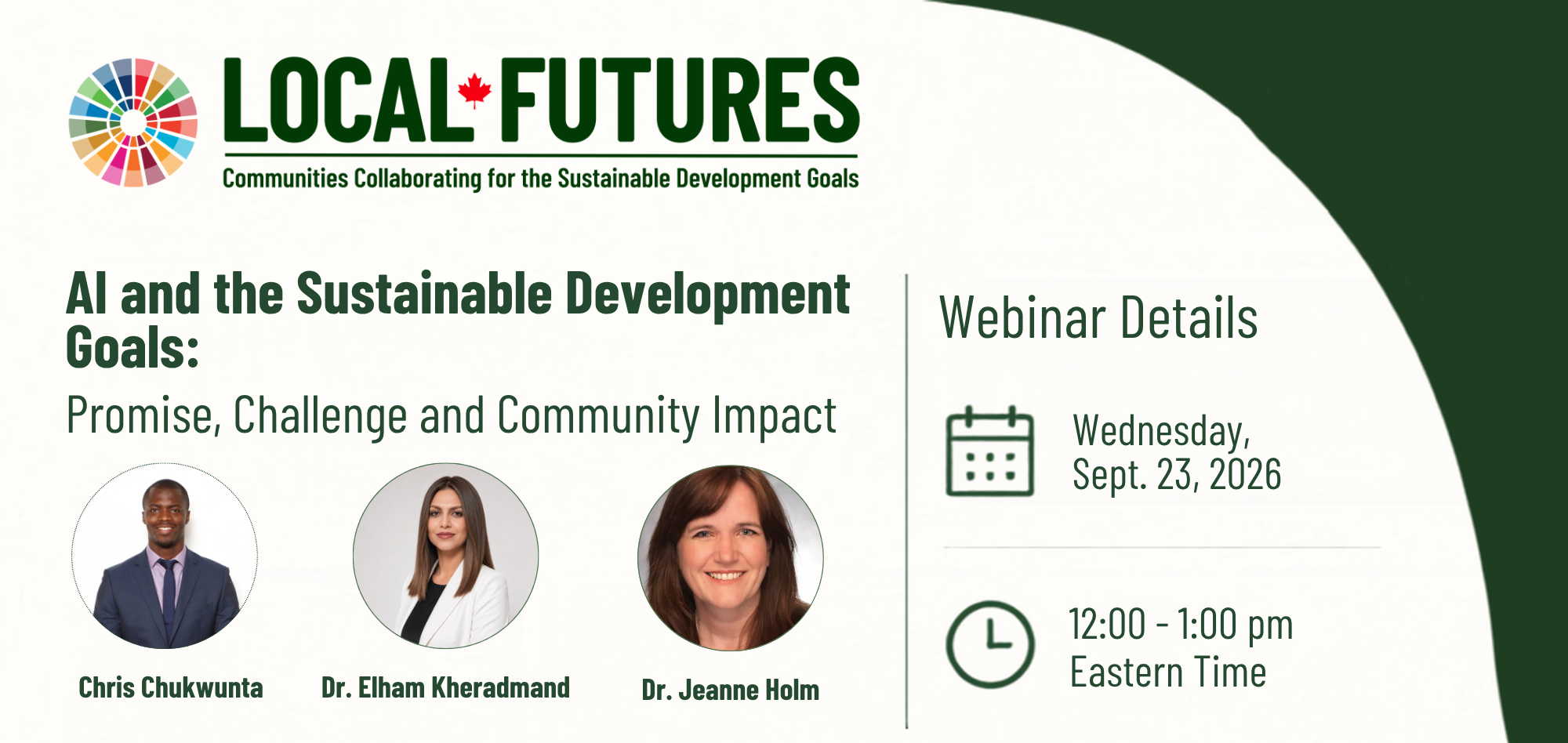
Last week we hosted our webinar “AI and the SDGs: Promise, Challenge, and Community Impact.” We invited three fantastic speakers to share their insights on how artificial intelligence (AI) needs to be developed to keep social good and advancing community goals as a top priority.
Here are some of the big takeaways.
Shifting from Technological Power to Human Outcomes
While AI presents unprecedented opportunities to advance human society, it also poses severe risks. The panel emphasized that realizing AI's positives requires shifting focus from raw technological power to human outcomes, equitable access, and proactive public oversight. All three panelists agreed that AI can help advance the SDGs, but only if the rules keep pace with the technology. The questions that kept emerging in the conversation were “who sets the rules, and who gains or loses as a result?” Panelists agreed that we "needed AI governance frameworks ten years ago," and warned that tech self-regulation can't be trusted on its own, with examples from the tobacco and oil and gas industries cited as clear proof of that. Industries don't police themselves, creating important oversight roles for government, civil society, journalists, and local communities.
Social Good Isn't a Button You Can Press
Social good has to be designed into AI systems from the start. This means building systems with transparency about evidence, honesty about uncertainty, data privacy, and careful testing. AI models learn from patterns in historical training data, which too often can contain omissions, errors, or human biases. Preventing the perpetuation of discriminatory practices, for example, in hiring, policing, or public service delivery requires transparent data selection, diverse development teams, and rigorous evaluation. Essential governance, ethical standards, and content guardrails must be implemented early to ensure AI actively contributes towards advancing social good around the world.
Session Speakers
- Chris Chukwunta, CEO of Intelligent Resilient Enterprise Systems
- Dr. Elham Kheradmand, CEO of Lucid Axon
- Dr. Jeanne Holm, Chair, Board of Trustees at Claremont Graduate University & President of Open Data Collaboratives
- (Moderator) Jon Beale, Director of Local Futures
Democratizing Intelligence
There is no doubt that AI can help anyone with an interest in a topic access the highest levels of expertise. In order to benefit from this “democratization of intelligence”, communities need to develop the necessary hardware, internet connectivity, and skill building to underserved populations. Unequal access to digital infrastructure and low digital literacy translate directly into unequal access to economic, educational, and public health opportunities. As was seen during COVID, 80% of the 650,000 students in the Los Angeles Unified School District were living in poverty and lacked the basic hardware or internet access needed to attend online classes, leading the City of Los Angeles to coordinate with telecom companies, school districts, and shelters to get them online so students could remain in school. Unequal digital access means unequal opportunity.
AI's Environmental Footprint
AI's environmental footprint has to be managed as a sustainability issue in its own right. AI data centers consume massive amounts of electricity and water, driving up greenhouse gas emissions and straining local power grids. In the province of Alberta alone, new data center proposals submitted to the province's grid operator are more than double the load of the peak electricity demand for the entire provincial electrical grid (21 gigawatts vs peak demand of 12 gigawatts).
Building AI for sustainability cannot happen without addressing these massive environmental footprints and turning data centers from “resource hogs into resource generators.” Some insightful examples shared on how to do this include mandating data centers to reserve a portion of their GPU capacity specifically to run grid-optimization algorithms, and equipping data centers with on-site renewable generation and battery storage. Cautious optimism was also shared around increasing efficiencies when resources are scarce. NASA's Voyager spacecraft (more than 21 billion km’s from earth and still going) running on 176KB of memory (the equivalent to one short email in today’s standard) is a good example of how constraints and resource scarcity can drive clever engineering.
What Next?
We concluded the webinar by looking ahead five years and asking, “what's one thing that needs to be done to put AI to work to advance community goals?” The panelists were clear: build community capacity now. Support municipalities, non-profits, and local leaders in developing the digital literacy skills needed to fully harness AI tools and how best to apply them to their own priorities. Develop the data infrastructure and governance needed to ensure equitable access to the technology and be proactive in creating local oversight and bringing diverse voices to the table.
As education, health services, and employment are increasingly integrating AI systems, unequal digital access will translate into unequal access to basic life opportunities. The promise of AI is very real, but without intentional investments, the perils threaten our progress every step along the way.