In April, we launched a Community of Practice on Collective Impact and the Sustainable Development Goals, in partnership with the Tamarack Institute. The Community of Practice provides an opportunity for members to come together regularly to learn new skills for multisector collaboration and to strengthen networks with changemakers across the country.
Creating a Strong Collective Impact Initiative
When we talk about “collaboration” it is often about sharing information, networking, and working together on specific projects or activities. Collective Impact offers an enhanced approach that focuses on building intentional and integrated coordination between partners by aligning work, building long-term relationships, and sharing resources towards long-term change (learn more about the many forms collaboration can take).
There are five key components in creating a strong Collective Impact initiative:
1. Create a Common Agenda: Outlines the key impact and goals that partners want to achieve and how they will work together. It is developed with the input of diverse stakeholders to ensure that the result reflects a shared vision.
2. Establish Shared Measurement Systems: Helps the initiative build accountability, ensure that activities are aligned, and understand the impact of those activities.
3. Build Mutually Reinforcing Activities: Coordinated activities and programs contribute to shared goals and outcomes. Each partner will act within their area of specialization but align their work to create systems and policy change that contribute to the common agenda.
4. Prioritize Continuous Communication: Helps to keep all those involved in the initiative informed and build trust between partners. It also provides an opportunity to address challenges that may emerge.
5. Establish a Backbone Infrastructure: Collaboration takes intentional time and effort to be successful and sustainable. Designate staff roles and responsibilities from among partners to coordinate strategy, lead communication, mobilize funding, and advance policy.
Engaging Diverse and Competing Perspectives
An important aspect for any collective impact initiative is to bring a diversity of perspectives, including competing ones, together to innovate and generate the best ideas. Many of today’s complex challenges have become highly polarized, with proposed solutions having a win or lose approach. To generate buy-in from a range of stakeholders, we need to recognize multiple viewpoints and priorities around community challenges.
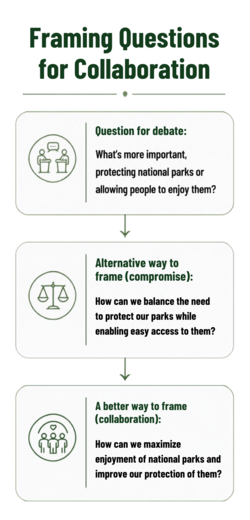
The way questions are asked can set up conversations for debate, compromise, or collaboration. Framing a question for debate leads to a win/lose solution. But framing a question for collaboration acknowledges that there are multiple perspectives and priorities that need to be acknowledged when determining a solution.
Asking questions that enable buy-in across diverse perspectives does not try to ignore differences in perspectives. Rather, it seeks to understand those differences more deeply, to bring more people, with a wide range of opinions, together to develop new solutions.
Practice your skills using the Horns of a Dilemma exercise featured at our July Community of Practice session.