
Measuring sustainability performance is challenging. It often involves tracking quantitative and qualitative indicators across environmental, social, and economic areas, and relating that performance back to strategies and plans to demonstrate progress made.
Despite the detail and rigour of this work, it can be easy to lose track of the bigger picture – can our local systems actually sustain the pressure we as humans are putting on them?
The most straightforward example of this is thinking about water use. It’s fairly common to measure water consumption per person for a community and to track that over time. In year 1 we measure water consumption at 40 units/person for our community and in year 10 we see that drop to 30 units/person. The story here seems clear: we are a more sustainable community because of it.
The part of the story that is missing is “what’s the annual water use that our watershed can support?” A community with a big watershed might be well within its limits to use 40 units of water per person each year, whereas a community with a small watershed might still be vastly unsustainable at 30 units/person. A watershed’s carrying capacity will be different for each community, meaning the context from which we measure “sustainable water consumption” is very important.
Our understanding of sustainability performance can change dramatically when we look more widely at the thresholds of our local sustainability systems. This approach using thresholds in sustainability measurement is known as context-based sustainability (CBS). It uses thresholds as ecological or ethical boundaries to assess sustainability with the aim of progressing the well-being of people and the planet. This type of thinking has been popularized in other similar approaches such as Doughnut Economics and the Planetary Boundaries (i.e. how many planet Earth’s are needed to sustain humans today).
Thresholds can also be applied to social dimensions of sustainability. For example, a living wage is a threshold to understand if people have access to sustainable employment compared to the traditional view of setting wages without consideration for what it actually costs to live in a community.
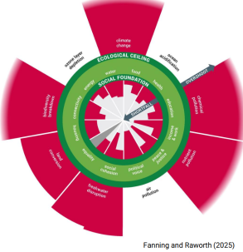
Diagram representing the Doughnut Economics model. The areas in red reflect where ecological and social boundaries are being surpassed.
Our Work Using Context-Based Sustainability
We are very pleased to be partnering with Randy Sa’d, Executive Director of the Flourishing Enterprise Institute and REFOCUS to use a CBS approach in the Local Futures project. Randy is one of Canada’s leading champions in how management systems across Canadian sectors need to evolve to understand sustainability performance in a rapidly changing and increasingly complex world. He focuses his work on providing guidance and support to leaders in applying a more integrated approach to measuring sustainability performance using CBS and thresholds. In our Local Futures work, Randy will be supporting the integration of CBS into the development of the Voluntary Local Reviews in our project’s five partner municipalities.
The Sustainable Development Goals are a framework focused on the interconnections between the world’s biggest challenges and how they relate to each other in systems-oriented ways. Context-based sustainability is one approach that integrates and embeds a systems-thinking lens in the way we collect and consider data. By giving a broader view on ecological and social boundaries, CBS creates a clearer picture of our current sustainability actions and what change needs to happen to ensure a lasting and prosperous future.
...sustainability indicators should be related to carrying capacity or to threshold of danger…Tons of nutrients per year released into waterways means nothing to people. Amount released relative to the amount the waterways can absorb without becoming toxic or clogged begins to carry a message.