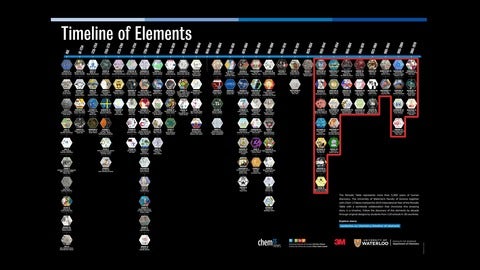
IYPT Timeline of Elements
Although the radioactive elements uranium and thorium were discovered early in the history of the elements — 1789 and 1828, respectively, years before the advent of the Periodic Table — radioactivity itself was unknown until 1896 when Henri-Antoine Becquerel (1852-1908) in Paris found that uranium could expose photographic plates, even when protected by black opaque paper. The renowned Marie Curie (1867-1934) promptly made a study of all elements (that were known at that time) and determined that only two were radioactive — uranium and thorium.
In 1789 Lavoisier turned the concept of “element” on its head when he proposed that water was a compound and that hydrogen, oxygen, carbon, sulfur, iron, copper, and 25 other substances were the true elements.
The alchemists had known since the 1500s that salts could impart various colors to a flame. In the 1700s Andreas Sigismund Marggraf (1709-1782) demonstrated that sodium salts could be differentiated from potassium salts by the former’s yellow color and the latter’s purple hue.
In previous chapters we have seen how chemistry has evolved in stages. First was the world of the ancients with their concept of the four elements — fire, earth, water and air.
Historically, the distinction between sodium and potassium was not made easily. Only gradually was it recognized that there was a difference between “plant alkali” (potash, potassium carbonate), obtained from the ashes of plants, and “mineral alkali” (soda, sodium carbonate), found in salt flats and evaporated seawater.
The stage was now set for a giant leap in the understanding of chemistry. A vast amount of knowledge had been accumulated during the previous several thousand years.
Modern science depends upon both theory (basic science) and technology (practical applications). Likewise, progress during the Middle Ages depended upon both theory and technology — as the alchemists were plodding along with their secret recipes and cryptic writings, the practical miners were advancing their techniques for extracting the metals from the ores for spears, plowshares and ornaments.
[This series is a companion to our International Year of the Periodic Table project — Timeline of Elements and Mendeleev Mosaic. Time periods from our timeline project will be featured highlighting the historical and scientific advancements resulting in the discoveries of the elements of that period. Jim Marshall researches the history of the discovery of the elements. Author: James L Marshall, Professor Emeritus, University of North Texas, Denton, Texas