A tribute to Carey Bissonnette
November 2019 Special Edition, Chem 13 News Magazine
This November issue is dedicated to Carey Bissonnette, who sadly passed away in May of this year. Many of you will remember him as the Chem 13 News Exam and Avogadro Exam coordinator as well as for his series "Tough Questions." We have included a heartfelt tribute by Bill Power, Chair of Waterloo's Department of Chemistry, a reprint of Carey's Tough Questions series, as well as tributes from readers.
Table of Contents
Select articles from the November 2019 Sspecial Issue
- A tribute to Dr, Carey Bissonnette by Bill Power
- The agony and the ecstasy*: Avogadro and Chem 13 News Exams
- Tough questions series - 2006 CHEM 13 NEWS Exam
- Tough questions series - 2007 CHEM 13 NEWS Exam
- Tough questions series - 2008 CHEM 13 NEWS Exam
- Tough questions series - 2009 CHEM 13 NEWS Exam
- Tough questions series - 2010 CHEM 13 NEWS Exam
- Tough questions series - 2011 CHEM 13 NEWS Exam
- Tough questions series - 2012 CHEM 13 NEWS Exam
- Tough questions series - 2013 CHEM 13 NEWS Exam
- Tough questions series - 2014 CHEM 13 NEWS Exam
- Tributes to Carey
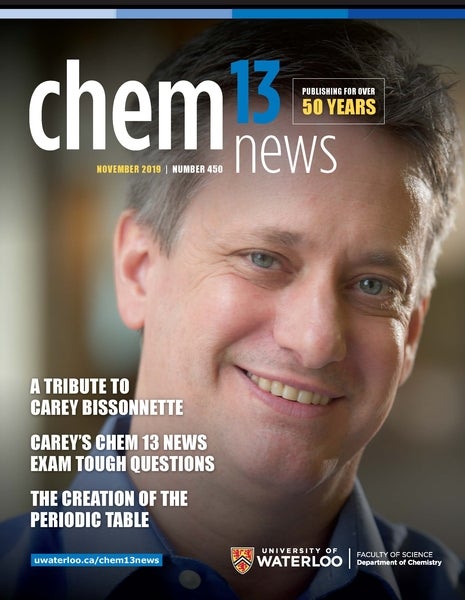
A tribute to Dr. Carey Bissonnette
By Bill Power,Department Chairman and Associate Professor, University of Waterloo, Waterloo, Ontario
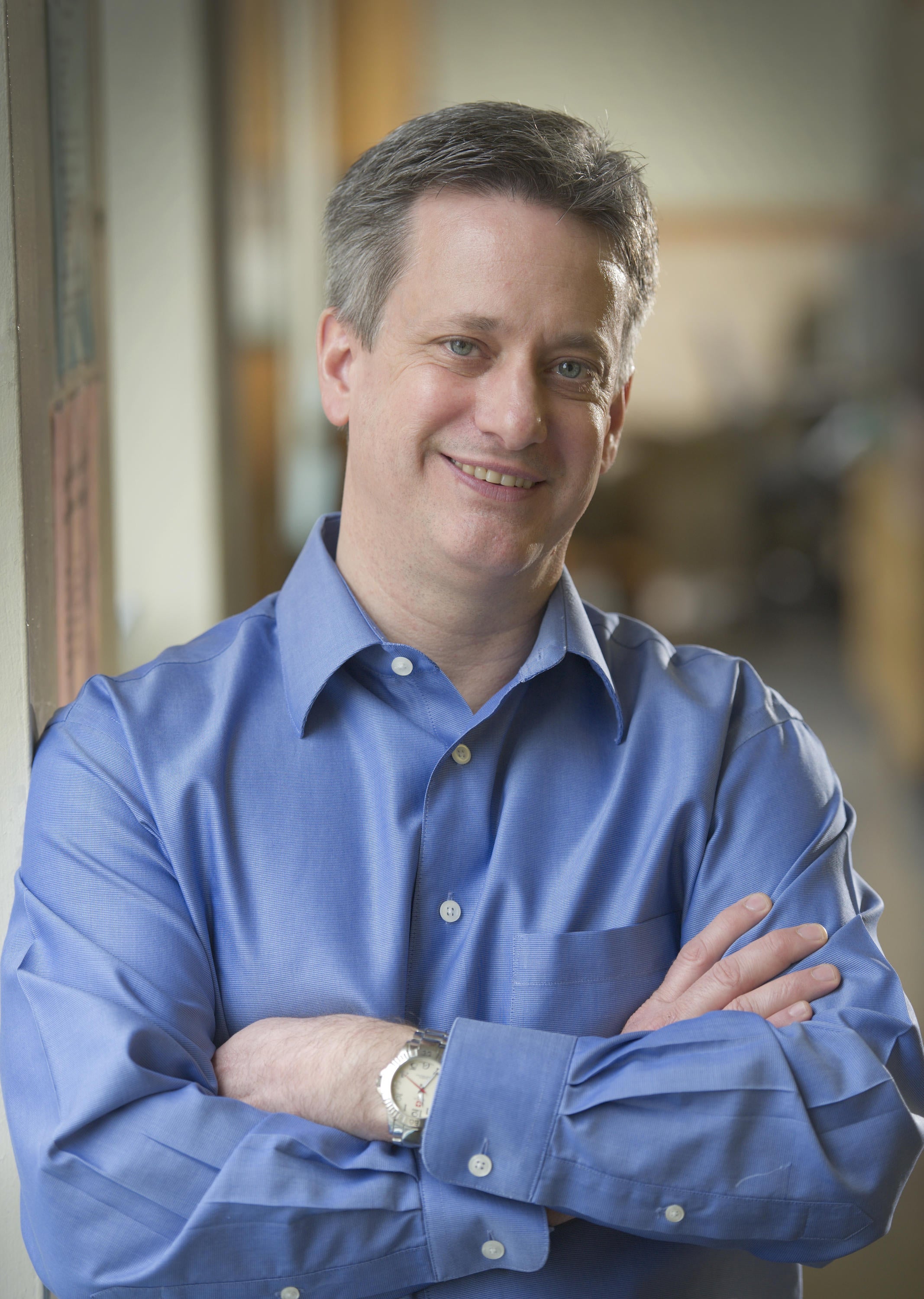
The faculty, staff and students of the Department of Chemistry are mourning a great loss this year, that of our dear friend and devoted colleague, Dr. Carey Bissonnette.
Carey was the very first Lecturer in the Faculty of Science, appointed in 1995, and quickly established his reputation as an outstanding instructor and mentor for students and colleagues alike. He was awarded the University of Waterloo's Distinguished Teaching Award in 2005, after several teaching awards within the Chemistry department recognized his talent and passion for teaching. He was a tireless advocate for students and their learning, serving as an Academic Advisor for Chemistry over the last 20 years, as our Teaching Fellow from 2012-2016, and since then as the Senior Teaching Fellow for the Faculty of Science.
Carey had an intense drive to make education better and dedicated much of his time doing so. In his quiet way — taking no accolades for himself — he has been a key driver behind every transformational (and future transformational) change in teaching and learning at Waterloo.
He worked on many important initiatives that support student learning, both in Science and across the University. Carey was a driving force in the creation of the 2011 task force report on deep learning, a report that spurred a permanent shift in the attention paid to teaching and learning at Waterloo. He advocated for the development of learning spaces that would support group work and team-based learning, and the current development of a pilot flexible classroom space is, in large part, due to Carey’s influence.
He advocated for, and helped adjudicate, the first Teaching Initiatives Fund grants, sponsored by the Dean of Science, to improve both learning, and collaboration in learning, across the Faculty of Science. He was a key player in most undergraduate-focused initiatives, serving on task forces and undergraduate councils within the Faculty and across the University. Those who worked with Carey on these initiatives knew that all efforts were improved by his honest, tactful and constructive contributions.
His other efforts to improve student learning included the development of online resources for first-year university and high school chemistry students and implementing and promoting innovative teaching practices and a scientific, data-supported approach to pedagogy in Chemistry, Science and subjects beyond. He served as Lead Author on the last two editions of the widely used textbook, General Chemistry – Principles and Modern Applications, by Petrucci, Herring, Medura and Bissonnette, and helped bring the first Maple TA and then Mobius platforms to Science courses at Waterloo, in partnership with the Faculty of Math. He was invited to conferences across North America to highlight approaches to teaching and learning he had championed and implemented at Waterloo, providing a huge profile to the University of Waterloo at the forefront of science education.
Beyond these broad efforts, he spent as much time on individual students, as an instructor, advisor and mentor, seeing each of them individually through their own challenges, of navigating programs, switching courses, or finding their own directions to fulfilling careers. He was tireless in all these pursuits, still worrying about student advising and transfer credits even as cancer stole him away from us at the end. Even with his overwhelming workload, he always had time to help his colleagues, to provide guidance or share a good joke, to get each of us through our days a little easier. Carey Bissonnette was a man of wisdom, insight, compassion and humour and he will be greatly missed.
The agony and the ecstasy*: Avogadro and Chem 13 News Exams
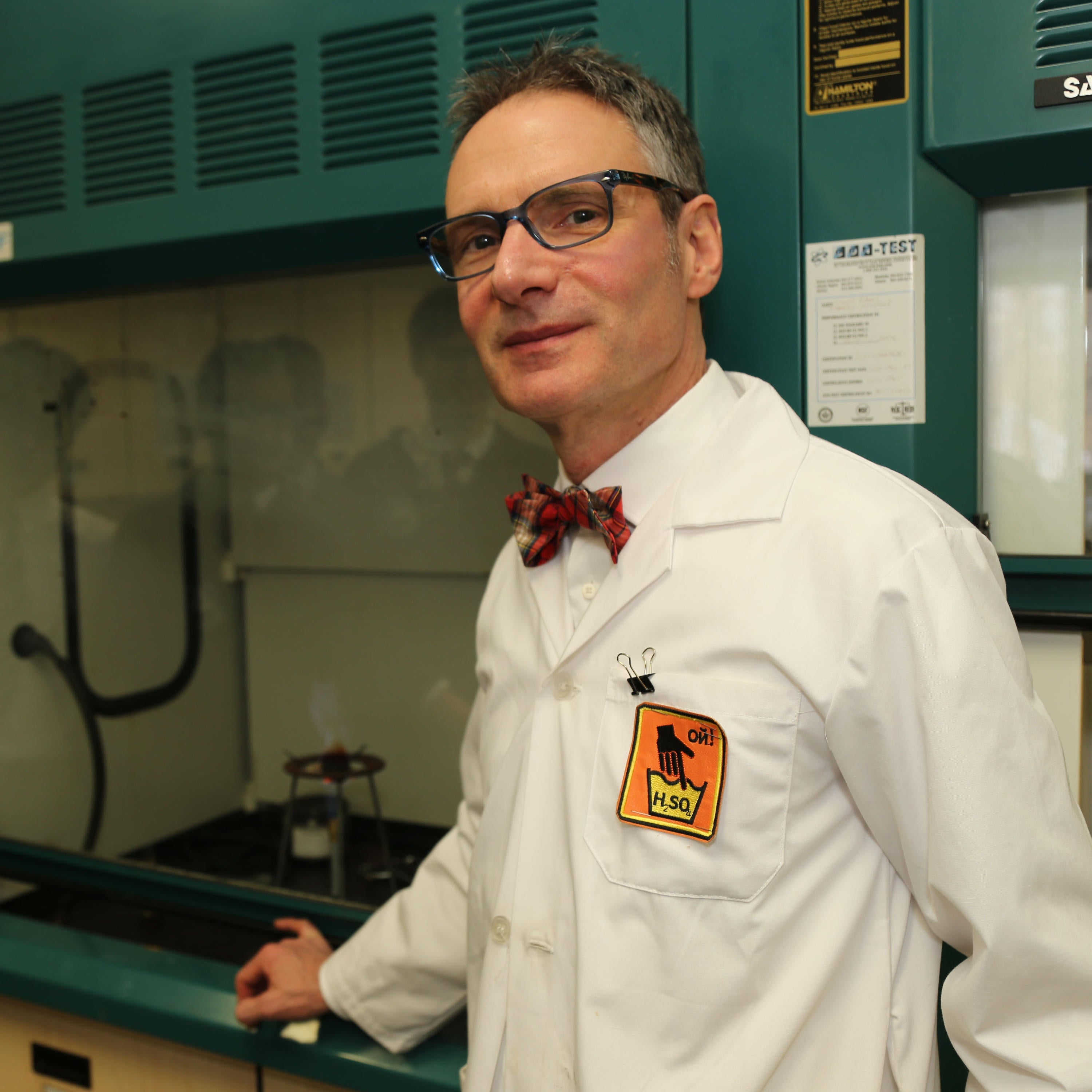
By Michael P Jansen, Crescent School, Toronto, Ontario
Chemistry students around the world have written the Avogadro and Chem 13 News Exams, prepared by the late Dr. Carey Bissonnette for many years. These papers have challenged the best and the brightest with questions ranging from straightforward to do-able to . . . ahem . . . challenging. I’m gonna be honest here, some of the questions give me a run for my money . . . that’s all I’m gonna say.
Why do these exams include difficult, sometimes obscure questions? Why do they penalize a quarter-of-a-point for an incorrect response?
The answer is simple — Carey didn’t want 500 students to get perfect.
A score of, say, 25 correct answers out of 40, is, in my mind, pretty respectable, putting one in approximately the 80th percentile.
My personal high point with the Avogadro Exam came in the early/mid-90s, when Crescent School placed first in consecutive years. The writers were brothers Gabriel Chan and then Joseph Chan. They were top-notch students with a work ethic that rivalled Michelangelo’s dedication to the Sistine Chapel. They studied past papers; they asked questions that made me earn my salary.
The Avogadro and Chem 13 News Exams give students from around the world a chance to show their chemistry-chops against the best-of-the-best, with a gladiatorial level, no-holds-barred contest that pretty much guarantees only one victor.
I met Carey at a Science Teachers’ Association of Ontario conference a bunch of years ago. I was with Jean Hein, the then-editor of this beautiful magazine. I can’t remember what was under discussion; Carey had recently returned from China, on Chemistry Department business. After listening to him talk, I understood the source of those excellent questions.
With Carey’s passing comes the opportunity for someone new to assume the test-writing mantle. He or she will have a tough act to follow — to prepare questions that walk a fine line between uber-challenging and impossible. And here’s the kicker: the questions that are posed are subject to editorial review by hundreds (thousands?) of Chemistry teachers — a tough bunch of customers.
Dr. Carey Bissonnette worked on the University of Waterloo’s Avogadro and Chem 13 News Exams for 20 years — from 2000-2008, with three colleagues in the Chemistry Department, in succession, and then on his own from 2009 through 2019. In this, and through his writing for Chem 13 News, Carey leaves a considerable legacy as a Chemistry Educator.
We are in his debt.
Footnote
*Apologies to Irving Stone.
Tributes to Carey Bissonnette
By Chem 13 News, Chemistry Department, University of Waterloo, Waterloo, Ontario
Whenever I think of teaching and the underlying mission of our Chemistry department, student education, our colleague Carey was the first person I thought of. In spite of his extremely busy schedule, which included student mentoring, teaching classes, contributing to departmental topics, developing on-line learning initiatives, Carey was always there for us to share his wealth of knowledge in teaching methods and blend in the practical aspects of various approaches. His door would always be open, and a smiling face would be waiting. He would also inspire and challenge us to improve the student experience. Carey, we’ll miss you so much. Thank you for sharing and helping us make what we do better.
John Honek
Professor
Carey received his highest degree from Cambridge University in England and came back to his alma mater, University of Waterloo. He became a member of a team that instructed the many classes of general chemistry. The new colleague became an instant friend with us and we saw his enthusiasm from the twinkle of his eyes. He always talked about chemistry teaching seldom mentioning about his time in Cambridge or about the time he worked on theoretical chemistry. He chose to do what he loved most instead of doing things that most people perceived as prestigious or glorious.
As time went on, we ignored our age difference and began talking about fun things in life. We communicate in common language of life from cycling, hockey, family, to children plus in a dialect of chemistry.
“Dr. Bissonnette had his third child in the morning and he was unable to come today.” I told his class when I walked in on his behalf. The students congratulated him in laud cheer, a reflection of the rapport he had with them making Carey a distinguished teacher.
Peter Chieh
Professor Emeritus
I met Carey at the University of Waterloo (UW) in 2000 when he was my instructor for first-year chemistry. At the time, I was not enrolled in Chemistry; however, after having Carey as an instructor, the decision was easy, I transferred into Honours Chemistry. Carey made learning chemistry fun: he challenged us; he kept us engaged; he was passionate; and he was always helpful and patient.
As UW Ph.D. student (physical chemistry), I was fortunate to work for Carey as a teaching assistant on several occasions. It was then that I began to truly appreciate Carey’s thoughtfulness, creativity and depth. His attention to detail and desire to create chemistry problems with unambiguous interpretation was awe-inspiring. He cared about his students getting the most out his classes; he worked day-and-night to produce course materials of the highest quality.
As a UW chemistry instructor, I worked closely with Carey co-teaching first-year chemistry courses for many years. To this day, he was the best teacher that I ever worked with. My teaching style and delivery is strongly influenced by Carey. Carey was my mentor; he inspired and supported me and was my friend. I miss Carey dearly.
Rick Marta
MNS Lecturer International & Materials and Nanosciences
Undergraduate Advisor
I am so grateful to have had the honour and good fortune to have known Dr. Carey Bissonnette. I am very sad he is no longer among us in person. Yet, I know his wise and generous spirit will live on and continue to benefit others. So it is, with a golden spirit such as his.
I first came to know of Carey when we were chemistry undergraduate students at the University of Waterloo in the late 1980s. Carey was in the year after my own, specializing in theoretical chemistry. I remember his friendly, quiet, thoughtful presence then. When we next were graduate students in the chemistry department at University of Cambridge, we would speak from time to time, in the tea room or en route there — I was glad he was there, calm and kind.
I got to know Carey much better after I returned to the department of chemistry in Waterloo in 1996, he had returned before me, and was already making great contributions to teaching. When I was a newbie to teaching myself, Carey helped me, as so many others, students and faculty. Coordinating many first-year chemistry instructors, showing us how things worked and smoothing the way, often by taking on more himself, Carey led by example. I was reassured and inspired by his great mind and his gentle sense of humour, and always taking the time to help, when I had questions, or problems. Over the intervening years, Carey became a person with whom I could easily talk, freely, in confidence, he would generously share his time and wisdom. A family man and a team player, at work and beyond. As a teacher, he never stopped learning, trying new things, striving to do better, and his best. Thank you, young Carey Bissonnette, as I called him, and he would respond in kind, with a smile. And so, Carey leaves us all with a trust: to share and help others in learning, and celebrating chemistry in all its forms, continuing to grow in understanding, with joy.
Liz Meiering
Professor
I had Carey for both 120 and 123 way back. I was very shy and anti-social so I always would sit alone in the front row of every class. I don't think he ever knew my name but he would always try to chat with me each day before class and it always made me feel like that even in a sea of students I somehow mattered a little bit.
(former student, anonymous)
When I first met Dr. Bissonnette, I told him that he had the wrong student. There was a mistake on the list of graduate students within the department, and I — starting my first semester and feeling lost on campus and in the lab — wasn’t meant to be sitting across from him as a tutorial teaching TA. But there was no mistake; I was in the right spot, not just for that semester’s TA assignments but also for my future career path.
Working with Carey over that term and my next few years at Waterloo, I was able to see how he wasn’t just teaching periodic trends or ICE tables, but was opening students’ eyes to chemistry. Listening to first-year undergrads chatter about the science of sink-holes days after their last lecture with him, I was inspired to be that kind of teacher. The one that excites and encourages students to look beyond the classroom. The one that helps them find self-confidence and a sense of achievement - whether that be in solving a problem, or leading a tutorial class. The one that helps others become better teachers, mentors, researchers and practitioners of chemistry.
Kaitlin Town
Educator, Ontario Science Centre
Carey Bissonnette was the face of the Chemistry Department for students. Under his guidance and mentorship first year students were introduced to the wonder of Chemistry. His door was always open and his advice and support provided a solid grounding that carried students through the program. Cary personified teaching excellence and his voice and demeanor have left an indelible mark in the lives he touched.
Marguerite Greavette
Former Chemistry Undergraduate Coordinator
I first met Prof. Bissonnette a few years ago during the Fall 2016 term. I was one of the CHEM 120 drop-in tutors over at the Ron-Eydt Village (REV) residence building, and Prof. Bissonnette was dropping by to check up on how the students were faring with their midterm reviews. Being in my third year of engineering studies at the university, I was amazed to see that a professor was taking a couple hours out of their personal time to drop by the student residences and check up on the learning and wellness of his students. I remember awkwardly mentioning to Prof. Bissonnette that I remembered his name from my first-year chemistry textbook. His extremely humble response is what I remember most. When I heard about the aftermath of Prof. Bissonnette’s cancer a week ago, I was devastated; I never really had the chance to connect with him beyond the couple times that I encountered him in REV’s Great Hall. That said, I’m happy to say that my brief memories of him will always be fondly remembered and that his legacy has contributed to my resolve of becoming the best educator in my professional practice. Thank you, Prof. Bissonnette.
Austin Boucinha
Candidate for Master of Teaching
Ontario Institute for Studies in Education
I have been fortunate to have occupied the faculty office “next door” to Carey Bissonnette in C2 from the time of his appointment as a Lecturer in 1995. His appointment to that position came at a time of huge change at the University of Waterloo resulting from the election of the Mike Harris Conservative government in 1995 and the virtually immediate budget cut to Ontario universities of 15% which followed. In order to manage this cut, UW introduced a Special Early Retirement Program (SERP) which was taken up by six of the then 33 faculty members in the Chemistry Department. None of those positions lost was permitted to be replaced. Carey had already been a sessional lecturer for the department and following this budget cut his teaching for the Department increased significantly. It immediately became apparent to all that his teaching in the first year of our Chemistry program was outstanding and, within the first 2-3 years following SERP, he took over complete leadership of the teaching of the first year Chemistry program. Students also quickly made their respect and enthusiasm for Carey’s teaching readily apparent and in 1998 he received the Gundrun and Hari Sharma Teaching Award administered by the Department and in 2000 he received the Chemistry Club Teaching Award administered by our undergraduate students.
In the late 1990’s, with the potential “Y2K crisis” looming, government purse strings loosened and some (but, initially, definitely not all) of the lost positions were permitted to be replaced. This led to an, occasionally heated, debate within the Department over in what sub-discipline(s) of Chemistry would new appointments be made. The example that Carey had demonstrated of excellence in teaching as a core value for the Department, resulted in the creation of three Continuing Lecturer appointments, of which, Carey was the first, with two others following fairly shortly. I think it is safe to say that no one currently in the Department now regrets that decision to take advantage of this faculty rank.
From that point onwards Carey had been regarded, not just within the Chemistry Department but also throughout the University, as a model academic educator. In 2005 he received the University of Waterloo Distinguished Teaching Award which recognizes only the most accomplished teachers in the University. When the University created “Teaching Fellows” to act as mentors for promoting teaching excellence, Carey was the first Chemistry Teaching Fellow and then he later became the Senior Teaching Fellow for the entire Faculty of Science. At the University level, he was a member of the “Task Force on Innovative Teaching Practices to Promote Deep Learning and a regular contributor to the “Teaching Excellence Academy”. There are, quite literally, no other teaching accolades at the University of Waterloo which he had not received.
At one point, while I was Dean of Science, I had proposed to Carey that he take on the position of Associate Dean Undergraduate Studies. Once I was back in the Chemistry Department, I was very happy that he had refused.
Terry McMahon
University Professor
My first meeting with Carey Bissonnette occurred in the Spring Term of 1987 when he attended a quantum mechanics course that I was teaching. Even at that relatively early age Carey was following his own independent path, as he had determined that the normal academic programs offered in the various honours streams of the Faculty of Science were too restrictive for those who, like him, wished to develop a more flexible background that would prepare them for a broader selection of disciplines to study at an advanced level. Upon completion of his undergraduate studies program in 1989, Carey was awarded a B.Sc. from the University of Waterloo. In addition, his scholarly achievements were recognized by the award of both a University of Waterloo Alumni Gold Medal and a Chemical Institute of Canada Merit Award. He was readily accepted by the University of Cambridge in the U.K. to pursue a Ph.D. in Theoretical Chemistry. Prior to his departure to study at Cambridge under the direction of Professor David C. Clary, Carey married the love of his life, Kimberley Ellert, who joined him in the U.K. upon completion of her own undergraduate degree program at UW. Following the completion of his graduate research program, Carey was awarded a Ph.D. from the University of Cambridge in 1993, and then returned to UW to take up a postdoctoral position in the research group of Professor R. J. Le Roy. Carey and Kim have three children, Victoria, Nicholas, and Justine.
His teaching career began with an outstanding performance as a Sessional Lecturer presenting a first year chemistry course on chemical reactions, chemical kinetics, and chemical equilibrium to a class of 150 students. In the Winter Term of 1995, Carey was appointed as the first definite term Lecturer in the Department of Chemistry. His career as an outstanding teacher took off from that point, as he became the First Year Chemistry Coordinator in 1996, Chemistry Advisor/Undergraduate Officer in 1998, and was appointed as the Department's first Continuing Lecturer in 2000. He has served on numerous Chemistry Department, Faculty of Science, and university-level committees since then. Readers of the Chem 13 News magazine perhaps best know him for his involvement with the preparation and coordination of the Chem 13 News and Avogadro Exams, a task that he first assumed in 2000. He served as a Teaching Fellow for the Faculty of Science/Department of Chemistry from 2012 through 2016 and was appointed a Senior Teaching Fellow in the Faculty of Science for the three-year term beginning in September 2016. Many students in the chemistry undergraduate program know Carey either as an instructor in one or more of their courses or through his participation as an author [together with R. H. Petrucci, F. G. Herring, and J. D. Madura] of the first year textbook General Chemistry: Principles and Modern Applications.
How Carey not only managed all of these activities simultaneously, but also managed them spectacularly well, is difficult to comprehend. Moreover, even though he participated actively in so many endeavours, he still managed to keep his door open to all who needed his help and/or his advice. If Carey had a fault, I would have to say that it was his inability to say "No" to any request that was made of him. I can only be glad that I had the pleasure of having his friendship for more than thirty years, during which time he never left me dissatisfied. His positive effect on the lives of many people is something for which he will be remembered.
Fred McCourt
Distinguished Professor Emeritus

Fall 2022 Special Edition Acknowledgements
We would like to acknowledge the following individuals whose teamwork and dedication made this project possible.
Production team
Professor Bill Power, Guest Editor
Kathy Jackson
Victoria Van Cappellen
Editorial team
Leanne Racicot
Laura Ingram
Julie Shikaze
Nilay Guler
Alex DeGagne
Design by Creative Services, University of Waterloo
Cristina Jones
Heather Bettridge
Printing by Simpson Print, Bloomingdale, Ontario
Rob Payne and the Simpson Print team
Sponsors
University of Waterloo’s Department of Chemistry and Faculty of Science
NSERC Promo Science fund
The Authors
Of course, the greatest tribute should go to the authors, Geoff Rayner-Canham, Chaim Christiana Andersenand Rosalina Naqitarvik, whose excellent work we hope this issue properly reflects and supports: Thank you.