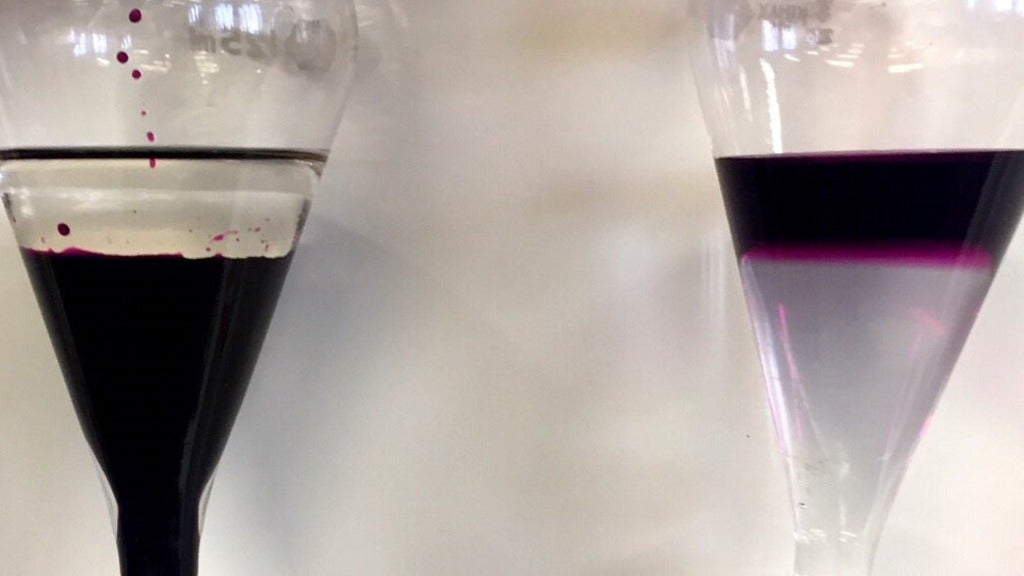
Dry-erase markers — and the teachable moment
I just had the most wonderful Grade 11 Chemistry lesson that really took off in the final few minutes.
The purpose of this letter is to evaluate and validate the procedures described by Ford and Mason (February 2018 issue) using a microwave oven and chocolate bar to measure the speed of light.
In the previous parts of this series, we presented an overview of what nanoparticles are and what they can do. We emphasized the importance of surface atoms as the only ones that can facilitate catalytic reactions.
ER doctor: We want a CT scan. You will be receiving an intravenous CT contrast agent.
Patient: What is the CT contrast agent?
ER doctor: Iohexol.
In part one of this series, I described how switching between macroscopic, microscopic, and symbolic representations of concepts and theories can be confusing for students, especially for those still operating as dualist (right and wrong only), concrete operational thinkers. I also described the nature of scientific models, and the need to carefully identify their inherent limits.
Chemistry competitions can help students build their confidence and skills in chemistry and critical thinking. The Chemical Institute of Canada hopes that chemistry teachers across Canada will support their students in enrolling in the Canadian Chemistry Contest (CCC) and/or the Canadian Chemistry Olympiad contest (CCO).
In Part 1 of this series we described nanoparticles, what they are, how they are made and how they compare to other forms of metal. We also described how metal surfaces serve as catalysts facilitating reactions such as the hydrogenation of an alkene.
In her article “2016 Canadian Chemistry Contest: Worst discriminators” (March 2017, Chem 13 News) Jennifer Pitt-Lainsbury described her analysis of a CCC question with a low discriminating index and asked for comments (see boxes, below). She challenged us to look more critically at all of our tests and evaluations and ask whether they evaluate what we think they are evaluating.
This is a continuation of the Thought labs used as review for AP Chemistry. This style of review allows students to incorporate the skills they have acquired throughout their course experience in AP Chemistry while providing a platform for them to increase their comfort level in situations where they are asked to apply their learning to a new lab setting.
Why does one attend ChemEd? Welllll (good Texas word!), one just never knows what is going to be shared. At this year's ChemEd in Brookings, South Dakota, at South Dakota State University, we suffered from curiosity.