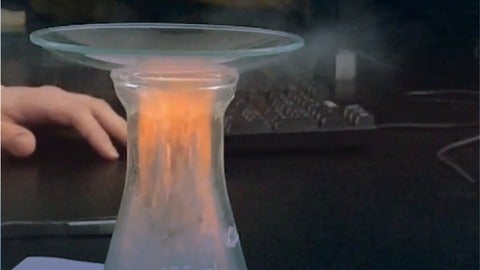
Indicator droplet art
The inspiration for making pictures from droplets of chemicals first came from a Chemistry Club session at our school.
Shortly after New Year’s Day 2017 a radio news item noted that the Province of Ontario’s newly introduced cap and trade1 system for carbon pricing would result in higher pump prices for gasoline and diesel fuel. The increase for diesel fuel would be greater on a per litre basis. Why is this?
In the previous parts of this series, we presented an overview of what nanoparticles are and what they can do. We emphasized the importance of surface atoms as the only ones that can facilitate catalytic reactions.
ER doctor: We want a CT scan. You will be receiving an intravenous CT contrast agent.
Patient: What is the CT contrast agent?
ER doctor: Iohexol.
In Part 1 of this series we described nanoparticles, what they are, how they are made and how they compare to other forms of metal. We also described how metal surfaces serve as catalysts facilitating reactions such as the hydrogenation of an alkene.
As a science teacher, if you were asked for an example of a catalyst, your car’s catalytic converter may come to mind. Most informed citizens would do the same. What may come as a surprise is that catalytic converters have dramatically changed in the past decade and now use only a small fraction of the precious metals that older models used.
I co-instruct and coordinate an undergraduate materials and nanoscience (MNS) lab at the University of Waterloo. One experiment in 2nd year consistently stands out as my students’ favourite, and it involves the synthesis and characterization of “capped” cadmium selenide (CdSe) “quantum dots” (QDs).
In part 1 published in the April 2017 issue, the molecular structures of the photochromic dyes used in eyeglass lenses were discussed. In part 2, the engineering and chemical design of the lenses will be highlighted. The student questions will focus on kinetics and experimental design.
Health Canada issued an advisory this past summer, suggesting that exposure to boron substances be reduced as much as possible from all sources.
The Merriam-Webster dictionary defines photochromic(1) as: “capable of changing color on exposure to radiant energy (as light), e.g., photochromic glass”. Photochromic eyeglass lenses were introduced in 1966, and photochromic plastic lenses....