
Symposium Information
Date: Saturday, October 17th, 2026.
Time: 8:15 AM - 4:30 PM - Dinner to follow at 6:00
Location: EV3, 200 University Avenue West
Event Schedule
| Time | Session | Presenters | Room |
|---|---|---|---|
| 8:15-8:45 | Breakfast | EV3 Atrium | |
| 8:45 - 9:00 | Opening Remarks | Dr. Jennifer Clary-Lemon | EV3 Auditorium (EV3 1408) |
| 9:00 - 10:00 | Keynote | Dr. Anne Pasek (Trent University) | EV3 Auditorium (EV3 1408) |
| 10:00 - 10:15 | Break | KMB Posters/Objects | EV3 Atrium |
| 10:15 - 11:00 | Plenary 1 Discussion |
Jane Tingley (York University) and Dr. Marcel O'Gorman (University of Waterloo) |
EV2 2002 |
| 11:00 - 12:00 | Lunch | EV1 250 (Courtyard) | |
| 12:00 - 12:45 | Plenary 2 Discussion |
Dr. Lauren Judge (Wilfrid Laurier University) and Dr. Mike McTavish (rare Charitable Research Reserve) |
EV2 2002 |
| 12:45 - 1:00 | Break | KMB Posters/Objects | EV3 Atrium |
| 1:00 - 1:45 | Plenary 3 Discussion |
Dr. Brendon Samuels (Toronto Metropolitan University) and Dr. Faisal Moola (Guelph University) |
EV2 2002 |
| 1:45 - 2:00 | Break | KMB Posters/Objects | EV3 Atrium |
| 2:00 - 4:30 | Roundtables/WIP | All invited presenters (see below for presenter bios) | EV 2402 (Design Studio) |
| 6:00 | Dinner to follow |
Expand Collapse
Keynote Speaker

Anne Pasek - Keynote Speaker
Anne Pasek is an Associate Professor and Canada Research Chair in Media, Culture and the Environment at Trent University. She studies the cultural politics of climate change and its intersections with the digital tech sector.
AI Before the Ruins: Industry and Inquiry Before and After the Bubble
How should we study something like "AI"—a subject of social and capital investment that rests more on speculative promises than given technologies or use cases? A committed focus on infrastructure and material throughputs is one possibility, yet the pace and breadth of current rates of AI's data centre expansion make it hard to parse the whole of this unfolding and geographically differentiated story. This talk will experiment with a slightly different approach, inverting our temporal horizons to sketch what these infrastructures might mean and do in the future, as industrial ruins. It takes as a foundational premise that current AI development efforts can be characterized as a financial bubble, with irrational investment and unproven use cases, that will eventually pop. When it does, it will leave behind large quantities of energy and computer infrastructures that presume fixed forms of use. Some will be amenable to salvage and reappropriation into other ways of living; others will persist only as waste. Drawing on political economic analyses of the tech sector, as well as a broader set of speculative fabulation practices by fellow data centre scholars, the talk will place AI in the past tense in order to assess both what it was and what it can become.
Plenary Discussion 1
Discussion Topic
Environmental Humanities in the Research-Creation Lab.
This dialogue features two EH scholars, Jane Tingley and Dr. Marcel O’Gorman, who direct research-creation laboratories. The speakers will discuss the role of research-creation methodologies in EH and how labs for critical experimentation might best serve the EH curriculum. Since both speakers have a history with the University of Waterloo, they will also discuss past experiences and speculate about futures for EH and research-creation at Waterloo.

Jane Tingley:
Jane Tingley is an artist, curator and Assistant Professor at York University. Her studio work combines traditional studio practice with new media tools - and spans responsive/interactive installation, performative robotics, and telematically connected distributed sculpture. Her current artistic trajectory is interdisciplinary in nature and spans the intersection of art, science and technology. Her current work explores the creation of spaces and experiences that push the boundaries between science and magic, interactivity and playfulness, and offer an experience to the viewer that is accessible both intellectually and technologically.

Dr. Marcel O'Gorman:
Professor Marcel O’Gorman is a University Research Chair and Founding Director of the Critical Media Lab (CML) at the University of Waterloo. The CML supports research and creative projects that examine the interrelation of technology, society, and more-than-human worlds. In his published work, O’Gorman has considered such topics as the phenomenology of nature identification apps, the visualization of solar power, and the shared finitude of human and more-than-human species. His artistic work has involved transplanting an antique greenhouse into an art gallery, building a barn swallow structure on an urban walking path, and installing artificial nests and bird skins together in formal display cases. The CML will serve as a key site of collaboration and co-creation for the Environmental Humanities Network.
Plenary Discussion 2
Discussion Topic
More-than-human Illuminations: Research Creation and Community Partnerships
This plenary dialogue will explore potentialities for environmental humanities partnerships that include research-creation, examining the benefits to students and to co-creating public engagement. In a recent project called More-than-human Illuminations, Dr. Judge created visual artworks in collaboration with the non-humans encountered while walking the River Trail in Blair, Ontario. This project was developed in partnership with Dr. Mike McTavish of rare, a community-driven land trust and research institute stewarding over 1,550 acres of habitat in the Region of Waterloo and Wellington County. More-than-human Illuminations offered opportunities for undergraduate students to explore the environment, gather observations and recordings, and help develop the artworks in the studio with no impact on the surrounding ecosystem. In 2026, Judge and McTavish have partnered again on a two-year project that investigates how to help community members to imagine more-than-human futures by fostering cross-species collaborations that produce artifacts, microhabitats, and narratives for a more-than-human future


Speaker Information
In a recent project called More-than-human Illuminations, Dr. Judge created visual artworks in collaboration with the non-humans encountered while walking the River Trail in Blair, Ontario. This project was developed in partnership with rare, a community-driven land trust and research institute stewarding over 1,550 acres of habitat in the Region of Waterloo and Wellington County. The Rare Research Department and Dr. McTavish support diverse forms of inquiry addressing environmental questions. More-than-human Illuminations offered opportunities for undergraduate students to explore the environment, gather observations and recordings, and help develop the artworks in the studio. With no impact on the surrounding ecosystem, the completed pieces were installed along the River Trail from October 15 to November 15, 2025, for community members to experience. The making and installation of the artworks were documented through narrated videos. The project’s aim was to illuminate the creative agency of non-humans, make speculative design accessible to all, and ultimately foster stronger relationships between people and the natural world.
In 2026, Dr. Judge and Dr. McTavish (rare) have partnered again on a two-year project called Designing More-Than-Human Futures: Using research-creation to locate opportunities for radical co-existence. With an interdisciplinary research team, they are investigating how to help community members to imagine more-than-human futures where humans can live within environmental limits and prioritize the wellbeing of nonhumans as well as themselves, and how research-creation can be deployed to foster cross-species collaborations that produce artifacts, microhabitats or narratives for a more-than-human future. This plenary discussion will explore potentialities for environmental humanities partnerships, including research creation, the benefits to students and co-creating public engagement.
Plenary Discussion 3
Cities and Wilderness: Opposites, or Distant Cousins?
Humans have become a new biological force that, in a remarkably short period of time, has altered the physical, chemical, and biological properties of the planet. We have disrupted the Earth’s carbon cycle, contributing to climate change, and accelerated the nitrogen cycle by more than 150 percent, resulting in acid rain, coastal dead zones, and other ecological impacts. The frequency, scale, and intensity of the human footprint are so profound that Nobel Prize–winning chemist Paul Crutzen proposed naming our current geological epoch the Anthropocene (The Human Epoch)to reflect humanity’s new role as a global force driving ecological change.
In this plenary discussion, Brendon Samuels (TMU) and Faisal Moola (University of Guelph) examine EH research, policymaking, and public engagement at two ends of the Anthropocene: cities, where most of the world’s population now lives, and wilderness, a category of global land cover that is in precipitous decline and now covers only about 25% of the Earth’s terrestrial surface.

Brendon Samuels
Brendon Samuels holds a PhD in Biology and an MSc in Neuroscience from Western University, where he studied the biological mechanisms and policy dimensions of solutions for reducing bird-building collisions. He previously completed a Bachelor of Science in Psychology at the University of Guelph. Brendon works with the Fatal Light Awareness Program (FLAP) Canada and Bird Friendly London, and has collaborated with the Ecological Design Lab on studio projects relating to bird safe building design, ecological connectivity and bylaws for biodiversity. Brendon maintains an extensive habitat garden at home and volunteers with local community groups engaging residents in environmental stewardship.

Faisal Moola
Dr. Moola works closely with a number of First Nations communities in defence of their lands and Treaty Rights, including the Dunne-za and Cree Treaty 8 First Nations in British Columbia, and Grassy Narrows First Nation in Ontario.
He is widely published in scientific journals on the topics of ecology, conservation biology, and environmental policy. He has contributed to a number of significant conservation and sustainability policy outcomes in Canada, including the protection of over two million hectares of temperate rainforest in British Columbia, the expansion of the internationally renowned Greenbelt in Ontario and the creation of Canada’s first Urban National Park on the edge of Toronto.
Knowledge Mobilization Presenters

Rob Gorbet
The SSHRC-funded Living Architecture Systems Group, founded in 2016, brings together researchers and industry partners in a multidisciplinary research cluster dedicated to developing built environments with qualities that come close to life: environments that can move, respond, and learn, with metabolisms that can exchange and renew their environments, and which are adaptive and empathic towards their inhabitants. The LASG is focused on developing innovative technologies, new critical aesthetics, and sensitive, integrative design working methods that help equip a new generation of designers with key next-generation skills and critical perspectives for bringing a post-humanistic approach to the built environment.
Presentation Description:
Living Dialogs Podcast — Produced by the Living Architecture Systems Group (LASG) Executive Producer, Rob Gorbet
The Living Dialogs podcast series brings together scholars and thinkers to collectively reflect on the term “living architecture,” its implications for our changing world and for the profession, and to envision an architectural practice based in mutual and ethical interaction with our living environments. There is strong alignment with the goals of the EHN, in the interdisciplinary approach to seeking more ethical, values-driven design practices that harmonize with our human and non-human goals.
- · Principles, Aesthetics, and Sustainability of Living Architecture
- · Biology, Computation, and Care in the Anthropocene
- · Collaborating with living systems: How mycelium can help us rethink architectural practice
Workshop participants will listen to episodes during breaks, thanks to pointers and QR codes and a listening station. Interested participants will respond to prepared discussion questions in a roundtable session.
Listen here:

Christopher Rogers
Christopher Rogers is a PhD candidate at the University of Waterloo. His research explores the rhetoric of shorelines through text-, field-, and design-based methods. He is interested in how mixed-method approaches to environmental humanities can facilitate hopeful ways of attending to nonhuman stakeholders and speculating about positive climate futures.
Presentation Description:
The Shoreline Weather Station (SWS) is a critical design project that embodies the problematic ethos of techno-solutionism in order to promote thinking through more-than-human relations. By working with the tension between environmental humanities and extractive technologies like Generative AI, the SWS provokes ethical questions and speculation about shoreline futures.

Thiruni Thirimanne
Thiruni is a PhD student in the Department of Civil and Environmental Engineering at the University of Waterloo in Canada. Her current focus is on hydrological modelling and the spatial analysis of erosion sensitivity in urban and rural landscapes, with an emphasis on land use and climate variability.
Presentation Description:
DataHub powers the INSPIRE Project by connecting datasets, sensors, tools, expertise, and people through an accessible platform. Together, they use data to drive collaboration, advance research, enrich student learning, and inform sustainability policy and action, enabling purpose-driven solutions, evidence-based decision-making, and meaningful real-world impact.

Erin Schmidt
Erin holds a Bachelor of Applied Science in Systems Design Engineering from the University of Waterloo. As Research Project Manager for the Waterloo Global Environmental Measurement and Monitoring (GEMM) Initiative, she works across campus on environmental sensing and data initiatives, including the INSPIRE Project, to connect collaborators and resources and help translate research into practical sustainability policy and action. Before joining the University, Erin held project management and senior account management roles in industry.
Presentation Description:
DataHub powers the INSPIRE Project by connecting datasets, sensors, tools, expertise, and people through an accessible platform. Together, they use data to drive collaboration, advance research, enrich student learning, and inform sustainability policy and action, enabling purpose-driven solutions, evidence-based decision-making, and meaningful real-world impact.

Hrysovalanti Maheras
Hrysovalanti F. Maheras (she/her) is a PhD candidate in Digital Media at York University. Her practice combines generative systems, electronic media, and kinetic sculptural assemblages to explore how affect emerges through light, sound, and movement across multispecies ecologies. Her work has been presented internationally at Emerson Contemporary, New Adventures in Sound Art, NYU Shanghai, among others.
Presentation Description:
Corpus Hormē is a kinetic light sculpture inspired by the sun’s passage into the monarch butterfly’s body (corpus). Solar heat activates its nervous system, generating impulses (hormē) that animate its wings. Illuminated through light and movement, these impulses trace exchanges between body and environment, questioning affect and vulnerability in a warming world.

Carly Davenport
Carly Davenport is an avid naturalist whose curiosity about the natural world drives her work at the intersection of science, advocacy, and community engagement. She contributes to diverse research and monitoring efforts and has been recognized nationally for her conservation advocacy.
Presentation Description:
Iris and Carly have teamed up to share their knowledge of bird-window collisions and offer creative solutions for treating glass in our built environment. Bird-window collisions cause significant annual mortality among migratory birds, which are already experiencing steep population declines. Bird-window collisions are preventable; learn what you can do!

Iris Häussler
Visual artist Iris Häussler’s recent projects emerge from her fascination with migratory birds. Having witnessed biodiversity decline in Germany during the 1970s, she mourns their losses. Through her art and volunteer work with FLAP Canada, she illustrates the often-deadly consequences of glass-reflections of mirrored skies and foliage for birds.
Presentation Description:
Iris and Carly have teamed up to share their knowledge of bird-window collisions and offer creative solutions for treating glass in our built environment. Bird-window collisions cause significant annual mortality among migratory birds, which are already experiencing steep population declines. Bird-window collisions are preventable; learn what you can do!
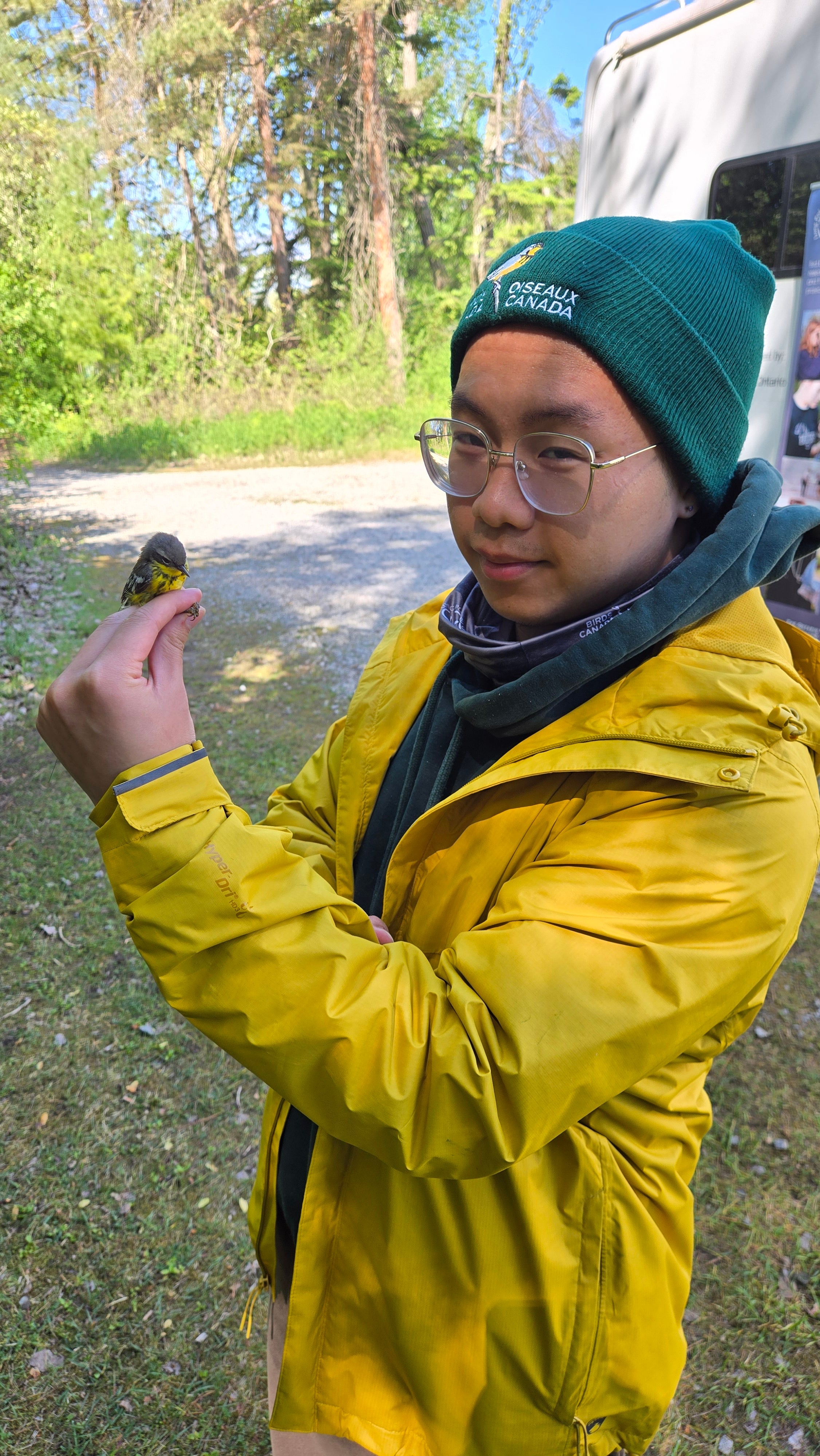
Leo Ta
I'm Leo, a final year biology student who is passionate about reconnecting people to nature through conservation and advancing veterinary medicine. I have a rich background working with wildlife, and my dream career is to become a wildlife pathologist and improve wildlife rehabilitation medicine and techniques!
Presentation Description:
In North America, billions of birds die from window collisions each year as they navigate migration season. The UW Society for Ecological Restoration chapter is working to mitigate bird fatalities through monitoring, advocacy and public engagement, resulting in a successful pilot project that has significantly reduced window collisions on campus.

Julianne Ho
Julianne is a third-year student in the UW Honours Geography and Environmental Management program with a passion for ecology, conservation and a curiosity for everything else! She is interested in using GIS to answer questions regarding animal dispersal patterns, transportation and urban planning, as well as severe storms.
Presentation Description:
In North America, billions of birds die from window collisions each year as they navigate migration season. The UW Society for Ecological Restoration chapter is working to mitigate bird fatalities through monitoring, advocacy and public engagement, resulting in a successful pilot project that has significantly reduced window collisions on campus.

Leigha Taylor
Leigha Taylor is currently in their second year of Environmental Science, with a specialization in Ecology, at the University of Waterloo. Leigha is committed to environmental conservation and sustainability, as well as promoting greater accessibility to outdoor spaces. They are passionate about connecting people with nature and fostering environmental stewardship.
Project Description:
Leigha’s Knowledge Mobilization Project represents the remaining greenspace in Toronto. Her project further dives into what percent of greenspace in Toronto is public versus private, and the issues that come along with the privatization of outdoor areas.

Juliana Stacey
Juliana Stacey (she/her) is a second-year English Language and Literature Ph.D. student at the University of Waterloo. She holds an Honours Bachelor of Arts (Professional Writing and Communication, English) and a Master of Arts (English) from the University of Toronto. She is primarily interested in how social media platforms shape and frame the reception and dissemination of women's reproductive health narratives.
Project Description:
Juliana's interest in narratives of care, as well as inspiration stemming from Anna Krzywoszynska’s article, “Caring for soil life in the Anthropocene: The role of attentiveness in more-than-human ethics,” brought forth her project, "...And Response," first presented at the Spring 2026 Critical Media Lab Showcase. This interactive project asks you to put aside expectations you may have about interactions between person and soil in order to make room for soil to speak.
Roundtable Participants

Tim Alamenciak
What does it mean to care for nature? Engaging people in biodiversity restoration and conservation is a major goal for some of the largest conservation organizations globally, but mobilizing ecological knowledge for engagement is a complex, nuanced undertaking that requires deep consideration of causality, positionality and the nature of evidence. EcoWeaver is an ambitious global collaboration working on representing, linking and synthesizing ecological knowledge broadly construed. This talk will discuss key insights from the first three years of the EcoWeaver project, and open the floor for collaboration on future work connected to this project.
Abstract:
Tim Alamenciak is an adjunct associate professor in the School of Environment, Resources and Sustainability at the University of Waterloo, a postdoctoral fellow with the Bennett Lab at Carleton University and a research fellow in the DRAGEN Lab at St. Jerome’s University. Tim is a translational ecologist working at the intersection of ecological restoration, community engagement and open knowledge systems. As such, he brings knowledge of both environmental sciences and historical research to co-convening the Environmental Humanities Symposium.

Steven Bednarski
As an environmental historian, Steven works hard to expand my methodologies by partnering with colleagues from other disciplines, especially those not immediately adjacent to my own. His most fruitful collaborations, have, thus, been partnerships with computer programmers and video game designers, climate modellers, and scientists working with stable isotope analysis. Much of his network is international and the EHN Symposium would allow him to exchange ideas and explore collaborations with colleagues from SW Ontario. At the EHN,he brings an important historical dimension to the conversation, alongside his proven track record of transdisciplinary collaboration.
Abstract:
Since 2019, I have been PI for Environments of Change, an international consortium of researchers, not-for-profit and for-profit agencies, postsecondary institutions, and governmental groups funded by a SSHRC Partnership Grant. We are well on our way to achieving our core objectives, which develop digital tools, knowledge, and products that communicate lessons about historical environment. One example has been the creation of a tablet-based video game in partnership with the Waterloo Region District School Board. Our game immerses players in an accurate 3D reconstruction of a deserted medieval village in Sussex, England, circa 1340. Players must respond to historical environmental challenges (floods, famine, resource depletion, etc.) and, in so doing, learn important lessons about environmental history. In addition, our team has produced climate mitigation models for the Kent County government to help protect heritage monuments, and we have produced new digital proxy data sets based on palaeodendrochronology.

Jennifer Clary-Lemon
Jennifer Clary-Lemon is Professor of English at the University of Waterloo, author of Planting the Anthropocene: Rhetorics of Natureculture and Nestwork: New Material Rhetorics for Precarious Species, and co-editor of Decolonial Conversations in Posthuman and New Material Rhetorics. Her work sits at the nexus between rhetorical studies and the environmental humanities, examining the ways that humans and nonhumans persuade each other through affectual and material investment.
As the co-convener of the Environmental Humanities Network at UWaterloo, Clary-Lemon has been an advocate for the environmental humanities in Canada, and is well positioned to both bring symposium attendees together as well as to foster collaborations among work-in-progress participants.
Abstract:
Environmental Humanities and Research Creation:
This talk provides an overview of arts-based methods in the environmental humanities and their overlap with disciplinary methods in rhetorical studies.
Reflecting on three collaborative projects that sought to examine the ways nonhuman species at risk are persuaded by human infrastructure, Clary-Lemon examines the impacts of both making and care as foundational methodological concepts in the environmental humanities. Reflecting on the building of a barn-board and tin barn swallow structure alongside photographic and material exhibits on human-made nests for owls and swallows, Clary-Lemon seeks to reveal common interdisciplinary “pressure points” that allow for communicating difficult environmental realities through research-creation projects.

Paul Ugor
Dr Paul Ugor is a Professor in the Department of English Language and Literature at the University of Waterloo, Canada. His research and teaching interests are in the areas of Modern African Literatures and Cultures, Anglophone Postcolonial World Literatures, Cultural Studies, Environmental humanities, Global Black Studies, and New Media Cultures in the Global South. His work in the area of environmental humanities has focused mostly on the unique ways in which modern African imagination bears witness to the malevolent complicity between Petro-imperialism and postcolonial autocracy. Focusing mostly on the oil region of the Niger Delta in Nigeria, his research documents how African eco-fiction functions as an imaginative testimonial to the relentless Petro- violence, widespread endangerment, and blatant denial of justice to victims of human-induced ecological disaster in the Africa continent.
Abstract:
Climate change is a global crisis that has disproportionally affected African countries —morphologically, economically, socio-politically, and physically. Thus, the African continent is in a unique position as a powerful actor in the global production of environmental thought and creativity as African writers, artists, filmmakers, and scholars are better equipped to represent the entangled connections between current dire environmental conditions with anticolonial struggles and social justice issues. Through its multidimensional analysis, the project aims to unfurl how the long history of violence and imbalanced exchanges between Africa and the rest of the world has compounded the reductive ways by which the impact of environmental catastrophes in the continent are read and represented. The project aims to show how climate injustices are inviably a human rights issue as it threatens the right of Africans to basic amenities like access to clean water, mineral resources, safe spaces of habitation, and the right of life.

Xuan Ye
Xuan Ye (叶轩) is an artist, musician, and technologist whose practice unfolds in a vibrational world-building via software, sound, image, installation, performance, publication, and teaching. Their work has appeared in recent solo exhibitions at the Centre for Culture and Technology (2025) and MOCA Toronto (2022), and in group showcases at the Kamias Triennial (2024), UCCA Center for Contemporary Art (2022, Shanghai), UQAM and Venice Architecture Biennale (2021), MUTEK Montreal (2021), Peer to Space (2021, Berlin), the Art Gallery of Ontario (2019, Toronto), the Goethe-Institut (2018, Beijing), among others. They have been recognized with awarded residencies at the University of Toronto (2025/26), ZHdK (2024), and Pro Helvetia (2023), and have received grants and scholarships from the Canada Council for the Arts, Ontario Arts Council, Toronto Arts Council, Partners in Art, and the SSHRC. Their practice has also been critically featured and reviewed in Peripheral Review (2020), Canadian Art (Winter 2020 and Spring 2020), ArtAsiaPacific (Issue 111), KUNSTFORUM (Vol. 257), Musicworks (Issue 136), and Bandcamp Daily (Best Experimental Albums). Ye teaches in the computational art specialization and other expanded media practices.
Abstract:
The Peripatetic Server Project: Open-Source Infrastructure and Toolkit for Community-Owned, Solar-Powered Networks:
Inspired by the solar-powered web servers of Solar Protocol and Low Tech Magazine, The Peripatetic Server Project offers a tangible alternative. We will build a working, solar-powered web server on campus as a host for environmentally and socially conscious web-based projects. Concurrently, we will create and disseminate an open-source toolkit and workshop series to empower other communities to build their own resilient solar-powered web servers using low budget accessible hardware like Raspberry Pi.

Michelle Rutty
Abstract:
The Life and Legacy of the Athabasca Glacier is an interactive art piece that aims to marry art and science in support of climate action. A bellwether of the accelerating effects of climate change, the Athabasca Glacier in Jasper National Park (Alberta, Canada) is retreating at a record rate and is projected to disappear before 2100. The glacier is a centrepiece in Jasper’s tourism-dependent economy, receiving an estimated 1.2 million visitors annually. The exhibit will be installed in the Glacier Gallery, located across from the Athabasca, in Spring 2027 following the successful pilot at UWaterloo in May 2026. The exhibit takes visitors on a journey through the different phases of the glacier’s life, contrasting the stark timescales between glacial growth (thousands of years), retreat (hundreds of years), and one human’s life (i.e., disappearance within one generation). The experience invites the audience to reflect on the legacy of disappearing glaciers and our role in what will be left behind. Results from interviews and messages gathered during the pilot launch will be shared, along with future research plans.

Tara Cooper
Tara Cooper’s art practice embraces an everything-but-the-kitchen-sink approach, combining print, ceramics, film, installation, and book arts. She draws from discursive and non-discursive storytelling, focusing on poetics: how art can unpack emotionally charged subjects while examining material meaning, from the origins of living matter to the production of manmade things. Cooper is interested in art as a way to communicate ideas, connect people, and potentially mobilize them into action. She is an Associate Professor of Fine Arts at the University of Waterloo. Her exhibition record spans more than two decades combining methods of interdisciplinarity, collaboration and community outreach. Her naturecultural approach to research creation positions her as an excellent contributor to the symposium.
Abstract:
“Listening to Public Art” employs research-creation as a way to tell stories about the environment, to understand ecological impacts through artistic expression, using CAFKA (Contemporary Art Forum Kitchener + Area) as a case study. Drawing on my role as CAFKA’s Programming Co-Chair (2018–2025), I discuss projects from two art biennials: Field Guide to the Understory(CAFKA.25) and Stay with Me (CAFKA.23). Selected highlights include Adam Basanta’s Monument (Sundial), installed in Kitchener’s Victoria Park, and Kandis Friesen’s One Thousand, One Hundred, presented in Waterloo Park. Basanta’s work is a 12-foot tower constructed from recycled bricks compressed using a hand-built garbage compactor, referencing cycles of waste and monumentality. Friesen’s piece is a billboard-scale photograph of a nine-hundred-year-old oak tree in Zaporizhzhia, Ukraine, slowly drowning due to rising water levels caused by a hydroelectric dam. Installed near Laurel Creek, the image echoed our local histories of land control and water management.

Kim Nguyen & Rohini Patel
Abstract:
Museum Politics and Local-Global Environmental Histories (with Dr. Kim Hong Nguyen)
Our collaborative work to date is focused on a public environmental history and memory project through a museum exhibit, which concerns local and global historical events tied to Elmira, the region of Waterloo, Six Nations of the Grand River, and Vietnam, Cambodia, and Laos in the twentieth century. This work proposes to invoke audiences to learn about water histories in southern Ontario as they are made through various and conflicting social and transnational processes, from Indigenous lifeworlds, to British and Canadian settler colonialism and industrialization, to modern US-Canadian military-industrial production. By taking up this effort to intervene in the museum politics of public memory that crosses multiple communities, ecologies, and histories, our work requires explicit and ongoing attention to how we choose to analyze and interpret collected information through interviews, informal conversations, primary and secondary research. It also requires an engaged comprehension at the local level of how these stories and memories already circulate, or are obfuscated, in public discourses; what issues local Canadian museums and galleries consider salient; and contradictions between communities that are differentially connected to the river and its histories. Drawing on oral histories, archival research, primary and secondary research, and discussions with scholars, artists, and local residents, we draw on feminist, disability, postcolonial, and environmental justice frameworks to approach this engaged environmental history and public humanities project.

Katy Fulfer
Abstract:
Title: “We’re caretakers. We’re gardeners” : Solarpunk as an Embodiment of Care Theory:
Abstract: “Solarpunk” describes an artistic and social movement that imagines and strives for sustainable futures, centering collective care, social justice, and optimism (“Manifesto”). While its principles have been linked to anarchic theory and punk social movements (Gillam 2025), solarpunk also aligns with common themes in care theory, such as relationality, challenging moral boundaries, and the moral relevance of emotions (Engster and Hamington 2015). As philosophers with interdisciplinary orientations, we theorize solarpunk as an embodiment of care theory, to the enrichment of both discourses. The first section of our presentation will explore how care theory and solarpunk, as both a literary and artistic genre and a form of social activism, can fruitfully strengthen each other. We make three claims:
1. Solarpunk aligns with recent approaches that de-center the nuclear family or interpersonal relationships in favour of communities as the locus of care (Piepzna-Samarashina 2018; Sosa- Provencio 2017).
2. Solarpunk’s holistic approach challenges binaristic divisions between social and ecological sustainability. This expands the scope of care and provides more avenues for care theory to be applied to ecological and interspecies justice.
3. We draw on feminist science and technology studies and disability studies to examine how solarpunk re-interprets the cyborg (from cyberpunk) and offers a novel way of approaching the nexus of care, technology, and knowledge production.
To conclude, we argue that care theory helps address criticisms that have been leveled against solarpunk’s ability to ground social and political change. We conceptualize solarpunk practices as animated by a care ethos, which helps clarify how community functions. Specifically, understanding a care ethos as a co-created moral identity (Hamington 2024) helps strengthen solarpunk’s emphasis on achievable actions. How community action is sustained and nurtured (but not romanticized) helps respond to criticisms of solarpunk’s utopian realism (Balkan 2024).

Trish Van Katwyk
I am an Associate Professor at the School of Social Work at Renison University College, uWaterloo. My work is explores the ways community immersion and artistic expression can activate healthy communities and many important ways of knowing. For the past 11 years, I have worked closely with members of the Six Nations of the Grand River, engaging in land- and water-based education and embodied exploration of the Two Row Wampum Belt. By centering land, relational priorities of accountability, humility, and reciprocity with all living forms guide my teaching, research, and daily practice. I strive to collaborate well, build deep relationships, and inspire collective commitments to positive change and social justice.
Abstract:
HumanTies 101: Environmental Justice Abstract: HumanTies 101: Environmental Justice is a free university-level course for community members who have faced obstacles to post secondary education. The online course considers environmental racism, intersectionality, White supremacy, colonialism, refugee experiences, as well as self-awareness, critical mindfulness, and health equity. The course moves to deep considerations of action and resistance inspired by reconciliation and Indigenous sovereignty. In this roundtable discussion, I will present the course with more detail to consider its significance as an action-oriented partnership between the University and the Community in response to the dire call for environmental justice.

Anna Mcwebb & Brianna Wiens
Dr. Brianna I. Wiens is an Assistant Professor in the Department of English Language and Literature at the University of Waterloo, where her research examines how digital technologies shape gendered power, with a focus on how machine learning systems intensify, normalize, and conceal misogyny. Wiens studies how algorithms, visual cultures, and AI driven platforms reproduce gendered violence, while also tracing feminist strategies of resistance, reframing, and intervention. Using mixed methods that combine computational analysis with feminist digital and rhetorical approaches, Wiens’s current project maps the cultural and political consequences of what she terms machine learning misogyny. This work treats machine learning as an extractive infrastructure that reshapes social relations and ecologies, redistributes harm, and reconfigures the conditions under which bodies, data, and environments are governed at scale. Her research offers a contemporary examination into the future of the environmental humanities and the extractive and unreflective uses of machine learning, which is often pitched as a methodological intervention into arts-based research methods.
Abstract:
This project introduces and theorizes machine learning misogyny as a framework for understanding how automated systems encode, circulate, and normalize gendered violence across digital platforms. It contributes to Environmental Humanities by foregrounding machine learning as an extractive infrastructure that reshapes social relations, cultural ecologies, and conditions of harm at scale. Building on feminist media studies, critical AI research, and digital humanities methods, it examines how machine learning technologies amplify misogynistic tropes through personalization, recommendation systems, generative media, and synthetic intimacy. Using a mixed methods approach that combines web archiving, computational analysis, and feminist rhetorical and visual interpretation, the project maps how misogyny evolves across platforms and time in response to political movements and technological innovation. Rather than treating algorithmic harm as incidental bias, the project foregrounds the cultural, aesthetic, and structural logics through which machine learning actively produces and conceals gendered oppression. By developing conceptual frameworks, typologies, and public facing tools, the project provides scholars, policymakers, and advocates with actionable resources for identifying, analyzing, and intervening in automated systems that reproduce gendered harm.
Parking Information
The University of Waterloo offers parking at the following locations:
X-Lot — Free. Approximately a 17-minute walk.
H-Lot — $4.29/hour. Approximately a 6-minute walk.
C-Lot — $10/day. Approximately a 9-minute walk.
Bike storage is offered outside EV3.
For more information, reference the Interactive Campus Map.
Campus Parking Map

Accommodations
For more information regarding accommodations:
Related Events
Ontario Ecological Restoration Conference:
The Ontario Ecological Restoration Conference (OERC) aims to provide an opportunity for ecological restoration practitioners, academics and people engaged in the conservation field to come together and share practical and experiential learnings. The hope is for this event to provide valuable connections with one another to further the ecological restoration work in our region and support thriving biodiversity.
For more information, visit:
Additional Information
Environmental Humanities Network (EHN) Website:
