
The following research stories are examples of partnerships, services, collaborations and expertise held at the Library.
Synthesizing knowledge as a path to community
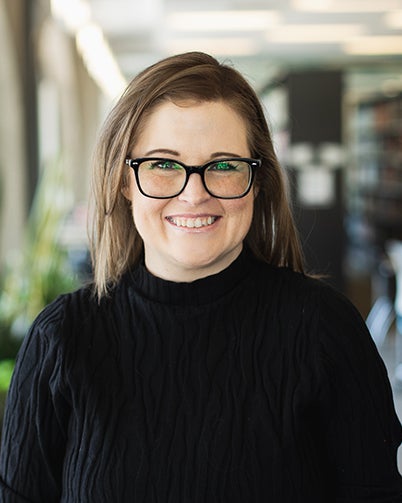
Brie – Research librarian
Knowledge Synthesis is at its core about identifying evidence, assessing its value and combining it to produce a summary that shapes best practice. This can take many forms; one of the most common forms is literature reviews. Literature reviews originated in healthcare disciplines and are increasingly being used across disciplines, helping to drive interdisciplinary research forward.
Taking up to two years to complete, conducting any rigorous form of literature review requires a strong team, deep understanding of the methodology, and expertise in conducting and designing effective literature searches. A librarian is a valuable team member who brings deep information skills to the table; research has shown having a librarian as a co-author results in higher quality reviews.
Brie McConnell is a health librarian with more than 20 years of experience in hospital and academic libraries. Her expertise is wide and varied, bringing clinical knowledge, health focused methodological expertise and a laser focus on supporting her colleagues in achieving their research goals.
McConnell is deeply passionate about building a space for research that supports curiosity as well as providing a place to turn when you aren’t sure what to do next. Having been a collaborator on many literature reviews, her expertise as a research partner is clear, with colleagues having noted that her guidance on how to navigate the review process, and what tools to use for collaborative projects, are life changing.
One of the most interesting reviews McConnell has contributed to recently emphasizes the growing interdisciplinary nature of research, with a focus on the convergence of health and technology. Reviews offer an opportunity to ground innovation in a rigorous foundation, a requirement to meet the challenges of a complex, global future.
McConnell’s main message to students, faculty, staff or members of the community is the same whether she’s helping a new graduate student or supporting a faculty colleague in applying for a career-changing grant, “It’s okay to not know what you need, reach out and we will have a conversation.”
With the rapid rise in the number of different types of information available online, there is a need for skilled expertise in finding the right information and the support in how to best interpret that information. With the rise of mis- and dis-information across many industries, building trust is critical for the identification and use of quality sources, as well as the dissemination of information in rigorous ways. This is fundamental to the advancement of scholarship.
Further Reading
- Brie McConnell is currently working on Incidence of spinal hematoma in cardiovascular surgery after spinal anesthesia: a systematic review, with colleagues at the School of Optometry.
- Brie McConnell recently completed Neurological injury following peripheral nerve blocks: a narrative review of estimates of risks and the influence of ultrasound guidance, with colleagues at the School of Optometry.
Building community through a better understanding of Data.
The ever-increasing pace of technological development continues to have profound impacts, both positive and negative, on the health and well-being of humanity and our environment. While some impacts are discipline specific, many are common to all and hard-won insight in one domain may be of great value in others. Collaboration across domains will create opportunities to address global issues.
The Library exists at the intersection of disciplines. This position, alongside our resources and expertise, ideally situates us to facilitate collaboration across Waterloo and encourage the use of new technologies to enhance scholarly processes and increase innovation.
No matter the domain of inquiry, research data management (RDM) is one thing all researchers will consider as they do their work. The phrase RDM is often misunderstood as the last step – where to store data. However, at its core, RDM is about supporting research excellence at each stage of the research data lifecycle.
From how data is collected and organized to how information is disseminated at the end of a project, this work takes many forms and involves many partnerships. One of the most common is data management planning and data deposit. Both involve building as well as understanding the meaningful connections between research and information management.
Anneliese Eber, research data management librarian, has significant experience in both data-focused research and libraries. Her expertise is multidisciplinary, with deep knowledge of the research lifecycle, how and when information management fits in, and strategies for bridging the gap between the two.
Eber has a strong interest in working towards addressing discipline-specific challenges in RDM and information management. To help bridge this gap, Eber is creating resources that meet researchers where they are, making RDM more accessible to Waterloo researchers at all stages of their careers.

Anneliese – Research Data Management librarian
Navigating a changing research landscape is a core function of an academic library. The Library is a partner to all Waterloo researchers, helping to navigate each step of the research process. From providing key information necessary to write a grant to supporting knowledge translation and repository requirements at the end of a grant, librarians provide information-navigation expertise as well as the tools, resources and support.
Further Reading
- University of Waterloo’s Research Data Management Institutional Strategy
- Anneliese created the Research Data Management Learning Guide as a first step for those looking to better understand RDM, and get more information on learning, planning, depositing, sharing and discovering data.
- Anneliese is part of the RDM committee for the 2D mature project, which has the goal of establishing a comprehensive view on scalable synthesis and processing routes for 2D materials units to develop a profound understanding of the emerging functionality.