
When completed in 2027, Mathematics 4 (M4) will be one of a limited number of Canadian buildings to feature a solar chimney. This architectural innovation harnesses natural forces to ventilate and cool, thereby reducing a building’s energy use. It’s a bold step toward a more sustainable future for campus spaces.
But how does it work?
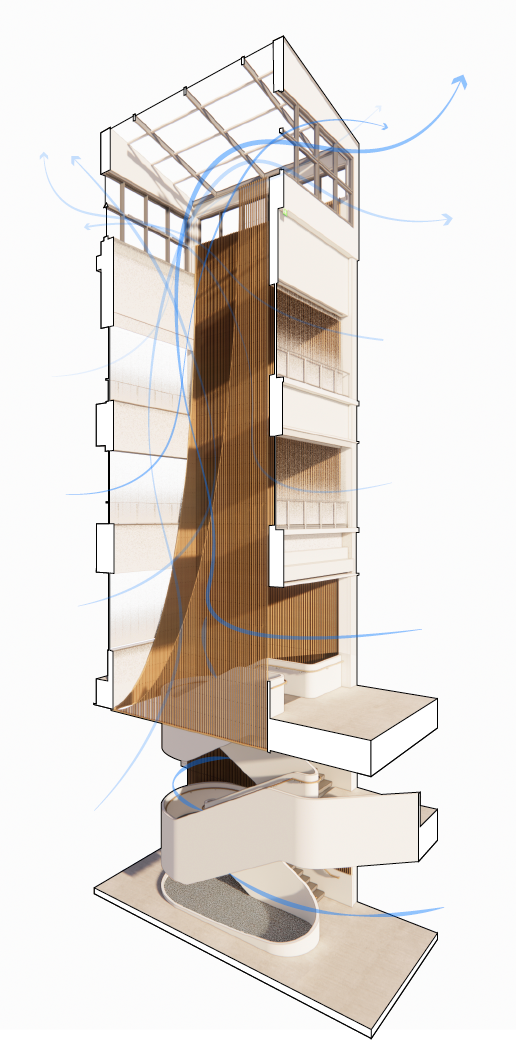
The chimney gives hot air a path to rise through the building and exit through vents at the roof. As warm air leaves, a slight vacuum is created, which draws in cooler, fresh air in through operable windows on the lower floors. The chimney accelerates this process by capturing the sun’s energy and further warming the air inside the chimney’s shaft, causing it to rise faster and bring in more fresh air.
“Buildings are required to always have a source of fresh air for occupants,” explains Brian Rudy (BES, BArch ’93), Partner at Moriyama + Teshima Architects, the company that designed M4. “Usually, that is done with fans and electricity. By taking the load off those fans, the solar chimney essentially provides free ventilation to the building.”


Old meets new
While solar chimneys are gaining popularity in contemporary architecture, the concept is not new.
“Solar chimneys are actually an ancient cooling technology,” says Eric Campbell (BASc ’16), Associate Principal at Introba, the engineering consultants that partnered with Moriyama to design the chimney. “They predate mechanical cooling by thousands of years.”
In ancient Iran, for example, buildings often featured windcatchers—structures that harnessed the wind to ventilate and cool interior spaces. “We’ve largely forgotten how to design buildings this way,” says Campbell. “Now we’re trying to reconnect with vernacular architecture and ancient techniques to bring down energy and carbon use.”
One of the things that marks M4’s chimney as modern, however, is its automation. Windows respond to indoor and outdoor conditions, opening and closing to optimize comfort, air quality, and energy savings.
“The window automation system is designed to coordinate with the mechanical systems to use the most efficient means – natural or mechanical – to maintain ideal CO₂ levels. So, for example, if CO₂ levels are rising, the system could partially open the windows in winter to bring levels back down,” Campbell explains.
Improving health and wellbeing
Beyond lowering the building’s energy consumption, the chimney will also provide health benefits to M4’s occupants.
“Engineered natural ventilation systems like this are designed with six to ten air changes per hour, whereas mechanical code might be one to three,” says Campbell. “That has all sorts of benefits in terms of keeping transmission of airborne disease to a minimum.”
In addition to reducing sickness, the chimney should help create a positive working environment. It will allow an abundance of natural light into the heart of the building, which Campbell notes has been shown to improve focus and productivity.
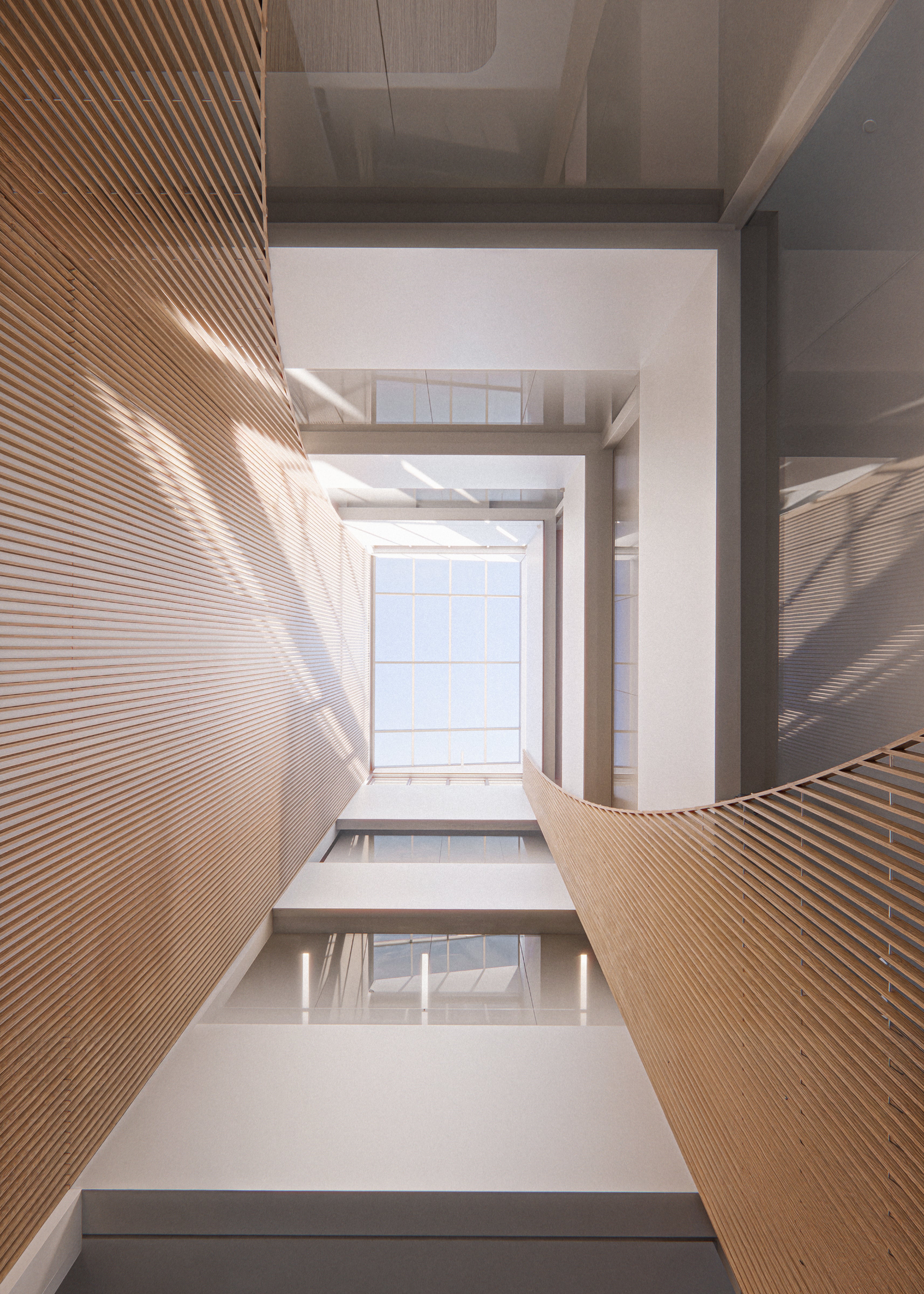
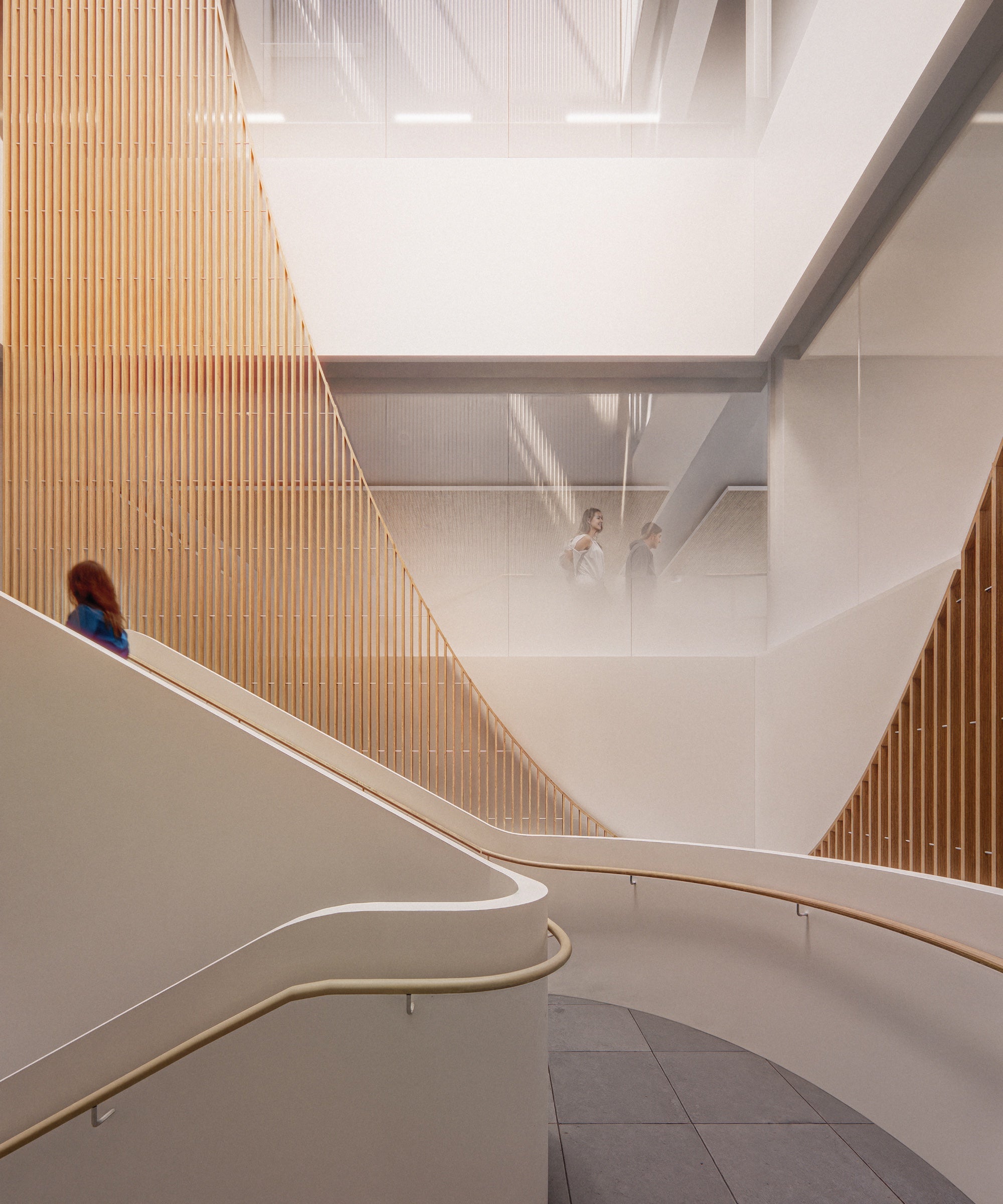
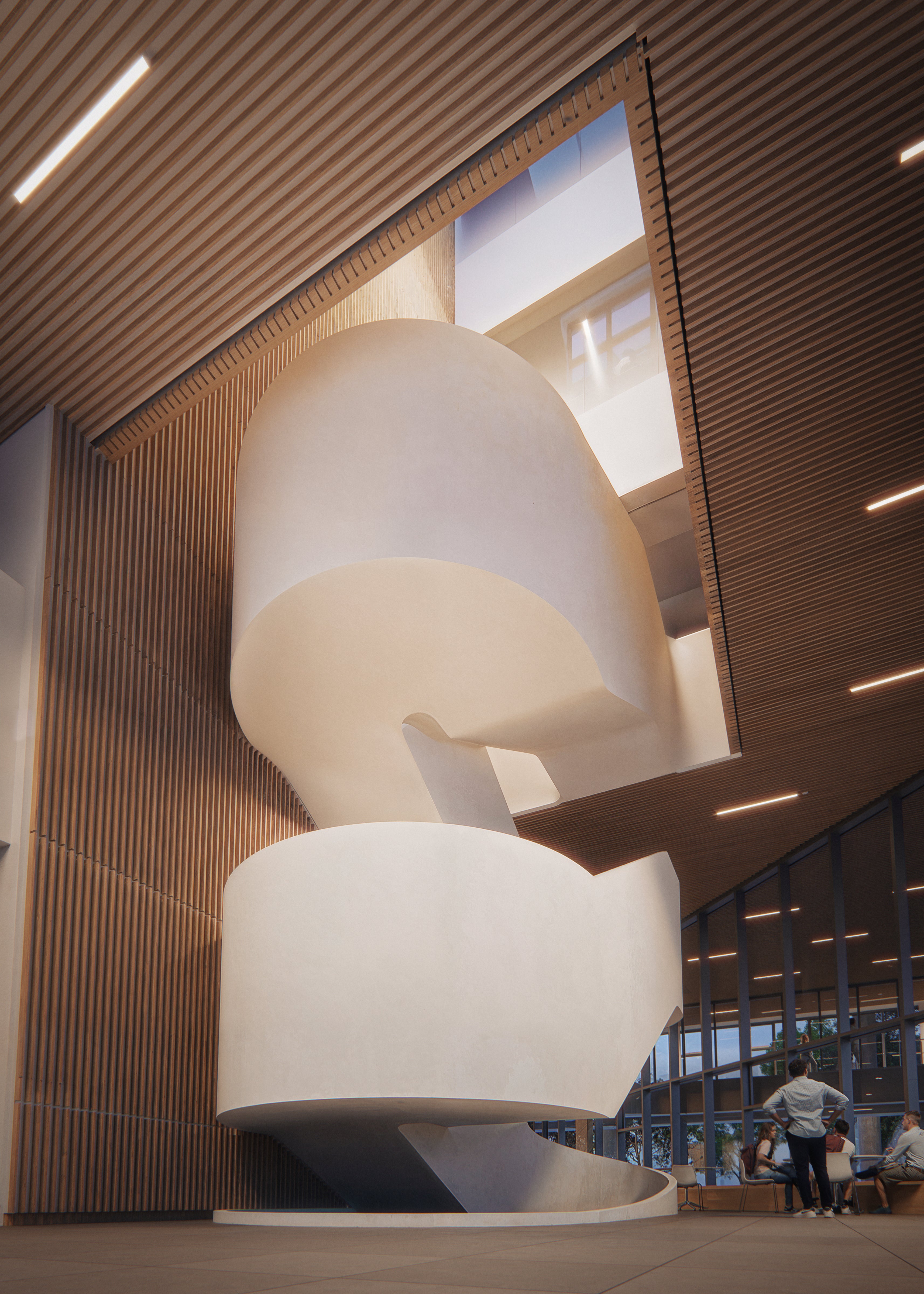
We see the chimney as M4’s symbolic centre, the heart of the building. The staircase and chimney weave together parabolic forms found in Continuous Math and connect from the earth to the sky.
Symbolism and aesthetics
In designing M4’s chimney, the architects strove to balance function with aesthetics, while maintaining a symbolic connection to the purpose of the building.
The chimney connects at its base with a feature staircase that links the first, second and third floors of M4. The staircase and chimney blend parabolic forms and Indigenous architectural traditions. It thereby honours the math that will be studied within M4 and the traditions of the peoples who, for generations, inhabited this land on which M4 is built.
“We see the chimney as M4’s symbolic center–the heart of the building,” says Rudy. “The staircase and chimney weave together parabolic forms found in Continuous Math and connect from the earth to the sky.”
It’s set to become a striking architectural centerpiece, one that not only delivers health and sustainability benefits but also inspires awe.
M4’s other passive design features
The solar chimney is a striking example of passive design, a strategy that uses the building’s architecture and materials to regulate temperature and airflow without relying on mechanical systems. But it’s not the only example within M4. Rather, it’s part of a broader strategy to reduce energy use and enhance occupant comfort through natural means.
Another key element is thermal mass—the ability of materials like concrete to absorb and store heat. By exposing concrete surfaces rather than covering them with carpet or drywall, the building can retain cool temperatures overnight and release them slowly throughout the day. This helps delay the need for mechanical cooling, especially during warmer months.
M4’s orientation also plays a role. The building is aligned along an east-west axis, which allows the south-facing façade to benefit from passive solar shading. Large overhangs shield the windows from direct sunlight during summer hours, reducing heat gain when it is least desired, while still allowing daylight to flood the interior in the winter months when it is of benefit to warm the building.
Even the window placement is strategic. Windows are positioned on multiple sides of the solar chimney to respond to prevailing winds. This ensures that air is always pulled in the right direction, maximizing ventilation efficiency.
Together, these passive strategies make M4 a model for sustainable design.
The building not only exemplifies the Faculty’s commitment to sustainability–it also resonates with some of the research that will take place within. The Green Room, a server room on the building’s fifth floor, will provide computing power for math research while enabling explorations in green computing. The room’s waste heat will be captured by mechanical systems and used to heat the building, providing a carbon-free source of energy for the building.
As such, M4 promises to become a beacon for those interested in studying innovative sustainability technologies–both ancient and modern–and building a greener future.
Discover more about how M4 is shaping the future of mathematics at Waterloo