Science

Monday, November 15, 2021

School of Optometry and Vision Science ranked 5th in the world

by Elizabeth Kleisath, Faculty of Science

The University of Waterloo’s School of Optometry and Vision Science is amongst the top optometry schools in the world, according to one of the field’s top scientific journals.

These rankings were published in Clinical and Experimental Optometry, naming Waterloo 5th overall, out of the 245 optometry schools in the world.

The listing also leaves Waterloo’s School of Optometry and Vision Science as #1 in Canada, and #3 of optometry schools in North America.

Saturday, October 23, 2021

There’s something in the water in Waterloo … and beyond

by Sharon McFarlane, Faculty of Science

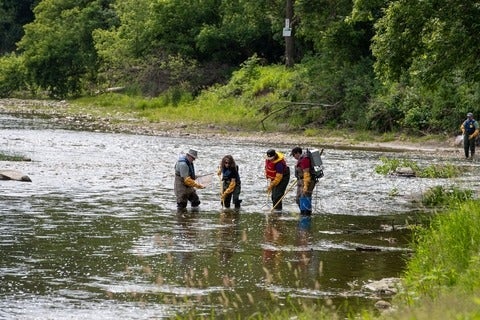
This fall’s Convocation isn’t the first for Tim Shardlow who is graduating from a master's in biology (microbiology specialization). With a little luck and a lot of hard work, it won’t be his last either. The Erin, Ontario native has already started his PhD at the University of Waterloo in the same field of microbiology with an environmental focus, and is well on his way to unlocking hidden secrets of what’s in the water.

Monday, October 18, 2021

Bringing eye health to the global scale

by Elizabeth Kleisath, Faculty of Science

Vision is one of our most dominant senses, and our world is often built around our ability to see. Despite this, the World Health Organization reports that more than one third of people around the world suffer from some form of vision impairment or blindness. Of these estimated 2.2 billion people, at least one billion of these cases could have been prevented or have not been addressed yet.

Thursday, October 14, 2021

Exploring new ways to test blood sugar levels for diabetes patients

by Dami Adebajo, Faculty of Science

Despite breakthrough diabetes research over the past century, people with diabetes still need to rely on obtaining blood samples to monitor their sugar levels. Daily glucose monitoring by tracking blood sugar levels is essential for managing both types 1 and 2 diabetes, however the current method – finger pricking – is invasive and can become burdensome with how often it needs to be done.

Friday, September 24, 2021

Aviation research takes off virtually on campus

by Elizabeth Kleisath, Faculty of Science

The University of Waterloo has recently undertaken a significant step forward in promoting aviation research on campus, through the purchase of a new flight simulator.

The new flight simulator will allow researchers to have priority access to a simulator, which although common technology within flight school settings — including the Waterloo Wellington Flight Centre — they usually prioritize student flight training instead of research efforts.

Thursday, July 15, 2021

Artificial Intelligence for fun

by Rose Simone, Faculty of Science

A serious passion for physics was what drew Parshant Utam to study Mathematical Physics at the University of Waterloo. Little did he realize that the University’s entrepreneurial atmosphere would lead him to become a co-founder of viral smartphone app that is pure fun.

Parshant came to Waterloo as an international student from Pakistan, fascinated by theoretical physics. He was drawn by the presence of both the University of Waterloo’s Institute for Quantum computing and the nearby Perimeter Institute for Theoretical Physics.

Friday, June 11, 2021

All in the family

by Sharon McFarlane, Faculty of Science

It’s Spring Convocation again, and this year the Faculty of Science will grant over 850 students their hard-earned Bachelor of Science degree. But for Susan and James Hadden, both BSc ’90 biology alumni, there’s one graduate in particular who they’re most excited to welcome into the club: their daughter, Jocelyn, who has earned her Bachelor of Science in Biomedical Sciences.

Friday, April 9, 2021

The origin of water on planets in our universe

by Elizabeth Kleisath, Faculty of Science

Water is essential for life as we know it – water makes up around 70% of the human body, covers about 70% of the planet Earth, has been found in the far reaches of our universe, and is at the centre of our search for habitable planets around other stars.

But how does this water find its way from interstellar space to the comets and planets it is found on? This was one of the questions that Professor Michel Fich from the Faculty of Science, and his international colleagues set out to research, using observations from the Herschel Space Observatory.