First SFM graduates prove the program was worth the bet
Waterloo's first sustainability and financial management cohort graduates, and every single student has a next step
In 2021, a small group of students admitted to the Accounting and Financial Management (AFM) program took a chance and entered the brand new Sustainability and Financial Management (SFM) program; a first-of-its-kind degree blending the two disciplines from the School of Accounting and Finance (SAF) and the School of Environment, Enterprise and Development (SEED).
It wasn't in the course calendar yet. There was no graduating class to look to, no employer track record to cite. There was just a conviction, backed by signals from industry: the people hiring at major firms were saying they needed professionals who could speak both finance and sustainability.
Twelve students said yes.
On June 18, that cohort of twelve crosses the convocation stage as the first-ever graduates of the SFM program and every single one of them has a next step. Six are continuing into the Master of Accounting (MAcc). Six have secured full-time employment. Of those, five are working directly in sustainability and ESG (environmental, social and governance) focused roles.
"I wanted to see how finance and sustainability could mesh in the real world," says Ali Malik (SFM '26), now a financial analyst at the City of Hamilton. "Holding corporations accountable for their environmental and societal impact is the only way to get them to act more responsibly."
For Maija Hoover (SFM '26), now a Sustainable Investment Associate at Fidelity Investments Canada, the draw was the combination of credentials and career positioning. "The opportunity to graduate with a unique degree, alongside strong work experience in a rapidly growing field, was something I felt set the program apart," she says. In her role, she supports ESG investment products and helps develop and manage ESG-focused funds for retail and institutional investors, work that draws directly on the emissions accounting, ESG risk management and sustainability reporting skills she built during her degree.
Shreya Beri (SFM '26) now a Responsible Investing Analyst at CAAT Pension Plan, had a similar instinct. "What's better than combining my passion for finance with meaningful work that contributes to positive societal impact?" she says. Today she integrates ESG considerations into investment processes, evaluates external fund managers on their responsible investing practices, and works on systemic challenges including climate change and human rights as financially material risks.
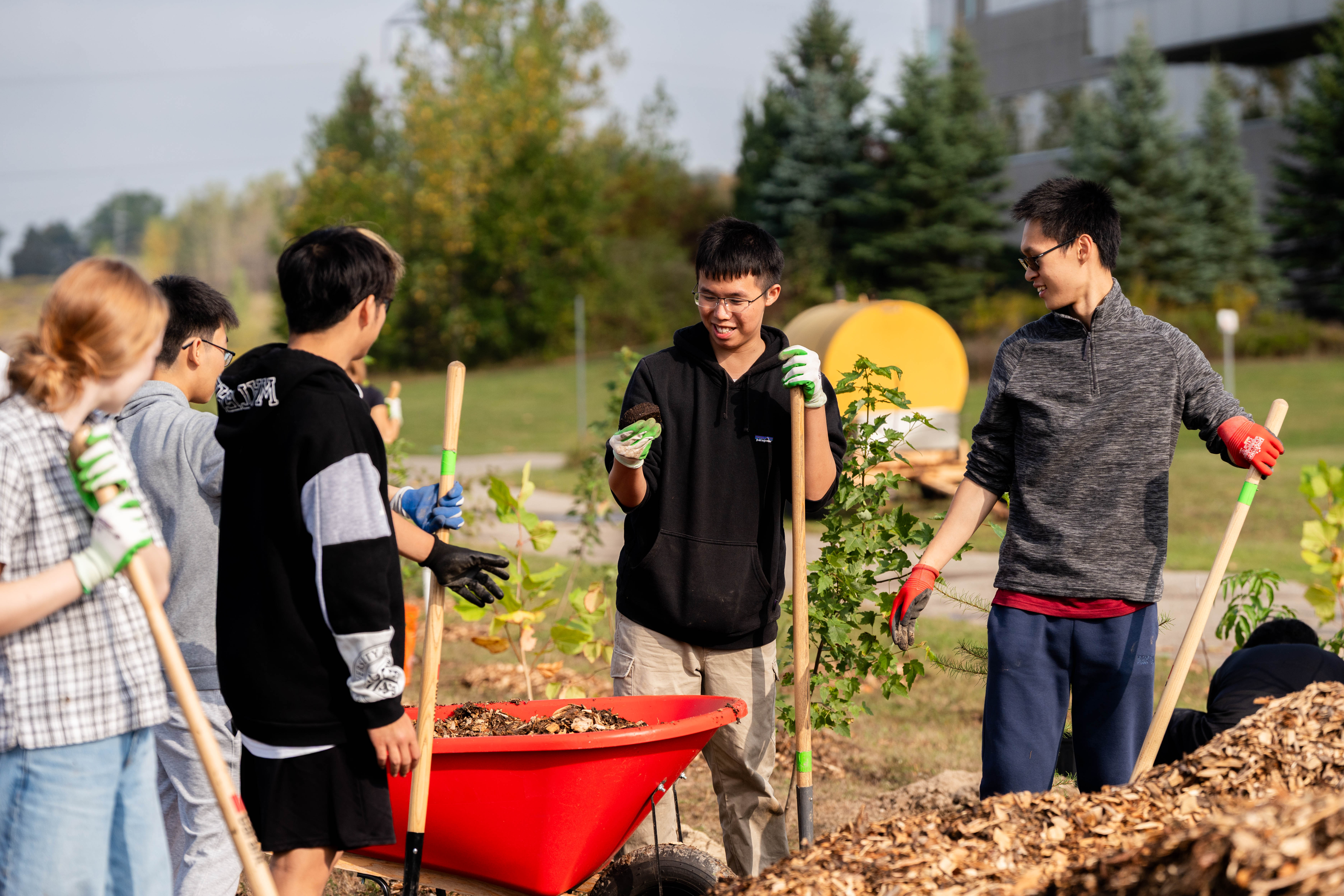
The SFM program's launch was bolstered by a $2.2 million gift from the RBC Foundation in 2022, which supported the establishment and growth of the BSFM program, a Professorship in Sustainability and Financial management, mentorship and experiential learning opportunities for students, and the creation of the Hub for Sustainability Integration — connecting students, faculty and external partners on sustainability challenges.
The program was co-created and championed by Dr. Blake Phillips, SAF Director, and Dr. Michael Wood, Professor in SEED and now a Co-Director of the program. Together they brought SAF's deep expertise in accounting, finance and professional business practice alongside more than two decades of sustainable business leadership from SEED, building SFM to respond directly to what employers said they couldn't find. With 16 months of paid co-op experience embedded in the degree, students don't just study the intersection of finance and sustainability: they work in it.
"What made the SAF–SEED partnership work is that it wasn't about layering sustainability onto finance — it was about integrating the two from the ground up," says Wood. "Students aren't choosing between skillsets; they're developing a combined lens that reflects how decisions are actually made in industry. That's what gives them an edge. Waterloo is the right home for this because of our co-op model and our culture of interdisciplinary problem-solving. Students here don't just study emerging fields — they help define them in real time."
“When co-op employers are interviewing our students, they often assume they'll have to choose between hiring someone with accounting and finance skills or someone with sustainability expertise," says Phillips. "SFM graduates have deep competencies in both worlds. That's not a small thing. Firms like Brookfield and KPMG are hiring these students and they're not having to compromise.”
For six members of the cohort, the next step is working toward becoming a Chartered Professional Accountant. Dhiya Susan Eapen (SFM '26) says SFM reshaped how she approaches complex problems entirely. "It gave me the space to be curious and to ask the right questions," she says. "It helped me see beyond simply maximizing shareholder value." That critical lens, she says, is what drew her deeper into the field and toward the MAcc, one of the most successful paths to becoming a CPA.
The cohort started their studies during a substantially disrupted year. Online learning, an uncertain campus environment and a field still taking shape meant these students were building the runway as they ran. They graduate not just ready for what's next, but ahead of it. And when students like these work alongside others who bring different but complementary expertise in accounting, in science, and in sustainability; the results speak for themselves.
Case in point? In May of this year, a team spanning SFM, AFM and BioTech CPA students, including one of the twelve in this first SFM cohort, won the CFA Institute Research Challenge global title, the world's largest student investment competition. "Results like these tell you something," says Phillips. "That cross-program depth is what the University of Waterloo is built on — and the world is noticing."