Founder spotlight: Rachel Bartholomew on advancing femtech and women’s health
For Global Entrepreneurship Week, we’re spotlighting some incredible University of Waterloo entrepreneurs making a difference for humanity and our world.

Nine researchers at the University of Waterloo have been awarded $7.5 million in funding to support their research as part of the illustrious Canada Research Chairs (CRC) program.
Each year, the CRC program invests up to $311 million to attract and retain some of the world’s most accomplished and promising minds.
Do you really want to know what we were doing on April 19? Listening to Taylor Swift’s double-album release, The Tortured Poets Department: The Anthology, of course.
Waterloo graduate Kiyoumars Zarshenas (PhD ’23) has been named a winner of the Science Exposed 2024 Jury Prize sponsored by the Natural Sciences and Engineering Research Council of Canada (NSERC) with a striking image captured with a scanning electron microscope.
The Science Exposed contest highlights photos of Canadian research to foster interest and curiosity in the sciences. Each year, 20 images are selected as finalists for the English contest and showcased by various means, including exhibitions.
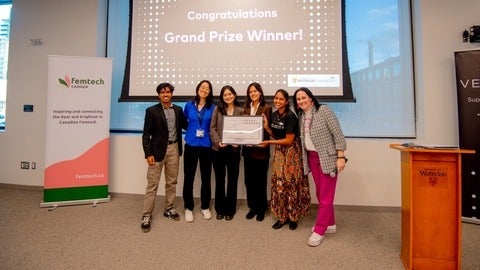
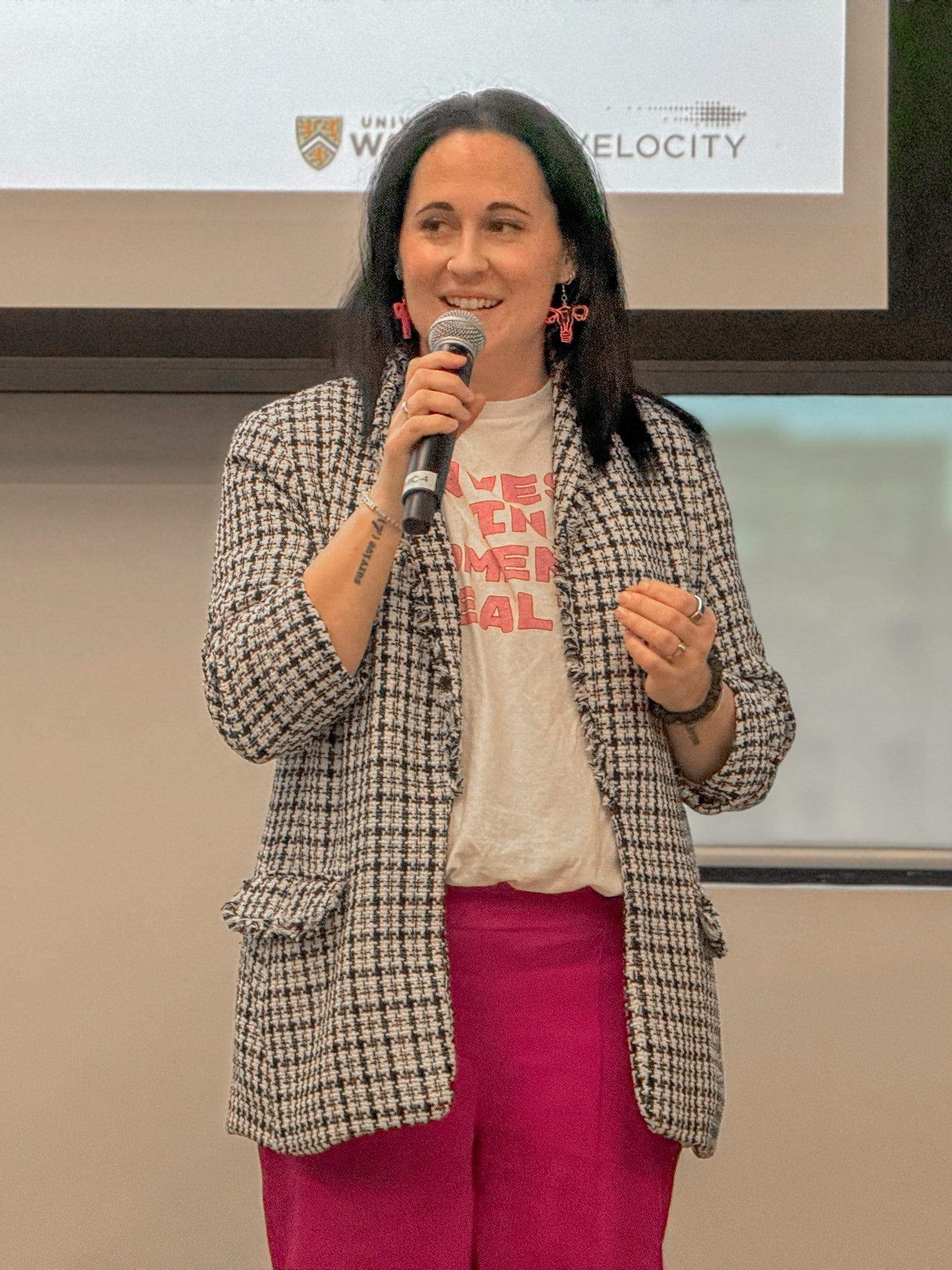
University of Waterloo alum and founder of Hyivy Health, Rachel Bartholomew (MBET ’14), returned to campus as a collaborator of Velocity and FemTech Canada’s Innovation Challenge, where more than 100 students formed teams to address three critical areas of women’s health: menopause, gynecological health and breast health.

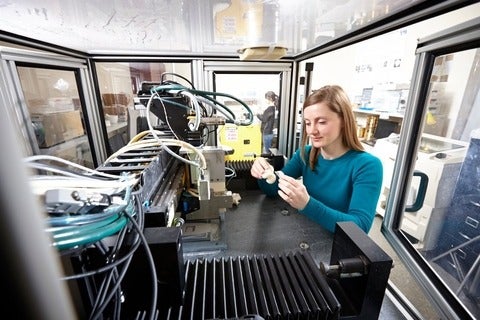
In 2004, the Multi-Scale Additive Manufacturing (MSAM) Lab at the University of Waterloo was a small, 150 square foot, windowless space. Today, it has expanded to become the largest metal additive manufacturing (AM) academic research lab in Canada, with more than $25 million in infrastructure, and is one of the most comprehensive university-based metal AM facilities globally.
A photon detector module designed, assembled and programmed at University of Waterloo’s Institute for Quantum Computing (IQC) launched into space earlier this week aboard a SpaceX flight and will soon arrive at the International Space Station. It will be used for quantum entanglement science experiments as part of the Space Entanglement and Annealing Quantum Experiment (SEAQUE) implemented by an international consortium under leadership from the University of Illinois Urbana-Champaign.
In a landscape where well-funded companies with substantial computational resources dominate, student founders must rapidly test their ideas to stay competitive.
In 2004, the University of Waterloo’s School of Architecture moved from the Waterloo campus to a repurposed silk mill in Cambridge, Ontario, to expand its facilities. The school’s new location in the heart of historic Galt was supported by the City of Cambridge and local businesses who recognized its potential to revitalize the municipality’s downtown core.