Learning from the past to safeguard our future
Merging Traditional Knowledge with western science to improve conservation strategies
On the south coast of Newfoundland sits the Little River Estuary, a culturally significant landscape that was declared an Indigenous Protected and Conserved Area in 2024. The area includes a river channel, a mixed water habitat and wetland environment.
As part of the process of having the Estuary protected, the Miawpukek First Nation sought to establish stronger governance and stewardship through community-led mapping, monitoring and conservation planning.
Kian Drew (BSc ’22, MSc ’25, PhD in progress) grew up in Mi'kma'ki, the ancestral lands of the Mi’kmaq, and his studies have taken him to New Brunswick, Ontario and the United Kingdom. His PhD research within the Faculty of Environment is now reconnecting him back to the land where he grew up.
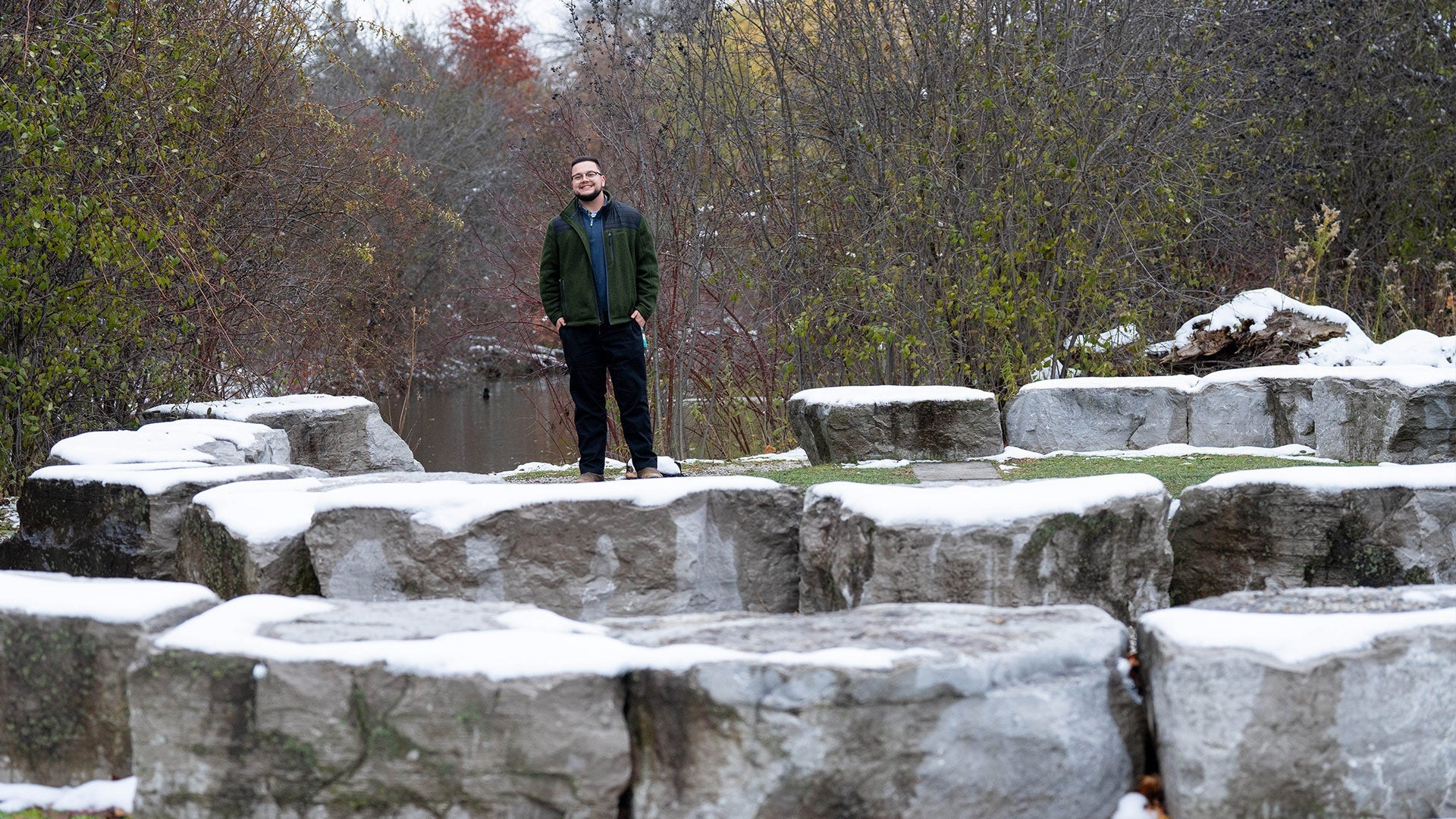
Drew’s PhD research is rooted in a long-standing history of Mi’kmaw use and occupation of the Little River area and looks to affirm these relationships while remaining attentive to cultural protocols and legal considerations.
“I feel like my whole post-secondary journey has been leading up to this research,” Drew says. “When you grow up learning about the land and its stories, it inspires you to want to make a difference. As someone who spent my undergraduate studies and my Masters studying earth and the environment, I am so excited to be connecting that understanding with Mi’kmaw knowledge and oral histories.”
By analyzing sediment cores collected from culturally significant areas, the research aims to reconstruct historical changes in water levels, vegetation, and disturbance events, including storms, flooding and traditional burning.
Waterloo has been a leader in sustainability research and education for the past 50 years, and the Faculty of Environment has been a catalyst for environmental innovation, solutions and talent developed with the world, for the world.
Using a Two-Eyed Seeing approach, Drew is weaving both Indigenous ways of knowing and science.
“When we take data and interpret it alongside Traditional Knowledge systems and stories, we get a broader understanding of the shifts in the coastal environments and how those shifts have impacted the landscape and its people,” Drew says. “The data by itself is helpful, but understanding how the environmental and ecological changes have been observed, understood and responded to over time helps both geoscience and Indigenous Knowledge systems in the future.”
Paleoenvironmental data from the research will aim to inform conservation strategies and community-focused planning for at-risk ecosystems, and Drew hopes it will lead to improved coastline and peatland conservation in Mi'kma'ki.
“Having been away from where I grew up for nearly a decade, it has been great to reconnect with my community and be able to give back.”
The research is funded in part by the Social Sciences and Humanities Research Council Canada Graduate Scholarship – Doctoral Program (2024 competition).