Waterloo researchers to receive more than $3.4 million
The Government of Canada announced funding for several University of Waterloo faculty members through the New Frontiers Research Fund (NFRF).

There is no recipe or instruction manual for building inclusive spaces because they can never be constructed — they are cultivated. But if you ever speak to a member of the Games Institute (GI) at the University of Waterloo, they’ll share how they get to work and learn in an inclusive, judgment-free ecosystem.
Aspiring entrepreneurs have long benefited from the innovation ecosystem at the University of Waterloo, an environment where entrepreneurship and innovation excel amidst a unique blend of co-op, work-integrated learning opportunities and customized wrap-around supports.
This traditional innovation ecosystem, however, wasn’t reaching the needs of aspiring Indigenous entrepreneurs.
An idea that combined solutions from multiple AI models to predict wildfire growth took the top prize at the first hackathon at the University of Waterloo intended to identify cutting-edge solutions for wildfire management.

Keith Cleland (MASc ‘22)
Student, Faculty of Engineering
> Founder, Aqua-Cell Energy
> Velocity
As someone born and raised in Calgary, Keith Cleland initially thought he would end up working in the oil industry. “Being from Alberta, that seemed like the natural thing to do,” he says.
Nfinite Nanotech has raised $6.5 million USD in seed funding to scale its nanomaterial product: a coating for sustainable and biodegradable food packaging that will help divert plastic waste from landfills. The University of Waterloo startup is developing an ultrathin and high-performance material for consumer-packaged goods, like granola bar wraps and potato chip bags, that keeps them fresh longer without the use of excessive non-biodegradable plastic packaging.
University of Waterloo researchers have developed a new method that can lead to significant energy savings in buildings. The team identified 28 major heat loss regions in a multi-unit residential building with the most severe ones being at wall intersections and around windows. A potential energy savings of 25 per cent is expected if 70 per cent of the discovered regions are fixed.
On May 11, University of Waterloo students were invited to participate in the GOODHack24 challenge held at Communitech in downtown Kitchener. The hackathon challenge offered a space for students to brainstorm, explore and develop innovative solutions at the intersection of open data, technology and local sustainable resources to support affected communities experiencing heat inequity.
GOODHack24 was co-hosted by the City of Kitchener, Go Open Data (GOOD) and GreenHouse, a social incubator at United College.
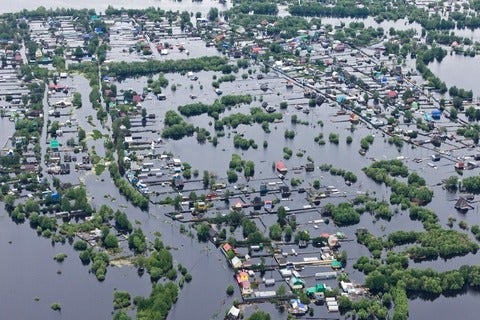
A pair of University of Waterloo flood disaster experts have published an analysis on the federal government’s national flood insurance program that finds the proposed plan can do more to make insurance abundant and affordable for Canadian taxpayers.
The build-up of ice on an airplane in flight can seriously impair its ability to fly and, in extreme cases, lead to catastrophe. In Dr. David Del Rey Fernández's lab, algorithms and software are being developed to understand these processes and enhance future aircraft designs to prevent negative outcomes.