Beyond Innovation: Waterloo’s 2016-17 State of the University Report

Great universities aren’t just bricks and mortar, they rise with the dreams and achievements of the people who pass through their doors.

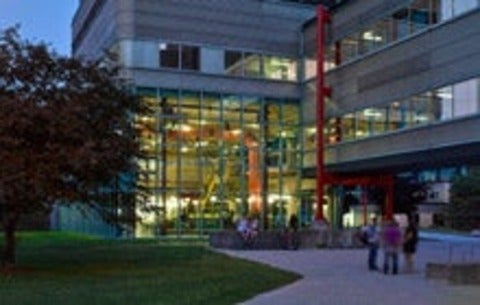
Opened in 2012, the Mike and Ophelia Lazaridis Quantum-Nano Centre offers some of the world’s most sophisticated laboratories for quantum science and nanotechnology research. Quantum research at Waterloo has the potential to change the way we share and secure information, and nanotechnology discoveries will influence everything from human health to alternative energy. These innovations include advances in cryptography that will keep our digital information safer and nano-materials than can help clean water.

Great universities aren’t just bricks and mortar, they rise with the dreams and achievements of the people who pass through their doors.


Croatian President Kolinda Grabar-Kitarović will visit the University of Waterloo to find out about Canada’s most innovative university and to tour the Institute for Quantum Computing
University of Waterloo is the top school in Canada for computer science and engineering, according to the US News' Global University Subject-area Rankings.
The US News ranking rates 1,000 universities in more than 60 countries in 22 subject disciplines. Computer science at Waterloo moved up one spot to 18th this year while engineering held strong in the 47th spot.
Researchers from the Institute for Quantum Computing (IQC) at the University of Waterloo led the development of a new extensible wiring technique capable of controlling superconducting quantum bits, representing a significant step towards to the realization of a scalable quantum computer.
Challenges to protecting information and systems from the massive processing power of quantum computers will be the focus of a workshop that the University of Waterloo’s Institute for Quantum Computing will co-host in Toronto next week.
The technology industry is now facing a Y2Q — years to quantum — challenge. The current deadline is estimated to be 10 years. All security dependent on existing standards is vulnerable.
David Cory didn’t waste any time getting down to business after Kirsty Duncan, Minister of Science for Canada, announced $76.3 million in federal funding Tuesday for a project that will boost the University of Waterloo’s position at the forefront of groundbreaking quantum research.
With about 150 dignitaries, colleagues and other guests on hand in the atrium at the Mike & Ophelia Lazaridis Quantum-Nano Centre, the professor at the helm of the winning initiative seized the opportunity to reach out to potential industry partners and collaborators.

What once took months by some of the world’s leading scientists can now be done in seconds by undergraduate students thanks to software developed at the University of Waterloo’s Institute for Quantum Computing, paving the way for fast, secure quantum communication.
Researchers at the Institute for Quantum Computing (IQC) at the University of Waterloo developed the first available software to evaluate the security of any protocol for Quantum Key Distribution (QKD).
What does it mean to say a quantum system is in superposition? And more important: Why should we care?
The reality is - from highly secure communications to ultra-sensitive devices and super-powerful computers - quantum mechanics will change the way we live, work and play. And while Prime Minister Justin Trudeau grabbed media attention recently when he delivered a one-minute quantum lecture, many of us don’t have even a basic understanding of the science that’s driving this technological revolution.
Canada’s Federal Minister of Science, the Honourable Kirsty Duncan, toured the University of Waterloo’s innovative research spaces this week to learn about how innovations developed here will fundamentally change the fabric of society.

“You come to a place like this and you feel the energy of the university and all the fields coming together,” said Duncan. “It’s phenomenal; it’s exciting.”