Reimagining the future of eye care
Global eye health researcher Dr. James Wolffsohn joins the University of Waterloo as the Eddie Goldenberg Research Chair in Health Innovation

The University of Waterloo welcomes Dr. James Wolffsohn from the U.K. as a Government of Canada Eddie Goldenberg Research Chair in Health Innovation. Wolffsohn is joining the School of Optometry and Vision Science and will continue his work advancing technology-driven solutions for earlier detection, personalized treatment, and equitable access to eye care.
Wolffsohn will officially join Waterloo on October 1, 2026, and establish a research program that spans the full innovation pipeline, from discovery and research through to commercialization, while engaging Waterloo students at every stage.
Describe your research and the key questions you are working to address
My research focuses on developing equitable, technology-enabled solutions that improve eye health and can move rapidly from the lab into real-world use. By combining diagnostics, artificial intelligence (AI), prevention, and therapeutic innovation, I aim to make vision care more accessible and effective for diverse populations.
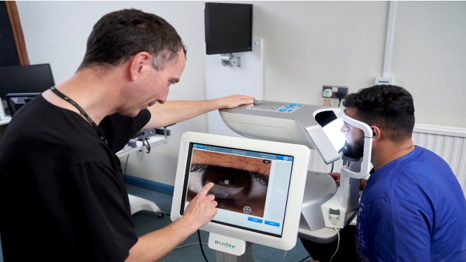
Key questions driving my work include how to expand early detection through low-cost, portable diagnostic tools; how AI-powered image analysis can improve disease identification and reduce preventable vision loss; and how new insights into disease mechanisms can inform next-generation treatments and contact/intraocular lenses. I am also exploring community-based approaches to monitoring conditions like macular degeneration, and investigating how digital platforms and mobile screening technologies can be integrated into routine care.
Ultimately, my goal is to ensure that research discoveries move beyond the lab to deliver meaningful benefits for patients, clinicians, and health systems.
What national and global challenges are you working to solve, and how does your research create impact?
My research addresses some of the most pressing eye-health challenges facing Canada and the world, including unequal access to care, rising rates of myopia in children, dry eye disease (and links with digital screen time), age-related retinal conditions, and gaps in services for rural and remote communities. By developing affordable diagnostic tools, AI-enabled technologies, and new approaches to prevention and treatment, I aim to make high-quality eye care more accessible and effective.
The biggest impact of the research will be earlier disease detection, more personalized care and better long-term outcomes for patients. It also contributes to the development of scalable technologies, digital health platforms and commercial innovations that will strengthen the eye-health sector. At the same time, my research helps advance new models of care, including tele-optometry and community-based screening programs. Through my work, I aim to help reduce preventable vision loss and position Canada as a global leader in equitable, technology-enabled eye-health solutions.
How will Waterloo’s strengths in research, innovation, entrepreneurship and industry partnerships complement your research?
Waterloo is uniquely aligned with the translational nature of my work. As a global leader in entrepreneurship, industry engagement, and research commercialization, the University provides a strong foundation for moving new eye-health technologies from discovery to real-world impact.
Waterloo’s creator-owned intellectual property model and commercialization ecosystem will support the development of diagnostic tools, digital health platforms and next-generation therapeutics. Resources such as the Waterloo Commercialization Office, the research partnerships team, and the new Waterloo Eye Institute offer valuable expertise in intellectual property, industry engagement, clinical validation, and prototyping. Combined with strong connections across the medtech, digital health and engineering sectors, these strengths will help accelerate the translation of research into practice, foster meaningful partnerships, and expand the reach of innovations that improve eye health in Canada and around the world.
What factors influenced your decision to make this move at this point in your career? Why is this the right next step for you professionally and intellectually?
Several factors influenced my decision to relocate to Canada and to the University of Waterloo. My work is strongly aligned with Canadian priorities in equitable eye care, AI diagnostics, and medtech innovation. Waterloo offers a unique environment where I can fully integrate the entire research and innovation pathway into my work, from discovery and clinical evidence to implementation, commercialization and real-world impact. Just as importantly, Waterloo provides an exceptional platform for training the next generation of researchers and innovators in areas such as digital health, artificial intelligence, and knowledge translation.
Professionally and intellectually, joining Waterloo is an opportunity to accelerate the impact of my research, build new partnerships, and expand its reach to benefit patients and communities in Canada and around the world.
What excites you most about working with Waterloo students, and what impact do you hope to have on the next generation of scholars?
Waterloo students have a unique combination of technical expertise, creativity, and entrepreneurial mindset. They are driven to solve real-world problems, making Waterloo an ideal environment for research that bridges discovery, innovation, and impact.
I look forward to working with students across many disciplines, including health sciences, engineering, and business, to develop technologies that improve eye health and expand access to care. Together, we can translate research into practical solutions with the potential to improve lives on a global scale.
I also hope to help students develop the skills and perspectives needed to become leaders in academia, industry, health care, and beyond. I want to inspire the next generation of scholars and innovators to pursue scientific research that is equitable, accessible, and focused on delivering meaningful societal impact.