Pharmacists at the core of oncology patient management

When one thinks of a cancer centre, nurses and physicians are at the forefront, but a pharmacist is also essential in providing care and designing treatments for those undergoing chemotherapy.

When one thinks of a cancer centre, nurses and physicians are at the forefront, but a pharmacist is also essential in providing care and designing treatments for those undergoing chemotherapy.
Naomie Seh Abomo, a fourth-year civil engineering student at the University of Waterloo, has been awarded Canada’s 3M National Student Fellowship Award. She is one of just 10 students from across the country to receive this prestigious national fellowship in recognition of her outstanding leadership and dedication to her community.
Marianna Iovenko remembers the fight for survival leading up to her departure from Ukraine, as Russian bombs were hunting civilians in Kyiv.
“We sat in complete darkness after 5:00 p.m. because it was important to hide anything that could shed some light. We only had a TV with news about war, thoughts that war would end soon—hopefully—and some food that we managed to find in a nearby store when it was difficult even to buy bread.”
Teaching and learning in engineering and other STEM disciplines can sometimes seem to be impersonal, in the sense that the subject matter is highly technical, and the focus is often on demonstrating discrete competencies.
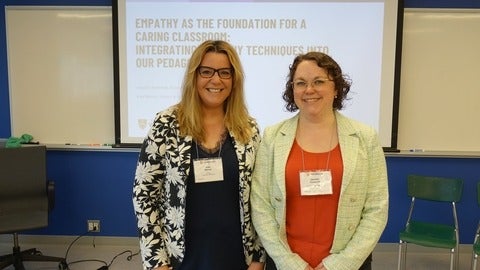
Yet for Dr. Jennifer Howcroft and Dr. Kate Mercer, seeing the world through the eyes of students and empathizing with them is an essential pedagogical technique.
Howcroft is a lecturer in the Department of Systems Design Engineering and Mercer is a librarian and sessional instructor who teaches in the Department of Systems Design Engineering.
On behalf of the University of Waterloo, I express concern regarding the ongoing conflict in Sudan and sympathy for those impacted by events there.
Fighting between armed forces is having devastating consequences for civilians in Sudan. Loss of life, injuries, destruction of property, displacement, and curtailment of access to critical services are only some of the tragedies and hardships affecting hundreds of thousands of people.
On May 5, the University of Waterloo community came together to observe Red Dress Day, also known as the National Day of Awareness for Missing and Murdered Indigenous Women and Girls and Two-Spirit People (MMIWG2S). The commemoration ceremony was led by Indigenous Knowledge Keeper, Elder Myeengun Henry, at B.C. Matthews Hall (BMH) Green. The Waterloo community was invited to help hang red dresses on trees around BMH Green to represent and honour the lives of the missing and murdered, while showing solidarity with their family and loved ones.
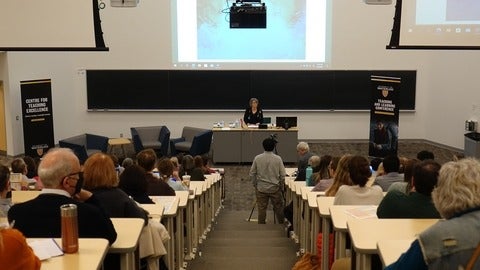
What does it mean to teach with kindness and care?
That’s the central theme of the 14th annual University of Waterloo Teaching and Learning Conference, taking place May 3 to 4.
Waterloo’s Centre for Teaching Excellence (CTE) organizes the annual conference, which features sessions and speakers from UWaterloo and other post-secondary institutions.
Professor Chris Houser will join the University of Waterloo as dean of the Faculty of Science for a five-year term commencing 1 July 2023. Houser succeeds professor Bob Lemieux who has served as dean since July 2015.
The appointment was strongly supported by faculty and staff and has been approved by the University’s Board of Governors and Senate.
“I grew up on the margins,” he says. “I was in a school system that wasn’t built for success, or was built for success for some people and not others. The seed was planted for me to think about pedagogy way back then.”
In his work as an assistant professor in the Department of Sociology and Legal Studies, Dr. Adam Ellis is now practicing an approach to teaching and learning that aims to undo the very systems that pushed him to the margins, a liberatory pedagogy he is developing organically.
Mitacs and the Indigenous and Black Engineering and Technology PhD Project (IBET), an initiative at the University of Waterloo, are expanding their partnership with a pilot initiative that will enable 10 PhD students currently participating in the IBET program to conduct research at an IBET partner institution. Called the IBET Connect Award, the program is designed to encourage Indigenous and Black researchers to build and strengthen connections across Canada.