Technological Futures

Monday, July 24, 2023

Liberum Bio raises seed round

by Media Relations

Artificial intelligence has made protein design lightning fast, creating digital blueprints for cures to some of the most life-limiting ailments. While this means we now have thousands of new potential therapeutics, for these cures to be realized the designs need to be synthesized and validated in a laboratory environment, which can take a considerable amount of time.

Thursday, July 6, 2023

Autonomous airline set to increase food security in remote communities

by Naomi Grosman , Velocity

Autonomous airline Ribbit has signed a $1.3 million contract with Transport Canada to start testing its commercial cargo aircraft to deliver goods to northern Canada, starting in 2024. 

“Ribbit ultimately exists to help improve access to transportation,” said Jeremy Wang (PhD ’23), co-founder and COO. "Our dream would be a future where anybody can receive goods quickly and reliably no matter where they are located.” 

Wang said the company’s initial goal is to serve northern Canada, where about 120 million pounds of food gets delivered annually. 

Friday, June 23, 2023

Autonomous racing team achieves personal best in Italian race

by Melodie Roschman, Faculty of Mathematics

The Italian race is the latest competition in the Indy Autonomous Challenge, a collaboration between public-private organizers and academic institutions created in 2019 to challenge university students to invent a “new generation of automated vehicle software” in order “to run fully autonomous racecars.”

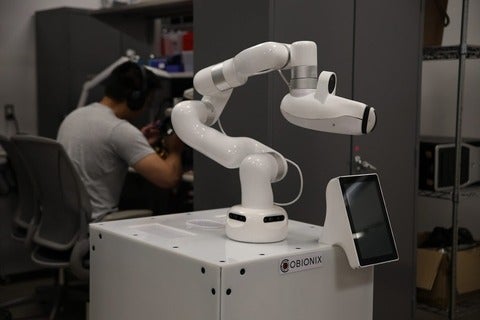
Robotics company Cobionix has raised a $2.8 million seed round to deploy its commercial robotics system Codi, an industry-first tele-robotic medical imaging tool.

The company, which is part of the University of Waterloo’s Velocity incubator, hopes that Codi will increase access to diagnostic imaging services and save healthcare costs by reducing procedure time, ultimately improving patient care.

One of the challenges in treating burn victims is the frequency of dressing changes, which can be extremely painful.

To bring relief to this and other problems, University of Waterloo researchers have created a new type of wound dressing material using advanced polymers. This new dressing could enhance the healing process for burn patients and have potential applications for drug delivery in cancer treatment as well as in the cosmetic industry.

Grand River Hospital Foundation’s Care Never Stops Week (from May 23 to May 28) featured a Health Innovation Challenge in partnership with the University of Waterloo’s Velocity Incubator, a free public talk with Tomi Poutanen, CEO and Co-founder of artificial intelligence-driven health company Signal 1, and a grand finale Rally for Health, with a free public concert. 

MedInclude is a new web platform which makes medical information more accessible for patients. The tool transcribes doctor’s notes in lay terms in real time and makes them available in a patient’s mother-tongue so they can more easily understand and take part in their medical care and decisions.

Seun Adetunji, a student of the Master of Business, Entrepreneurship and Technology program at the University of Waterloo is the founder of MedInclude. Her goal with the company is to make medical information more accessible for patients.

Tuesday, May 23, 2023

Waterloo students pilot portable milk pasteurization device in Rwanda

by Melodie Roschman and Naomi Grosman, Faculty of Mathematics & Velocity

Waterloo student-founded company Safi – from the Swahili word for “pure” or “safe” – is a startup with an ambitious mission. They want to empower East African farmers to pasteurize milk cheaply and easily, with the ultimate goal of ending milk-transmitted disease. Today, Safi’s founders are working with governments, presenting at international conferences and preparing for a 300-unit test rollout in Rwanda. Two years ago, however, Safi was just an idea.

Wednesday, May 17, 2023

Students design solutions for the local health-care system

by Angelica Marie Sanchez, University Relations

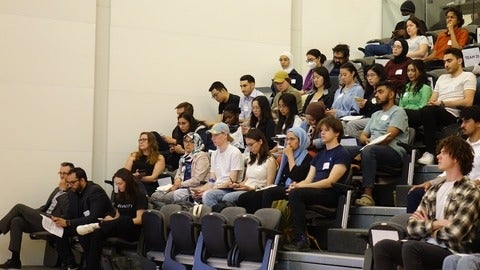
On May 16, Velocity kicked-off a partnership with the Grand River Hospital Foundation (GRHF) as part of their Care Never Stops campaign by presenting the Health Innovation Challenge.  The student hack-a-thon with a twist provides an opportunity for University of Waterloo students to take part in designing solutions to health care challenges being experienced within our local c