Students driving change in Canadian cities and communities
New program connects municipal partners with Waterloo students to tackle real-world problems with real-world constraints
As cities across Canada grapple with complex challenges, a new program established by the Future Cities Institute founded by CAIVAN (FCI) connects municipal partners with students from the University of Waterloo to deliver practical solutions.
CIVIC (City Innovation Via Internships and Co-op) was launched in 2025 with a simple central idea: cities across the country have problems that they do not have the capacity to solve, and the experience students gain from working on and learning from real-world issues is invaluable. The program brings these two things together and adds the critical lens of scalability.
“CIVIC is a symbiotic relationship between Canadian cities and Waterloo’s incredible data and engineering talent pipeline,” says Dr. Leia Minaker, Director of the FCI. “Cities benefit through increased data science capacity and democratized AI tools across all lines of municipal business. Students benefit by applying their technical skills to working through tricky problems with a team that includes the end-user. Ultimately, Canada benefits by having a pipeline of work-ready grads whose horizons are broader than Silicon Valley, as well as a suite of tools that can seriously improve productivity within Canadian municipalities.”
The City of Edmonton was one of the first municipalities to participate. A leader in developing AI solutions across multiple lines of municipal business, the city had a summer staffing problem it had been trying to solve for years. FCI’s inaugural CIVIC student, Preethi Raghuraman, spent her co-op term in Edmonton helping to fix this problem.
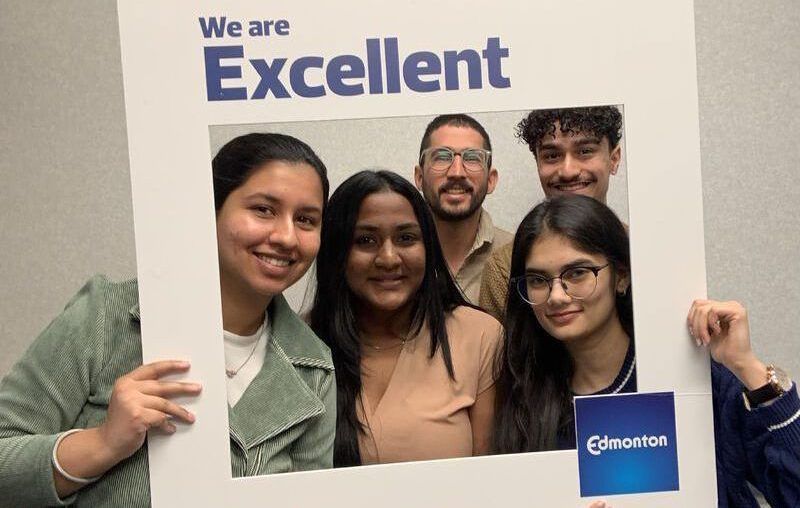
Raghuraman (centre left) and interns from the University of Alberta at the City of Edmonton.
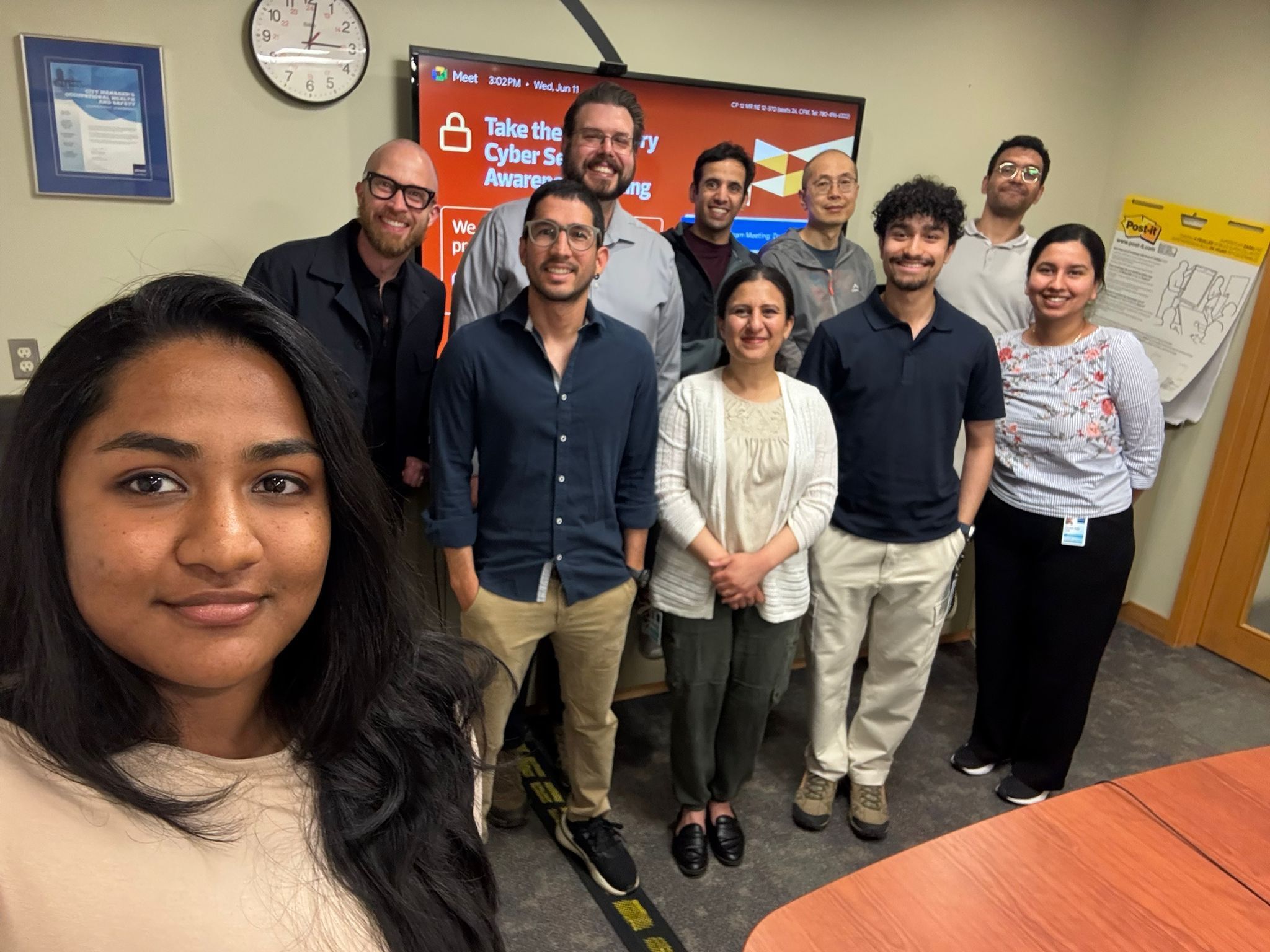
Raghuraman and the Data Science and Research (DSR) team at the City of Edmonton.
CIVIC treats each co-op work term as a unique research project, with the goal of creating something that another student could continue working on, that the partner city can use, and that other municipalities can potentially benefit from as well.
For Raghuraman, this meant developing a tool called SmartShift. The City of Edmonton’s Parks and Roads Services had been handling staffing for hundreds of employees manually, and the Data Science and Research (DSR) team was seeking a way to automate it. There were many important elements for Raghuraman to consider, including union collective agreements, staff preferences and certification needs.
“It sounds like a scheduling problem until you actually try to solve it,” she says. "There are many competing things to consider, and they do not always fit together seamlessly. Whatever you build, the people who use it have to trust it, or it may be useless. Nothing can prepare you for this kind of work except doing it.”

The view from Raghuraman’s office in Edmonton (winter).
This constraint-forward approach reflects the practical realities that must be considered. The city has budgets, rules and timelines that students have to factor in and work with to ensure the tool holds up to real payroll, crew and work season demands.
“I was not just working on a side project,” Raghuraman says. “I was working on something that the city actually really needed. That changes how you approach every decision."
Once the co-op work term ends, students return to Waterloo, where they begin unpacking their experience. They examine what worked, what didn’t and what next steps could look like for whoever comes next. The goal is for these work terms and learning experiences to evolve into longer-term research projects, creating opportunities to build, refine and implement solutions over time.
Raghuraman was invited to join forces with a Planning student from the Faculty of Environment and turn her experience into a research report, so that the solution she developed could be taken on by other municipalities.
In time, these packaged solutions can be shared with other municipalities across Canada experiencing similar problems. When another city picks up that solution, it also tends to reveal another problem worth solving, which in turn can become another CIVIC placement. This circular process is the CIVIC loop.
“FCI’s ambition is to be useful,” Minaker explains. “Our CIVIC program is a shining example of how universities can and should be useful – to our students, to our cities, and to our country.”
For Raghuraman, knowing that the solution didn’t end with her was one of the most fulfilling parts of the experience.
“The best part is knowing that this solution does not stop at Edmonton,” she says. “There are many other cities across Canada currently facing this issue, and now they don’t have to start from zero. That forward-thinking is exactly what got me into this program."
CIVIC is recruiting its next cohort. Students interested in gaining hands-on experience through embedded placements, faculty seeking to test research questions in real-world settings, and municipalities and organizations with challenges worth solving are encouraged to contact FCI@UWaterloo.ca to learn more.