Waterloo’s 2026 Schulich Leaders
Meet the 10 outstanding students who have been selected for their entrepreneurial mindset, innovation and early impact
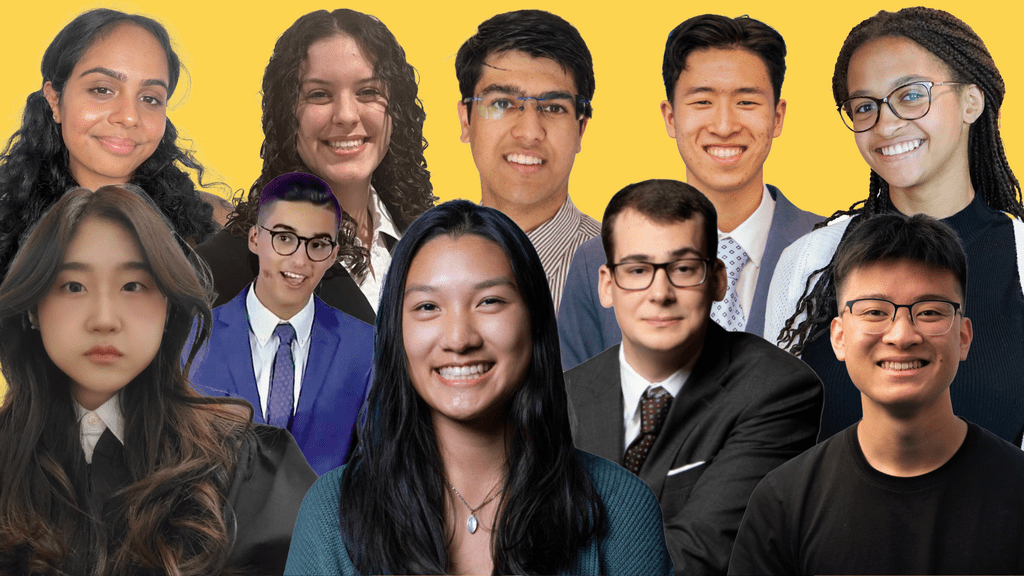
Ten exceptional students are joining the University of Waterloo this fall as Schulich Leaders, Canada’s most coveted undergraduate STEM scholarship. Selected for their entrepreneurial mindset, leadership and commitment to making a meaningful impact, these students are already tackling global challenges — from climate change and accessibility to space exploration and robotics.
Here’s how this year’s incoming cohort is shaping the future.
Melind Bhroat | Science and Business
Melind Bhroat blends entrepreneurship with a drive to solve global food insecurity. A passionate builder, he has already designed solutions ranging from a water filtration system to combat invasive algae to launching his own company producing ergonomic keyboards, addressing repetitive strain injuries among typists.
He also founded “Cookies for Cancer,” raising funds for cancer research after the loss of a teacher — an experience that shaped his commitment to community impact.
Alongside this work, he leads STEM initiatives as Engineering Club president and mentors younger students through coding outreach. Looking ahead, Bhroat envisions building a hydroponic farming business capable of producing food in extreme climates, from deserts to the Arctic.
At Waterloo, he hopes to merge science, business and innovation to create scalable solutions to one of the world’s most pressing challenges: sustainable food access.
“I am consistently driven by the belief that business and technology, when applied with commitment, can make a meaningful impact,” he says.

Anna Denisova | Computer Engineering
Anna Denisova has been writing her own path in STEM since elementary school — accelerating by taking high school courses early. Her drive continued in high school, where she founded her school’s first in-house coding competition, transforming it into an annual event that inspires collaboration and problem-solving among peers.
A leader across disciplines, Denisova balances programming and robotics with athletics, competing on her varsity basketball team while excelling academically in advanced STEM courses. As lead editor of her school newspaper, she also honed her communication skills, coordinating teams and delivering content to a wide audience.
Her interests lie in automation, robotics and quality control systems. “My goal is to create cutting-edge technologies that improve efficiency and reduce costs and waste,” she says.
Denisova aims to deepen her technical expertise at Waterloo, while continuing to build opportunities for others — combining curiosity, discipline and leadership to innovate in both engineering and community.

Angela Ho | Business and Computer Science
Angela Ho is driven by a simple idea: technology should empower people. That philosophy has guided her work as a full-stack developer, STEM instructor and founder of initiatives that expand access to learning.
During a hackathon, Ho developed AutiSpark, a literacy platform designed for individuals with autism, applying user-centered design to reduce cognitive and sensory barriers. She also founded her school’s first Women in STEM club, helping peers transform ideas into working applications and fostering an inclusive environment for innovation.
“To me, design is not decoration — it is how technology communicates with people,” she says. What I love about technology is not only that it solves problems, but that it shapes experiences.”
As a result, her work consistently connects design and functionality, ensuring that technology feels intuitive and accessible.
Ho hopes to become a startup founder building scalable digital tools that expand educational opportunities. While at Waterloo, she plans to continue bridging design and technology to create systems that help users move from confusion to confidence.

Kaumudi Jeevendra | Mechanical Engineering
For Kaumudi Jeevendra, passion is defined by action — and her work reflects that philosophy across education, writing and engineering. She has led initiatives from fundraising for children’s educational resources to redesigning her school’s outdoor spaces, demonstrating how thoughtful design can influence well-being and learning.
Jeevendra’s unique strength lies in communication. Through blogs, essays and school publications, she translates complex scientific ideas — particularly in nuclear science — into accessible narratives that spark curiosity and discussion.
Her goal is to become a nuclear engineer and advance safe, sustainable energy, while also improving public understanding of the field.
“Scientific innovation alone is not enough to create change if the public cannot trust it,” she says. “I want to use my passion for education to communicate its complexity.”
At Waterloo, Jeevendra will combine technical training with her passion for education, working to bridge the gap between innovation and society — ensuring that transformative technologies can truly make a difference.

Shiza Khan | Mechatronics Engineering
Shiza Khan approaches technology as a puzzle — one she is determined to solve piece by piece. Her curiosity spans hardware, software and systems design, from dismantling computers to building interactive projects that combine programming and game design.
She has already applied this mindset to real-world challenges. At her school, Khan launched a digital accessibility initiative to ensure students who miss announcements can still access information about clubs and opportunities. As a mentor in robotics competitions, she has guided teams to success while fostering creativity and problem-solving skills.
“As a computer enthusiast, I’m always looking to explore software outside the curriculum,” she says. “That’s why I aim to establish a company that will build global accessible spaces through software-oriented technologies.”
At Waterloo, she plans to prototype technologies that make everyday environments more inclusive — transforming barriers into opportunities through thoughtful engineering.
She’s grateful for the Schulich Leaders Scholarship as it will provide the opportunity to obtain technical feedback on her prototypes along the way from a vast network of STEM experts.

Jerry Li | Computer Science
Jerry Li is already building systems that connect people across the world. As founder of TopsOJ, a global competitive mathematics platform, he has reached users in more than 90 countries with more than 2,500 registered users, transforming what is often an isolating pursuit into a collaborative community.
A top-tier programmer and USACO Platinum competitor, Li combines technical excellence with bold vision. His work extends beyond algorithms to space innovation: as part of the Conrad Challenge, he helped develop a system to optimize astronauts’ circadian rhythms, earning recognition from industry leaders.
Li’s interests lie at the intersection of physics, software and space exploration. “I aspire to commercialize space exploration technology by founding a startup that provides AI-powered health intelligence for spacesuits,” he says.
Li plans to leverage Waterloo’s strengths in innovation and entrepreneurship to scale his technical expertise and the impact of his ideas. In 10 years, he aims to build technology that brings people together while expanding the boundaries of what’s possible.

Onna Okeke | Mechatronics Engineering
Onna Okeke has spent years turning curiosity into creation. A competitive swimmer and Olympic Trials qualifier, she pairs athletic discipline with a passion for engineering and invention.
From building early prototypes in her room to designing impactful technologies like a “fish light” to address overfishing or a phone locking system to tackle the issue of procrastination, Okeke thrives on solving real problems.
Her entrepreneurial mindset began in 2020 with 3D printing solutions for classmates and evolved into leading teams as a CEO in school-based ventures, including developing wearable technology that enables charitable donations.
“Seeing my ideas evolve into real, successful innovations is an experience I will never get tired of,” she says.
She brings creativity, resilience and a willingness to experiment — whether refining AI models, designing robots or exploring new engineering challenges.
Okeke envisions herself as a CEO-engineer developing globally impactful technologies. At Waterloo, she plans to continue building solutions that combine compassion and innovation, driven by a belief that every problem can be solved with persistence and creativity.

Noah Robinson | Electrical Engineering
For Noah Robinson, curiosity is the foundation of everything. From analyzing the plumbing systems in his childhood home to developing AI simulations, he has always been driven to understand how things work.
Robinson has applied this mindset to community impact, leading a team that won a district-wide innovation competition with a wildfire prevention solution. Using his programming skills, he built analytical tools to guide strategy and reach broader audiences.
An entrepreneur from a young age, he has launched ventures ranging from importing specialty goods to running a YouTube channel and tutoring business. Through it all, he has developed the ability to identify opportunities and act on them.
At Waterloo, Robinson plans to explore machine learning and engineering solutions that tackle real-world challenges. “At this point, what I know is that I know I want to solve real-world problems by combining my love of puzzles with helping others,” he says.

Bill Xu | Computer Science
Bill Xu is redefining what it means to be a student entrepreneur. As the grand prize winner of the Diamond Challenge, he developed a startup focused on recycling 3D printing waste.
He has also built platforms for others, co-founding PinataPitch, Montreal’s largest student-run tech competition, which connects young innovators with mentorship and funding.
Alongside entrepreneurship, Xu conducts research in machine learning, developing models in environmental science and quantum computing. He also presented at the international science and engineering fair with a solution that can map soil carbon across Canada to support environmental conservation.
Motivated by firsthand experiences, Xu is determined to use technology to advance these fields.
“In 10 years, I want to be leading a deep-tech startup that pioneers research while deploying commercial solutions,” he says.
During his time at Waterloo, he aims to integrating research and entrepreneurship in everything he pursues.

Sophia Xu | Computer Science
Sophia Xu brings together design, technology and leadership to create meaningful change. Her passion for user interface (UI) and user experience (UX) design has led her to work with startups and major organizations, including redesigning a content management system at the Royal Bank of Canada now used by more than 5,000 employees.
“That experience enabled me to meet with real users and translate their feedback into prototypes,” she says. “I saw how efficient UI/UX design could save time, reduce frustration and it genuinely excites me because it humanizes technology.”
Xu is also a national leader in student innovation. As co-director of Hack Canada, Xu led a 50-person team to organize a large-scale hackathon that brought together hundreds of participants and secured major sponsorships. Her commitment to accessibility and education is reflected in initiatives like the Cents and Sense Project, which has reached thousands of students with financial literacy resources.
While at Waterloo, she plans to continue building technology that empowers people — combining empathy, design and engineering to create systems that make a real difference.

Together, these Schulich Leaders represent the future of STEM: collaborative, creative and deeply committed to building a better world.