Research

Monday, October 26, 2020

There’s a new, faster way to train AI

by Media Relations

Researchers have developed a new method to make machine learning more efficient. 

The technique, called “less-than-one-shot learning,” can train an AI model to accurately identify more objects than the number it was trained on – a huge shift from the expensive, time-consuming process that currently requires thousands of examples of one object for an accurate identification.


Thursday, October 22, 2020

World's largest human tissue archive adopts Waterloo search system

by Brian Caldwell, Faculty of Engineering

Technology developed by engineering researchers at the University of Waterloo has been adopted by a major pathology facility in the United States.

The Joint Pathology Center (JPC), which has the world’s largest collection of preserved human tissue samples, will use an artificial intelligence (AI) search engine to index and search its digital archive as part of a modernization effort.

Environmental, Social, and Governance (ESG) scores are ratings of a company’s performance in relation to pressing societal issues such a climate change. Investors may use these scores to screen investment candidates or use them as one factor in a more integrated quantitative trading strategy. 

Most people think that investing through an ESG lens will ensure that their stock holdings are more resistant to severe losses when the market crashs, like what has happened during the COVID-19 pandemic.

Tuesday, October 20, 2020

New analysis shows a “wobble” in the ring around a black hole

by Rose Simone, Faculty of Science

When the first picture of a black hole, a gravitational well from which no light can escape, was unveiled last year, it was a stunning technological feat.

That now-famous image of the black hole known as M87* which is 55 million light years away in the Messier 87 galaxy, was the result of over a decade of work by hundreds of scientists and engineers who are part of the Event Horizon Telescope (EHT) collaboration that created an “earth-sized” telescope out of eight telescope facilities around the world.

Researchers have taken an important step in the development of a microscope to precisely guide doctors during surgery to remove brain tumors.

For the first time, a team led by engineers at the University of Waterloo used laser imaging technology to almost instantly identify cancerous tissue with accuracy comparable to laboratory tests that take up to two weeks.

That means the Photoacoustic Remote Sensing (PARS) imaging system could tell doctors where a tumor ends and healthy tissue begins so they know exactly where to cut.

Friday, October 16, 2020

Tackling mental health with tech

by Brian Caldwell, Faculty of Engineering

Work by a Waterloo Engineering alumnus to tackle mental health issues using digital technology was highlighted this week as part of a national initiative to help prepare Canadian youth for the future.

Yuri Quintana, who earned all three of his engineering degrees at Waterloo, is a professor at Harvard Medical School and chief of clinical informatics at one of its teaching hospitals.

Wednesday, October 14, 2020

Four brilliant researchers join Waterloo on fellowships

by Staff, University of Waterloo

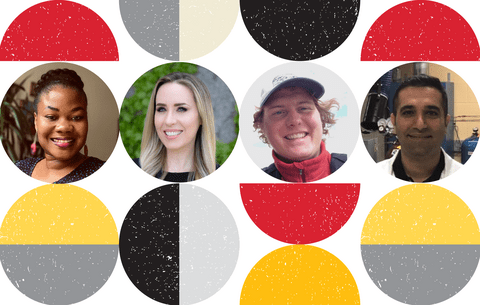
Four world-class academics pursuing research to improve society are the inaugural recipients of the AMTD Waterloo Global Talent Postdoctoral Fellowship at the University of Waterloo.
The five-year program was made possible by a generous donation from the AMTD Foundation, led by Waterloo alumnus Calvin Choi (BA ’01). 

Tuesday, October 13, 2020

Postdoctoral fellowship helps advance water treatment research

by Carol Truemner, Faculty of Engineering

Backed by a new postdoctoral program, a chemical engineering researcher will spend the next couple of years designing innovative technology to remove toxic chemicals from wastewater.