Research

Thursday, January 31, 2019

Strickland lecture highlights importance of fundamental research

by Pamela Smyth, University Relations

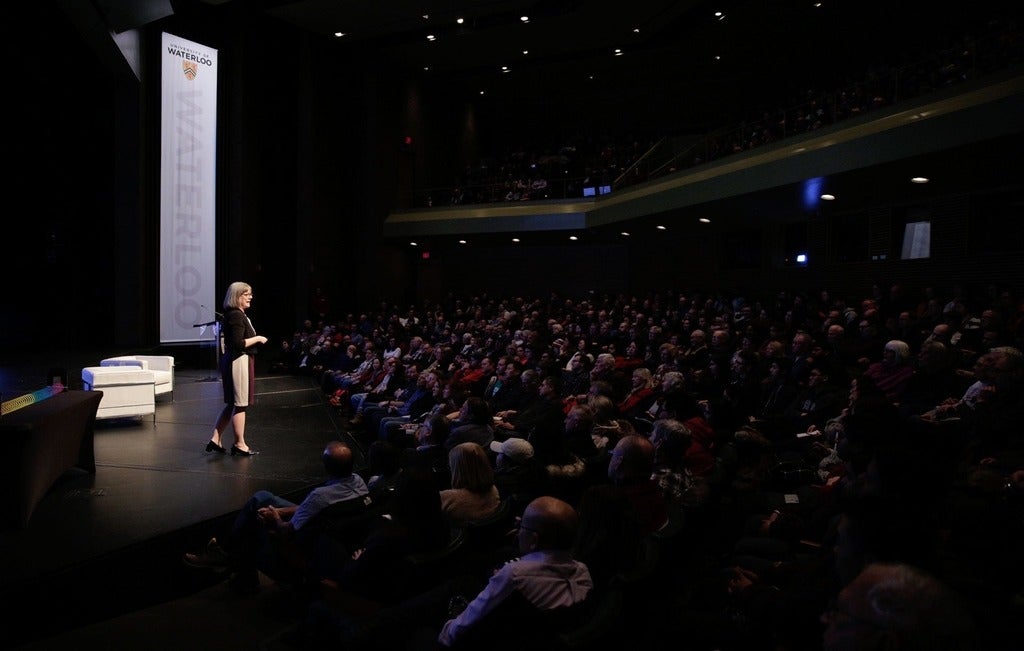
Future innovations rely on researchers doing basic science, Canada’s newest Nobel laureate told a near-capacity crowd during the President’s Lecture at the University of Waterloo.

Donna Strickland, a professor of physics at Waterloo, advocated for support of curiosity-driven research during a thought-provoking discussion with Kate Lunau, senior editor at Motherboard, VICE’s science and technology site. The fireside chat followed Strickland’s lecture.


Thursday, January 31, 2019

Hybrid electricity system would reduce rates, improve service

by Media Relations

A new distribution system designed by researchers at the University of Waterloo would reduce electricity prices by more than five per cent while also improving service reliability.

The design involves the integration of the two kinds of electric current that power homes, industries and electric vehicles - alternating current (AC) and direct current (DC).

Powerlines

Wednesday, January 30, 2019

Your body image is impacted by those around you

by Media Relations

In a new study, researchers examined how social interactions influence body image. They found that in addition to the previous findings that being around people preoccupied with their body image was detrimental, that spending time with people who were non-body focused had a positive impact.

Monday, January 28, 2019

New report sets climate tests for project assessments

by Media Relations

A new report by climate and assessment experts has developed a set of tests that could help determine whether federal projects support Canada’s commitment to the Paris Agreement. 

The Paris to Projects report was authored by experts from the universities of Waterloo, Dalhousie, Concordia as well as the Quebec Centre for Environmental Law. 

Thermometer

Monday, January 21, 2019

It's almost midnight; do you feel fine?

by Sam Toman, University Relations

According to the women and men at the Bulletin of the Atomic Scientists — the group of scientists trusted to set the Doomsday Clock — we’re two minutes away from the end of the world as we know it.

In 1947 the Doomsday Clock was established as a universal metaphor to illustrate how close we were to losing control of civilization-destroying technologies developed during and after the Second World War. Originally set at seven minutes to midnight, by 1953, the clock had ticked down to two-minutes to midnight as tensions between the Soviet Union and the United States heated up.

Monday, January 21, 2019

Pharmacists could help reduce smoking rates

by Media Relations

Enlisting the help of pharmacists could help in the quest to get people to quit smoking, according a white paper released by the University of Waterloo.

The paper details ways in which an increased role for pharmacists in the public health effort could help curb smoking rates and aim to reduce the estimated 45,000 annual deaths that occur in Canada from tobacco use.

Man Smoking

Thursday, January 17, 2019

Study identifies way for employers to retain casual workers

by Media Relations

“Managers can use job enrichment to make work more engaging and to develop a bond between staff and the organization,” says David Drewery, a PhD candidate in Waterloo’s Department of Recreation and Leisure Studies. “Job enrichment aims to design work conditions in ways that maximize meaning, responsibility and knowledge.”

The study surveyed 124 seasonal student workers who had just completed a four-month-long summer job to find out whether they intended to return the following year, and the motivations behind their intentions.