Research

Tuesday, September 4, 2018

Getting your TV to understand you better

by Media Relations

The research, in collaboration with the University of Maryland and Comcast Applied AI Research Lab, uses artificial intelligence (AI) technology to achieve the most natural speech-based interactions with TVs to date. 

“Today, we have become accustomed to talking to intelligent agents that do our bidding – from Siri on a mobile phone to Alexa at home. Why shouldn’t we be able to do the same with TVs?” asked Jimmy Lin, a professor at the University of Waterloo and David R. Cheriton Chair in the David R. Cheriton School of Computer Science. 
Tuesday, September 4, 2018

Machine learning the solution to networking problems

by Media Relations

Computers can now learn to solve networking problems for themselves, a study from the University of Waterloo has found.

“There are several challenges in computer and telecommunication networks, such as network security, network management, and traffic engineering,” said Raouf Boutaba, a professor in the David R. Cheriton School of Computer Science at Waterloo. “The use of machine learning in this context will make networks more secure, better managed, and provide a better quality of service.”

The small, tube-like device is designed to be fitted to braces after joint surgery to wirelessly send information to computers, smartphones or smartwatches to track range of motion and other indicators of improvement.

“That data would be continuously collected, so it would be as though the physician or physiotherapist was always there, always observing the patient,” said Hassan Askari, an engineering doctoral candidate at Waterloo.

In the most significant study of its kind, researchers from the University of Waterloo found that MNCs from nearly every country complied better with Canadian labour laws if their operations in Canada were unionized. 

“Unions entirely mitigate the country of origin effect,” said Chris Riddell, economics professor at the University of Waterloo and co-author of the study. “The study shows an example of how unions can play a broader role in ensuring companies comply with the law.”

Researchers at the University of Waterloo have reached an important milestone by logging their 100th kilometre on public roads in a self-driving car.

Achieved last week in an industrial area of Waterloo, it is the culmination of almost two years of work since the research team won approval from the Ontario government to do on-road testing in an autonomous vehicle pilot program.

Friday, August 24, 2018

AI technology rapidly analyzes water samples

by Brian Caldwell, Faculty of Engineering

Progress on new artificial intelligence (AI) technology by Waterloo Engineering researchers could improve monitoring at treatment plants to help ensure clean water and safeguard public health.

The researchers have developed AI software capable of identifying and quantifying different kinds of cyanobacteria, or blue-green algae, a threat to completely shut down water systems when it suddenly proliferates.

Chemists from the University of Waterloo have successfully resolved two of the most challenging issues surrounding lithium-oxygen batteries, and in the process created a working battery with near 100 per cent coulombic efficiency.

The new work, which appears this week in Science, proves that four-electron conversion for lithium-oxygen electrochemistry is highly reversible. The team is the first to achieve four-electron conversion, which doubles the electron storage of lithium-oxygen, also known as lithium-air, batteries.

The winners, called Schulich Leaders, receive between $80,000 and $100,000 towards their university education. UWaterloo’s high number of interested and qualifying students for these prestigious awards mean the University is one of only five across Canada to award four scholarships instead of the usual two. 

Friday, August 17, 2018

Reducing the time to diagnose and treat patients

by Megan Vander Woude, Faculty of Engineering

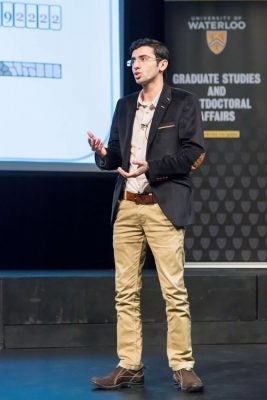
Seyed Hossein Mirjahanmardi talking on stage
Waterloo researchers in the Advanced Concepts Research Lab are developing a new method for medical imaging that could reduce the time to diagnosis.