Research

Wednesday, November 20, 2024

Charge your phone just by moving your body

by Media relations

A new technology that can generate electricity from vibrations or even small body movements means you could charge your laptop by typing or power your smartphone’s battery on your morning run. 

Researchers at the University of Waterloo have developed a tiny, wearable generator in response to the urgent need for sustainable, clean energy. It is also scalable for larger machines. 

Wednesday, November 20, 2024

12 Waterloo researchers among the most influential in the world

by University Relations

Twelve University of Waterloo researchers have been named on the annual Highly Cited Researchers™ 2024 list from Clarivate. The list identifies individual researchers and scientists who have demonstrated significant and broad influence in their fields of research.  

Researchers named on the Highly Cited Researchers™ list are those whose publications rank in the top 1 per cent of citations from an international and wide-ranging network of citing authors.  

Thursday, November 14, 2024

Nine Waterloo researchers awarded $7.5 million

by University Relations

Nine researchers at the University of Waterloo have been awarded $7.5 million in funding to support their research as part of the illustrious Canada Research Chairs (CRC) program.  

Each year, the CRC program invests up to $311 million to attract and retain some of the world’s most accomplished and promising minds.  

Friday, November 8, 2024

From small lab to global additive manufacturing powerhouse

by Darren McAlmont, University Relations

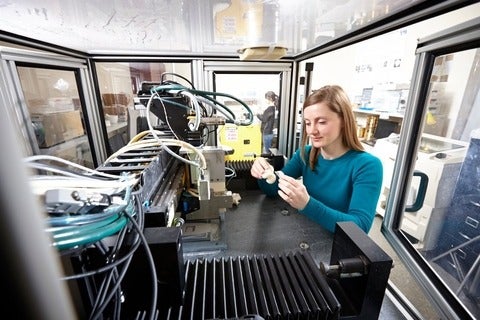
In 2004, the Multi-Scale Additive Manufacturing (MSAM) Lab at the University of Waterloo was a small, 150 square foot, windowless space. Today, it has expanded to become the largest metal additive manufacturing (AM) academic research lab in Canada, with more than $25 million in infrastructure, and is one of the most comprehensive university-based metal AM facilities globally.  

Friday, November 8, 2024

Waterloo quantum tech launches into space aboard SpaceX flight

by Naomi Grosman, Institute for Quantum Computing

A photon detector module designed, assembled and programmed at University of Waterloo’s Institute for Quantum Computing (IQC) launched into space earlier this week aboard a SpaceX flight and will soon arrive at the International Space Station. It will be used for quantum entanglement science experiments as part of the Space Entanglement and Annealing Quantum Experiment (SEAQUE) implemented by an international consortium under leadership from the University of Illinois Urbana-Champaign.