Research

Friday, April 12, 2024

IQC is an international destination for quantum innovation

by Elizabeth Kleisath, Institute for Quantum Computing

Canada’s National Quantum Strategy, released last year, identified quantum science as having “the potential to transform how people work and live.”  

Since the discovery and inception of quantum mechanics more than 100 years ago, this field has been disrupting our understanding of the universe and igniting new technologies. Without past advances in quantum information, many technologies used today would not exist, including lasers, GPS maps and hospital MRI machines. 
Thursday, April 11, 2024

Cosmic rays, quantum bits and underground labs intersect to advance the future of computing

by Elizabeth Kleisath, Institute for Quantum Computing

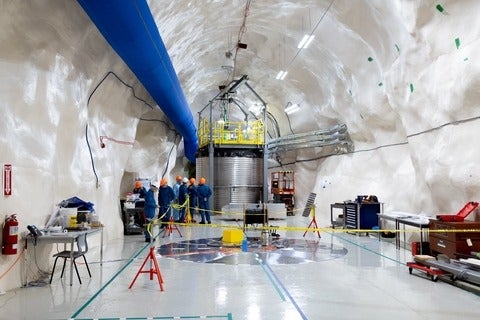
A new collaboration between researchers from the Institute for Quantum Computing (IQC) at the University of Waterloo, SNOLAB near Sudbury, Ontario, and Chalmers University of Technology in Sweden has been awarded a new grant to investigate the impact of radiation and cosmic rays on quantum technologies.

Thursday, April 11, 2024

How to have a more natural conversation with a robot

by Media Relations

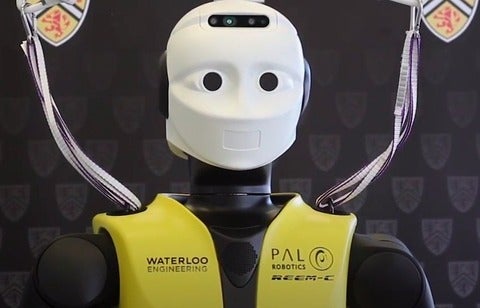
Talking to a robot often feels stilted or delayed, thanks to computer software trying to keep up with the conversation. However, new research from the University of Waterloo has improved the ability for humans to communicate naturally with humanoid robots.

Waterloo researchers were able to solve how a humanoid robot can identify the direction where human speech was coming from, re-orient itself to track that voice to create a more realistic conversation and speed up its reaction time to communicate back with its human counterpart.

Nasal-administered naloxone is cost-effective and could help reduce the number of opioid-related fatalities compared to the current publicly funded intramuscular version, a new study has found.

Since 2016, Canada's opioid crisis has worsened, with over 40,000 opioid-related deaths, or about 22 deaths per day. Most of these accidental deaths (88 per cent) occur in British Columbia, Alberta and Ontario.

Monday, April 8, 2024

$10 million alumni commitment supports prosperous cities of the future

by Jennifer Ferguson, Office of Advancement

For Frank Cairo (BES ’05), investing in new approaches to planning and building cities isn’t a choice — it’s a necessity.

“We're facing complex challenges. From the rising cost of housing to aging infrastructure and environmental impact. We need new thinking, across a variety of disciplines to tackle these problems through innovation and the scientific method.”

Thursday, April 4, 2024

Waterloo receives landmark $10 million donation to build prosperous future cities

by Darren McAlmont, University Relations

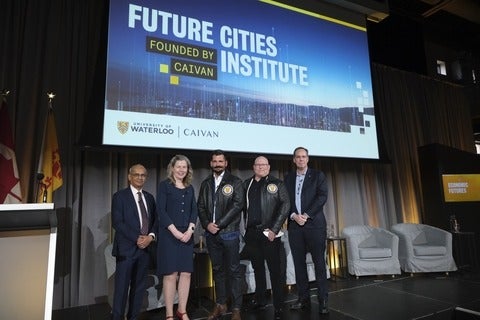
Thanks to a transformational $10 million donation from Caivan Group (Caivan), one of Canada’s leading real estate developers, co-founded by Waterloo alumni Frank Cairo (BES ’05) and Troy van Haastrecht (BASc ’93), the University has embarked on a bold new mission to create healthier, more prosperous cities with the launch of the Future Cities Institute founded by CAIVAN (FCI).  

Wednesday, April 3, 2024

Antarctic expedition collects more than scientific data

by Faculty of Arts

Research activity often includes social and instructional interactions, especially when researchers and students from multiple disciplines collaborate on a project. But the experiential knowledge generated by these interactions is typically unmentioned in published scientific findings, says Dr. Götz Hoeppe, an associate professor of anthropology with cross-appointment to sociology and legal studies:

Wednesday, April 3, 2024

Leading minds join forces to future-proof cities

by University Relations

The University of Waterloo and Ontario land development and homebuilding company The Caivan Group (Caivan) are launching the Future Cities Institute (FCI) thanks to a transformational $10-million commitment from Caivan. The Institute will bring together some of the top minds in the country and provide the resources they need to tackle the greatest challenges facing urban spaces now, and in the future.