Research

The first Tourism and Climate Change Stocktake report has been released by the Tourism Panel on Climate Change (TPCC) timed with the UN COP-28 Climate Conference. Its 24 key findings aim to support policymakers and the tourism industry in accelerating planning and investment toward low-carbon and climate-resilient global tourism.


Thursday, December 7, 2023

Is Alexa sexist? In short, yes

by Media Relations

University of Waterloo professor and Canada Research Chair in Technology and Social Change Dr. Lai-Tze Fan analyzed hundreds of Amazon’s virtual assistant Alexa’s voice-driven skills. Dr. Fan’s goal was to better understand how the encoded technology mirrors and reinforces traditionally feminized labour and sociocultural expectations.

Thursday, December 7, 2023

Waterloo is Canada’s top comprehensive research university

by Angelica Marie Sanchez, University Relations

The University of Waterloo has been designated Research University of the Year in the comprehensive category by Research Infosource Inc. for the 16th consecutive year. Waterloo’s consistent ranking stands as a testament to the University being at the forefront of fostering the next generation of researchers and entrepreneurs. 

Wednesday, December 6, 2023

Celebrating five years of the Waterloo Centre for Astrophysics

by Katie McQuaid, Faculty of Science

For the past five years, the Waterloo Centre for Astrophysics (WCA) has created a research-rich atmosphere where the sky is (literally) the limit. Thanks to a generous donation by Mike Lazaridis, which enables a Distinguished Research Chair in Astrophysics, the centre has become an exciting hub of activity nestled in the physics building at the University of Waterloo.

Terrorist attacks and mass shootings are devastating for the people and communities they affect. These events impact our society in many ways, including perhaps unexpectedly, by changing how big companies calculate and report their earnings.

A recent study by Professor Seda Oz from the School of Accounting and Finance at the University of Waterloo explains why.

Tuesday, December 5, 2023

Using AI to find microplastics

by Media Relations

An interdisciplinary research team from the University of Waterloo is using artificial intelligence (AI) to identify microplastics faster and more accurately than ever before.

Microplastics are commonly found in food and are dangerous pollutants that cause severe environmental damage – finding them is the key to getting rid of them.

The research team’s advanced imaging identification system could help wastewater treatment plants and food production industries make informed decisions to mitigate the potential impact of microplastics on the environment and human health.

Monday, December 4, 2023

Transforming CO2 into valuable products

by Nicola Kelly, Faculty of Engineering

An interdisciplinary research team from the University of Waterloo aims to tackle CO2 emissions in the value chain by transforming CO2 into valuable chemicals needed by industry.  

Supported by BMO, the research focuses on the use of green hydrogen to capture CO2 from power plants as well as the iron, steel, and cement industries, and convert it into useful gases via reverse water gas shift reaction.  

Wednesday, November 29, 2023

New method can detect early-stage breast cancer in two minutes

by Media Relations

University of Waterloo researchers are pioneering a method to detect breast cancer in women early enough for them to receive life-saving treatment.

The innovative technology aims to be more accurate as well as cheaper to provide than today’s most common diagnostic tools such as X-ray mammography, ultrasound and magnetic resonance imaging (MRI). Test runs have been completed in two minutes and used less energy than a smartphone. It would also be safer than X-rays, which expose patients to high-level radiation that can damage DNA and cause cancer.

Wednesday, November 29, 2023

Researching the cutting edge of 5G network slicing technology

by Jordan Flemming, University Relations

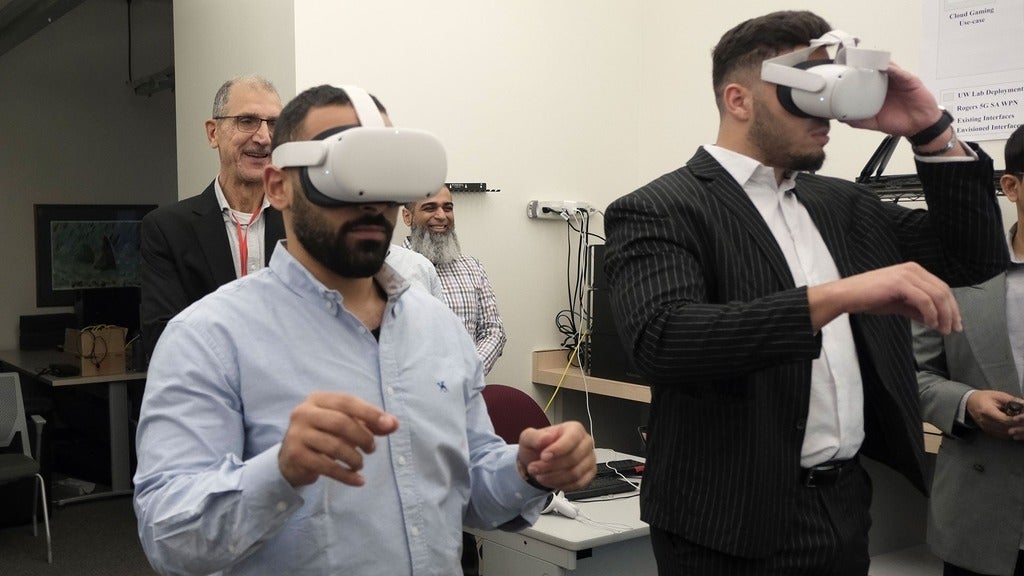
The emergence of 5G technology is transforming telecommunications, granting people and industry remarkable capabilities. With research advancements, in the future we could see 5G offer speeds of up to 20 gigabits per second — it far surpasses 4G. This speed not only enables lightning-fast downloads, its low latency, as low as 1 millisecond, is ideal for real-time applications like remote surgery and augmented or virtual reality. 5G's ability to connect up to 1 million devices per square kilometer is also accelerating the development of the Internet of Things (IoT).