Why Remembrance Day matters
University of Waterloo historians are helping students move beyond ceremony to understand the people, sacrifices and stories behind Canada's military past
Every year, Canadians pause on November 11th to observe a moment of silence, wear a poppy and attend ceremonies in communities across the country. But for Dr. Geoffrey Hayes, a military historian at the University of Waterloo, Remembrance Day is more than a national ritual. It is an opportunity to examine how history, memory and identity continue to shape Canadian society.
"It's a great teaching moment," says Hayes, who studies military history and remembrance. This year, he plans to take students from his fourth-year seminar to local sites of remembrance, including cenotaphs and cemeteries, to explore not only the history they commemorate but also the cultural meanings they carry today.
As geopolitical tensions and armed conflicts continue to dominate headlines, Hayes believes Canadians need to engage thoughtfully with the past.
"We need to develop collective, informed memory because new groups of people are wanting to understand this stuff," he says. "It's still a powerful way in which it links families, nationalities and ethnic communities. It's how so many people understand what we do as a country."
That idea of informed memory is central to the work being done by historians at Waterloo. While Remembrance Day ceremonies provide an important opportunity for reflection, Hayes argues that understanding the past requires looking beyond symbols and familiar narratives.
"Our relationship with the past continually shifts," he says. "What I always find fascinating is the ongoing conversation about who gets included in remembrance."
At Waterloo, students engage directly with that history through the University's archives and special collections, where they examine photographs, letters, scrapbooks, military records and other artifacts that reveal how war shaped local communities and individual families.
"We've got a wonderful collection of local material," Hayes says. "The numbers of things that the library has acquired over the years really do give us a neat sense of how both wars were such a powerful driver in so many respects."
For many students, that research becomes deeply personal. Waterloo students have also travelled to former battlefields, cemeteries and memorials on the Western Front (in Europe), connecting stories preserved in the archives to the places where they unfolded. For some, those journeys reveal family connections stretching back generations.
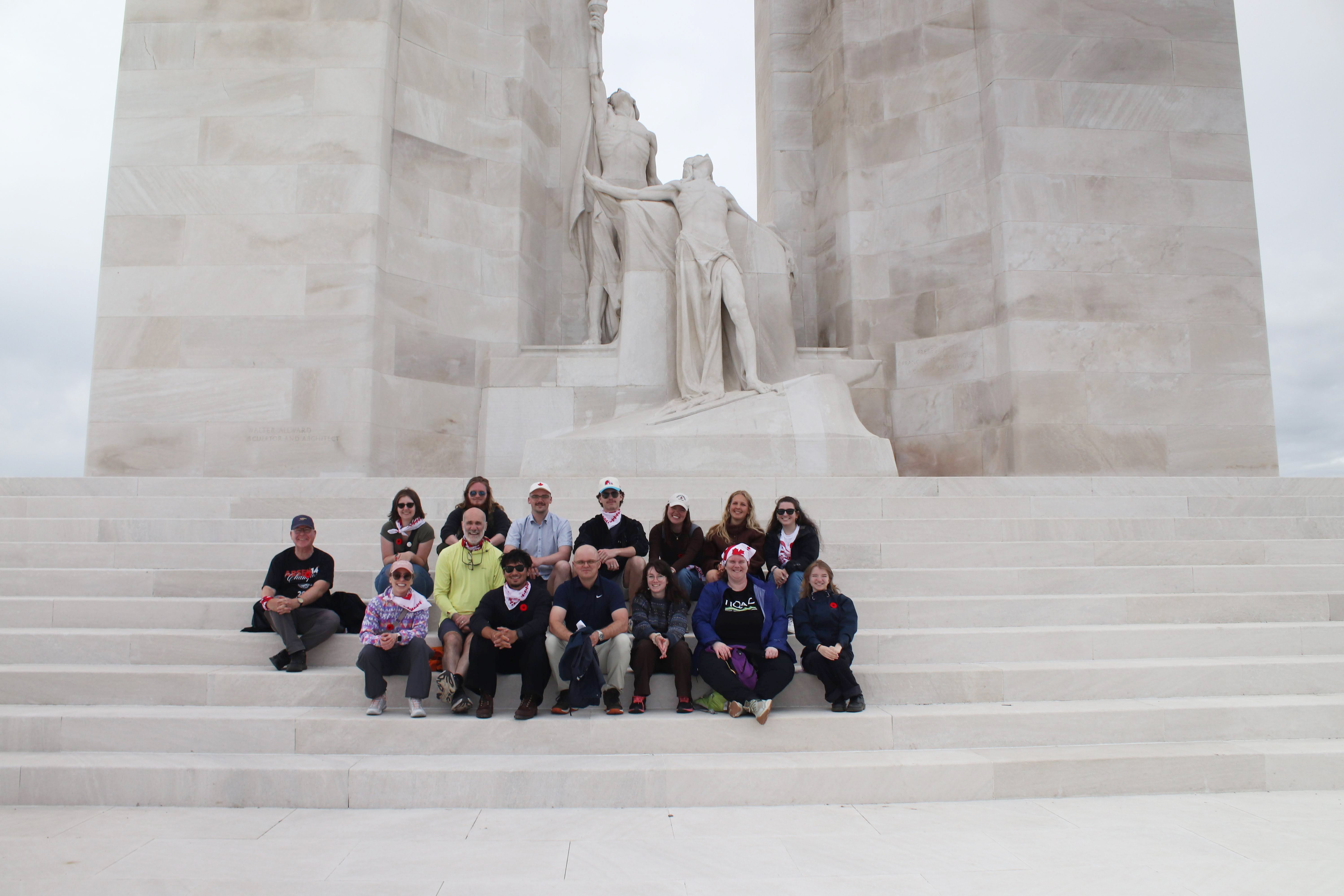
"We've often taken students who have a relative somewhere buried along the way, First or Second World War," says Hayes. "It does become very emotional. It's as if the disruption of the war has disrupted their family."
The research can have a similar impact closer to home. Hayes recalls reviewing wartime scrapbooks assembled by local families, records that preserve the hopes, fears and losses experienced during times of conflict. Looking through those pages, he found himself emotional as he reflected on the lives behind the documents and the sacrifices they represent.
Those experiences help transform historical events from dates and statistics into stories about real people. More than 60,000 Canadians died during the First World War, but Hayes believes the numbers only tell part of the story. Behind every casualty was a family, a community and a life interrupted.
Despite decades of scholarship, there is still an enormous amount of research to be done, particularly at the local and personal level. Letters, photographs, scrapbooks and archival records continue to reveal new insights into how Canadians experienced war, loss and remembrance.
For Hayes, Remembrance Day is not about glorifying war. Instead, it is about understanding the human cost of conflict and preserving stories that might otherwise be lost.
"I'm a historian. I want to know what happened and why," he says.
At the University of Waterloo, that work continues through research, teaching and hands-on learning opportunities that help students connect individual stories to broader historical events. As new generations seek to understand Canada's military past, Hayes believes there is still much to discover.
"There are so many layers, there are so many points of entry into this whole discussion," he says. "We've had lots of good students, lots of really good professors, and this has been a really strong area for us for a long time. I hope it continues."