Alex Petric, Dawn C. Parker, Sean Geobey, and Kirsten Wright
Executive summary
Waterloo Region has experienced spikes in population and housing construction, but housing costs have continued to rise. We analyzed public data to compare spatial distributions of population and housing growth over time, and to assess how the housing crisis affects housing suitability—a rough metric for overcrowding. We found that, despite significant housing growth, the Region’s downtown areas have added even more population, creating localized housing shortfalls. We observed a spike in high-rise apartment construction which has since declined, alongside a continual growth in lower-rise apartments. Our analysis also shows disparities in housing outcomes for visible minorities and recent immigrants, who disproportionately experience unsuitable housing. We propose municipal policy options like moderate intensification in zoning, unit mix requirements, equity indicators in land and housing needs assessments, and regional inclusionary zoning as ways to identify and address housing needs.
Key findings
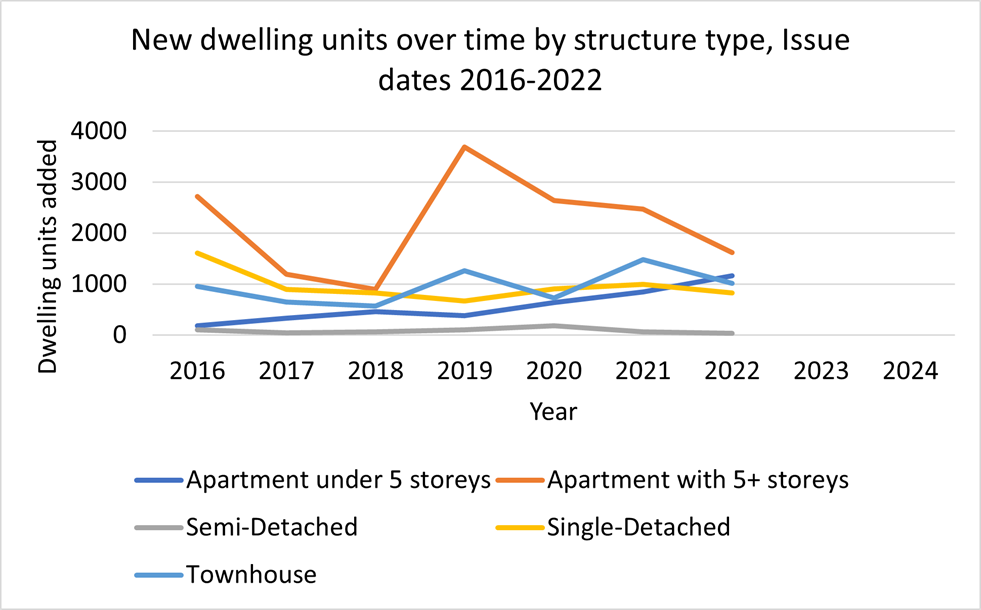
Supply has shifted and spiked, but it appears to be slowing
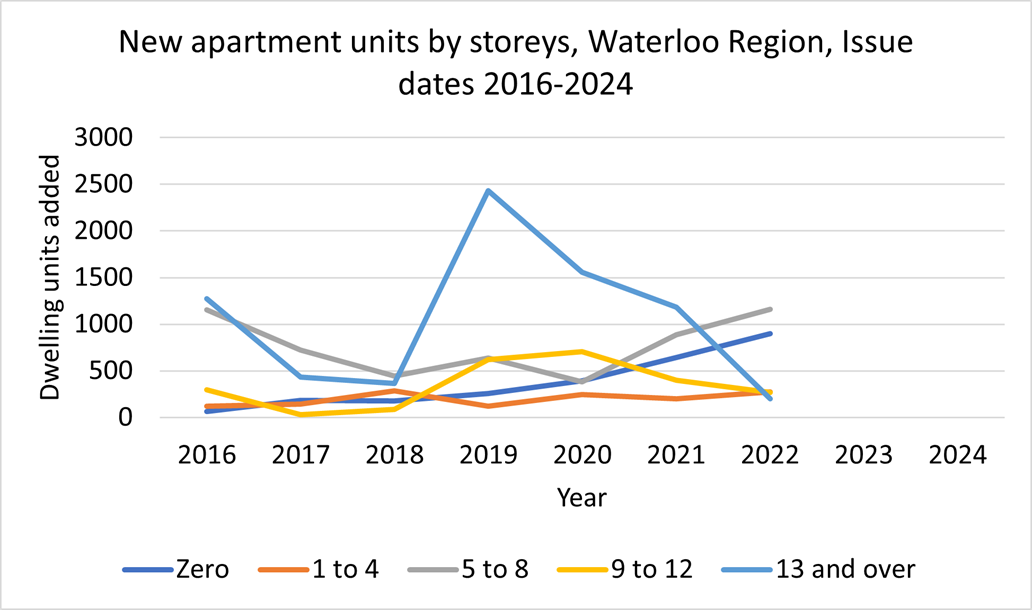
Incentive programs drove apartment building permit approvals to a peak in 2019, fuelled mostly by buildings 13 storeys and taller. However, new apartment approvals declined in following years, raising concern about housing supply as the Region continues to grow. Apartments under 9 storeys still showed positive trends at the end of the study period, and townhouses have grown as a component of the Region’s housing supply.
Waterloo Region needs larger units, not just more housing
Population growth exceeded the pace of construction in many parts of the Region around the Central Transit Corridor anchored by the ION light rail. This growth suggests a need for more housing overall to accommodate a growing population. However, we also find that unit mix is a key factor: Nearly 1 in 10 households in 1- and 2-bedroom units are in unsuitable housing that lack appropriate space, with extended families and one-parent families particularly impacted.
Visible minorities and immigrants are at higher risks for unsuitable housing
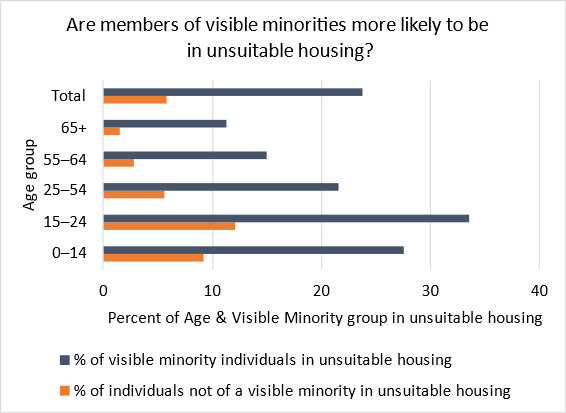
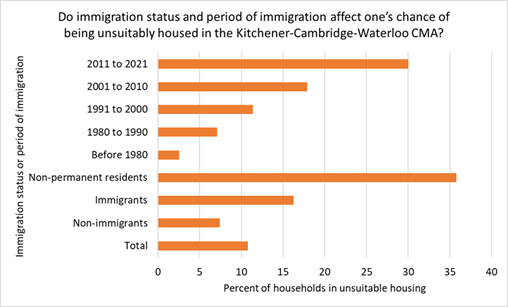
Members of visible minorities are far more likely than persons not of a visible minority to live in unsuitable housing, particularly among residents under 25 years of age. 62% of the Region’s unsuitably housed population belongs to a visible minority, despite only 30% of the Region’s population belonging to a visible minority. Immigrants are also more likely to live in unsuitable housing, and the likelihood of this outcome is higher for more recent immigrants, with 30% of immigrants arriving in 2011–2021 living in unsuitable housing.
Broader factors may drive housing mismatches
By comparing statistics on unsuitable housing, Core Housing Need, and shelter-cost-to-income ratios, we find that renters with lower housing costs are far more likely to live in unsuitable housing, but that they often could find affordable, suitable housing. This contradiction suggests that residents tolerate cramped housing to save income, or that they remain in place for other benefits, like transit, a rent-controlled unit, social connections, or familiarity.
Conclusions and policy implications
The housing system in a fast-growing region like Waterloo Region requires foresight and planning to meet the population’s shifting needs. We propose several policy ideas, including:
- Streamlining development applications to prioritize medium-density development, as it appears financially viable, supporting of larger units, and environmentally beneficial.
- Zoning for slower intensification via missing-middle housing, to prevent land value spikes.
- Requirements on unit mix to ensure that new supply accommodates larger households.
- A provincial requirement for municipalities to include housing suitability and equity metrics in land and housing needs assessments, similar to the Federal Housing Needs Assessment Template and to British Columbia’s approach.
- An inclusionary zoning policy covering all of Waterloo Region, to avoid having local regulations push investment and construction elsewhere.
Learn more: