Dawn Cassandra Parker, Shahab Valaei Sharif, and Kaitlin Webber
Executive summary
Missing Middle (MM) housing–low- to medium-density housing suitable for larger families–is critical for addressing housing affordability and transit-oriented neighbourhood density. However, its production has been declining across North America. We investigated the paradox of a residential building boom coinciding with decreasing housing affordability along a new light-rail transit line in the Region of Waterloo, Canada. In 2019, the Region launched the ION light-rail transit (LRT) network with the goal to moving people and intensifying urban cores. While the intensification goal succeeded—generating more than CAD 4 billion in new building investments in the Central Transit Corridor since 2011—the new buildings were almost all high-rise residential towers developments, and local housing prices increased steeply with these builds. Through participatory research, data narratives, and semi-structured interviews with planners and real estate stakeholders, we used a systems-thinking approach to identify complex barriers to MM housing. Our research demonstrates that the market dynamics that have created LRT-driven “land-value uplift”--increasing land prices associated with the planned LRT have led to a self-reinforcing "lock-in" of high-density builds while actively locking out family-sized missing middle housing..
Key findings
Latent Demand is Evident but Unmet
Market research over ten years showed strong demand for MM housing from diverse groups, including young professionals, families, and downsizing seniors. Surveys indicate renters ideally seek units between 1,000 and 1,500 square feet. Despite a 40% rent premium for new three-bedroom units over existing ones, units with three or more bedrooms made up only 6.0% of new purpose-built rentals in 2020. To genuinely appeal to these buyers, apartments must offer the right "bundle of attributes," specifically combining sufficient bedrooms with access to private or high-quality public greenspace.
Developer Skepticism and Financing Barriers
At the time of this research, many developers expressed a "wait and see" approach, expressing doubt that buyers would pay a premium price for a three-bedroom condo when suburban townhomes were perceived as being an alternative choice. Furthermore, developers explained that project financing presents a massive hurdle; lenders require developers to pre-sell up to 80% of units and demonstrate a potential internal rate of return of at least 10% to secure capital. However, the typical gap of at least three years between pre-sales and occupancy deters family buyers, who often have immediate housing needs.
Investor Preferences and Rent Control Dynamics
The condominium market relies heavily on pre-build investors, who generally avoided purchasing family-sized units. While no reasons were stated for this preference, it’s possible that investors might perceive that renting to families with children could cause more wear and tear. Additionally, because small families might stay in a three-bedroom unit indefinitely, as investors are restricted by rent regulations that limit annual rent increases, they may prefer more turnover. Consequently, investors may prefer smaller units with frequent turnover to rapidly raise rents, or may they prefer keeping units empty to easily liquidate them in volatile markets.
Land-Value Uplift and "Tall and Sprawl" Lock-in
We argue that the plan for light rail, along with station area plans that envisioned high-rise builds, created strong expectations of highly profitable high-density development. More specifically, planning changes created latent demand from potential residents seeking transit-oriented developments and improved accessibility. Investors and developers anticipated that this latent demand would be supported by planning changes, which signaled a favourable assessment of the profitability of high-rise developments, thus leading to increased investment and supply of high-rise small-unit housing stock. The demand from new residents encouraged positive price expectations by investors and developers, which reinforced additional supply of high-rise builds. While the expectation of rising prices caused a "land-value uplift," as long as there was investor or resident uptake of housing units, this dynamic created a self-reinforcing lock-in of the high-rise development.
Despite the increased supply of small-unit high-rise buildings, latent demand from larger families remains unmet. While new planning changes signal MM builds, we argue that without strong evidence of existing demand and profitability, developers and investors may not perceive the latent demand for MM housing, and therefore, planning changes will prove ineffective in encouraging the needed new supply to meet the latent demand for MM housing. With no MM supply of the product, latent demand will not be revealed, locking out new MM housing supply.
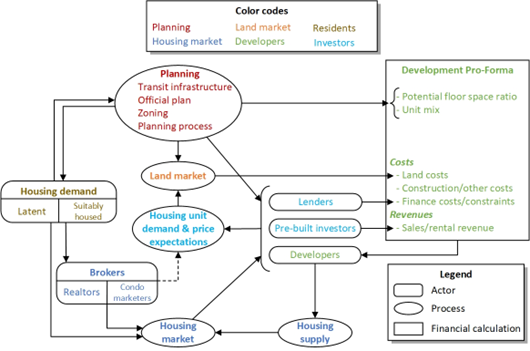
Figure 1. A qualitative systems map representing developers’ decision-making context: actors, processes, and calculations by shape, and actor realm by colour; dashed line represents incomplete information flow. See the explainer video referenced in the full article describing how the interaction between system elements leads to “lock-in” of high-rise high-density and “lock-out” of MM builds.
Conclusion and Policy Implications
To overcome the systemic barriers locking out MM housing, we argue that policymakers should implement a coordinated suite of planning and financial interventions., including:
Planners should strictly enforce low-to-midrise rise zoning in targeted areas to curb speculative land-value uplift.
Municipalities can simplify the approvals process by permitting multiple units on residential parcels as-of-right and establishing easily approved, standardized architectural typologies for MM builds--and both have happened since the article was published, including many cities allowing 4 units on any residential parcel, and the creation of the Federal Housing Catalogue and BC Housing Catalogue.
To address restrictive financing and investor bias against family-sized units, governments can provide non-profit financing, facilitate co-op developments, and enable municipal or non-profit pre-purchases of three-bedroom condos to meet lender pre-sale requirements.
Finally, implementing strict unit-mix requirements that mandate family-sized units with adequate greenspace, alongside supporting MM demonstration projects to prove market viability, can help correct these market failures and catalyze the supply of suitable, affordable housing.
Want to learn more?
Read the full text of the paper.
Citation
Parker, D. C., Valaei Sharif, S., & Webber, K. (2023). Why did the “missing middle” miss the train? An actors-in-systems exploration of barriers to intensified family housing in Waterloo region, Canada. Land, 12(2), 434. https://doi.org/10.3390/land12020434.