Chemistry and Inuit Life and Culture
Fall 2022 Special Edition, Chem 13 News Magazine
On behalf of the University of Waterloo Chemistry Department, I am pleased to present this special issue of Chem 13 News on the intersection of Inuit Life and Culture with Science and Chemistry. We have collected and curated the wonderful contributions of Chaim Christiana Andersen, Rosalina Naqitarvik and Prof. Geoff Rayner-Canham over the last several years in a single edition, to promote and present them in a coordinated form, for the benefit of all who want to learn more about the Northern lands, peoples and ways of life through a scientific lens provided by the Inuit themselves. We hope this strengthens both knowledge and appreciation for the innovation, tremendous respect and care with which the Inuit inhabit their climate – a climate that is both seemingly difficult for many of us, and, more worryingly, increasingly under threat.
It is through this new perspective I have enjoyed taking in these articles, and a journey I hope each of you will share as well.
- Professor Bill Power, Department of Chemistry, Faculty of Science
Table of Contents
- Territorial Acknowledgement
- An Inuit Introduction: Inuit Nunangat (homelands)
- Languages and dialects of the Inuit
- How it came about
- Ramah Bay: 7,000 years of Indigenous culture – and chemistry
- Soy Sauce: An essential Inuit condiment
- PFOS: The newest Arctic pollutant
- Sea Ice: Essential for northern survival
- The Ulu: Chemistry and Inuit women’s culture
- Chemistry of the Cure: Case studies of some Inuit remedies
- The Arctic Atmosphere: Unique and amazing
- Snow: Making life possible in the Arctic
- Living on the Edge: Some chemistry of the Inuit diet
- Composites in Inuit Life: What was old is new again
- The Land Beneath our Feet: Inuit rock of ages
- Climate Change: Our way of life will change, our culture will survive
- Acknowledgements
Territorial Acknowledgment
This special issue of Chem 13 News aims to bring light to the chemistry behind the traditional knowledge of the Inuit People. Not included in the Indian Act, the Inuit People hold a separate legal status in Canada from First Nations and we acknowledge their importance in Canada’s history.

Inuit Tapiriit Kanatami (Inuktitut meaning “Inuit are united in Canada”) is a non-profit organization that represents over 65,000 Inuit across the four constituent regions of Inuit Nunangat (homelands): Nunavut, Nunatsiavut1, Nunavik, Inuvialuit, and the rest of Canada.
Nunavut was established as a Territory in 1999 after a decision from the Nunavut Land Claims Agreement Act allowed the Inuit people the ability to self-govern.
Nunatsiavut land claim agreement of 2005 provided for the establishment of the Government of Nunatsiavut to represent the residents of the land claim area and any Labrador Inuit living elsewhere in Canada.
Nunavik is part of the administrative region of Nord-du-Québec. The James Bay and Northern Quebec Agreement of 1978 led to greater political autonomy for most of the Nunavik region with the founding of the Kativik Regional Government.
Inuvialuit Settlement Region, located in Canada’s western Arctic, was designated in 1984 in the Inuvialuit Final Agreement by the Government of Canada for the Inuvialuit people.
NunatuKavut is a currently-unrecognized Inuit territory in Labrador which encompasses Southern Labrador.
Chem 13 News also acknowledges the traditional Mi’kmaq territory of the Qalipu First Nation on which the Grenfell Campus of Memorial University is situated. Newfoundland and Labrador are located in the traditional territory of the Beothuk, Mi’kmaq, Inuit, and Innu People.
Chem 13 News is headquartered at the University of Waterloo’s main campus. The University of Waterloo is located on the Haldimand Tract, land granted in a legally binding treaty to the Six Nations, and within the traditional territories of the Neutral, Anishinaabeg and Haudenosaunee Peoples.
As our issue is being distributed across Canada in recognition of the Second National Day for Truth and Reconciliation, we encourage each of our readers to learn about the local history of the land they live and work on. Reconciliation is a continuous process and requires all Canadian citizens to be invested in repairing the harms of colonization.
References
1 https://en.wikipedia.org/wiki/Inuit_Tapiriit_Kanatami - cite_note-1
An Inuit Introduction: Inuit Nunangat (homelands)
In order to appreciate this compilation, it helps to have a knowledge of the names and locations of Inuit Nunangat (homelands) in Canada.
They comprise over 35 per cent of Canada’s land-mass. The map here shows the names of the different homelands: Nunavut, a territory itself; Nunatsiavut, northern Labrador; Nunavik, northern Québec; and Inuvialuit; northern parts of the Northwest Territories and Yukon. In addition, the southern coastal settlements of Labrador, NunatuKavut, are Inuit-claimed lands.


Languages and dialects of the Inuit
Included in the discussions of the Chemistry of Inuit Life and Culture are some of the Inuit terms. To appreciate any culture, it is important to know a little about the language. The language of Inuit peoples, from northern Alaska, across northern Canada, to Greenland, is unique and has no resemblance to any other language. As you can imagine, spread over thousands of kilometres and over thousands of years, the oral language differentiated regionally into different constituent languages. In Canada, Inuktitut is spoken throughout much of Nunavut and Nunavik, though Inuktitut is not unitary but has several regional dialects. Inuttut, a dialect, is spoken in Nunatsiavut, while Inuinnaqtun, a significantly different language, is spoken in western Nunavut.
In these articles, you will encounter singular and plural terms. For example:
- INUK one Inuit person
- INUUK two Inuit persons
- INUIT three or more Inuit persons
In English, we use adjectives to define a noun more precisely (such as light rain, heavy rain, torrential rain, etc.). In the Inuit languages, the way to provide more information is to add-on to the end of the word – hence, making some extremely long words at times!
Some words are common across Inuit lands. For example, a woman’s knife is called an ulu (plural: uluit) from Alaska to Greenland (see “The Ulu: Chemistry and Inuit women’s culture” – article five). By contrast, the term for aurora is called: atsanik (Inuttut); aqsarniit (Inuktitut); or akhaliak (Inuinnaqtun) (see “The Arctic atmosphere: Unique and amazing” – article seven). We, the authors, hope that as you learn of the links between chemistry and Inuit life, you will also come to appreciate the fascinating and unique language of the Inuit peoples.
The languages of the Inuuk co-authors
Chaim Christiana Andersen lives in Nunainguk (Nain), Nunatsiavut, where Inuttut is spoken. German missionaries settled there and developed written Inuttut using the European alphabet. Thus, the terms she uses in her co-authored articles reflects this background.
Rosalina Naqitarvik comes from Ikpiarjuk - ᐃᒃᐱᐊᕐᔪᒃ (Arctic Bay), northern Baffin Island, Nunavut, which has its own unique dialect called Iglulingmiut. The missionaries arriving in eastern Nunavut came from southern Canada. There, they had devised a syllabic written form of the Cree language. These missionaries used the same syllabic set for a written form of Inuktitut. Thus, Inuktitut can be written in both syllabics and in the European alphabet.
How It Came About: The Chemistry and Inuit Life and Culture series backstory
By Geoff Rayner-Canham, Professor Emeritus, Memorial University
How did this compilation on Chemistry and Inuit Life and Culture come to be? A good question! And one which provides important context. This author, Geoff Rayner-Canham, is Professor Emeritus at the Grenfell Campus of Memorial University, Corner Brook, Newfoundland. A significant concern of mine is that, in my view, chemistry is so much more interesting than the endless mole calculations of conventional chemistry courses. I therefore developed a set of household chemistry demonstrations and experiments to take to grade schools across Labrador and western Newfoundland.
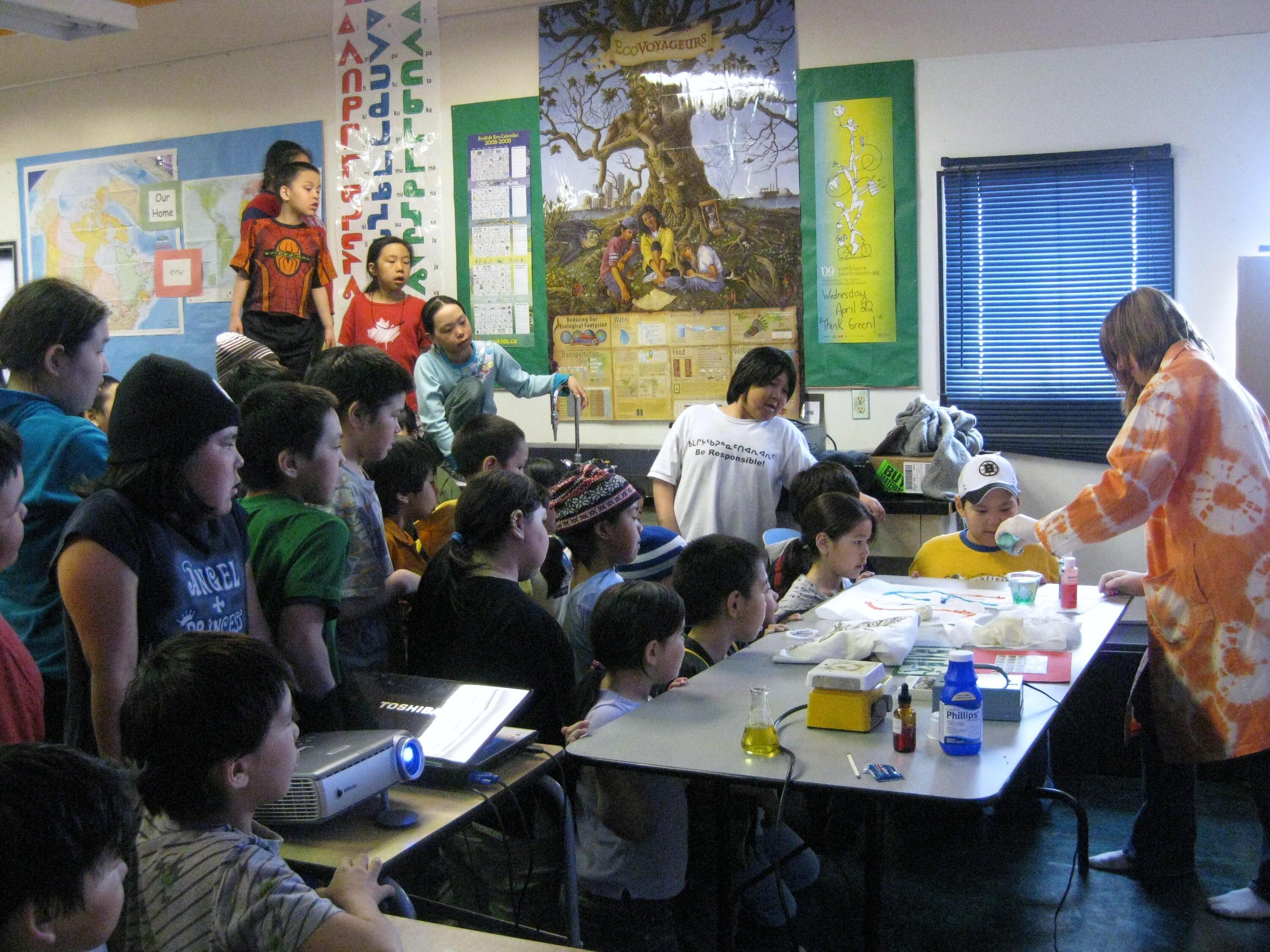
Figure 1: Chemistry Outreach, 2009, Quqshuun Ilihakvik Junior School, Uqsuqtuuq, ᐅᖅᓱᖅᑑᖅ (Gjoa Haven), Nunavut. Credit: Geoff Rayner-Canham, used with permission
On each Outreach visit, I was accompanied by one or two volunteer chemistry students. The presentations were well received everywhere, but the reception was phenomenal in the Inuit schools of Nunatsiavut, the Inuit self-governing portion of northern Labrador. Eager to extend the Outreach to other Inuit communities, I was able to obtain funding for the Chemistry Outreach team to visit schools across Nunavut. The reception was equally enthusiastic in the Nunavut Inuit schools, one example being shown in Figure 1.
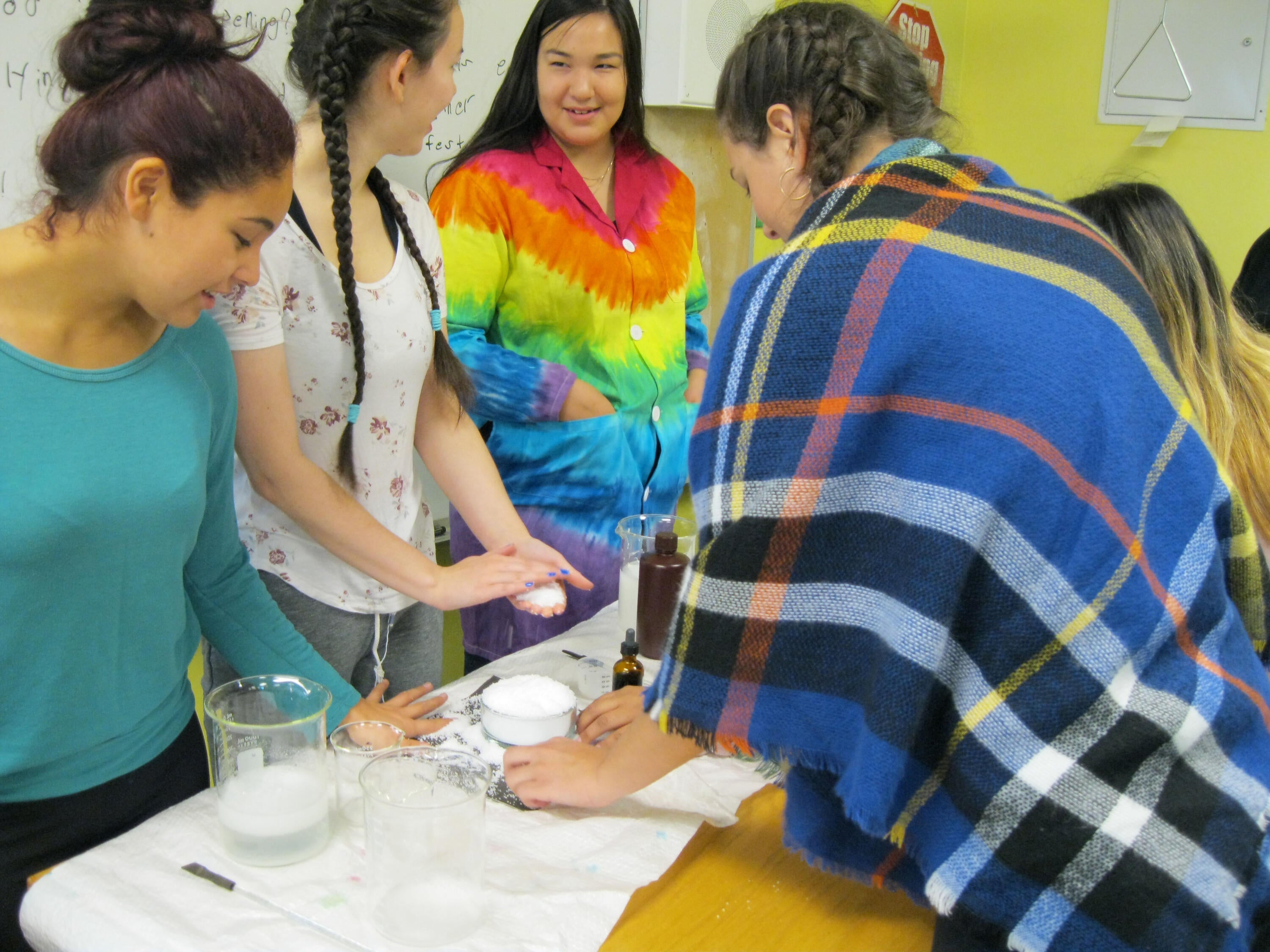
Subsequently, I was asked to devise an Indigenous-contextualized chemistry presentation for a group of Inuit and Innu high school students visiting the Grenfell Campus. This proved highly successful.1 The following year, there was a gifted Inuit student, Chaim Christiana Andersen, from Nain, Nunatsiavut, in one of my chemistry classes. She eagerly agreed to join the Chemistry Outreach team (Fig. 2). During the travels we had many discussions how chemistry really was fundamental to aspects of Inuit life and together we produced a series of articles on specific aspects which would interest the readers of Chem 13 News.
Figure 2: Chemistry Outreach, 2017, Lake Melville School, North West River, NunatuKavut, Labrador, with Chaim Andersen in multi-coloured lab coat. Credit: Geoff Rayner-Canham, used with permission
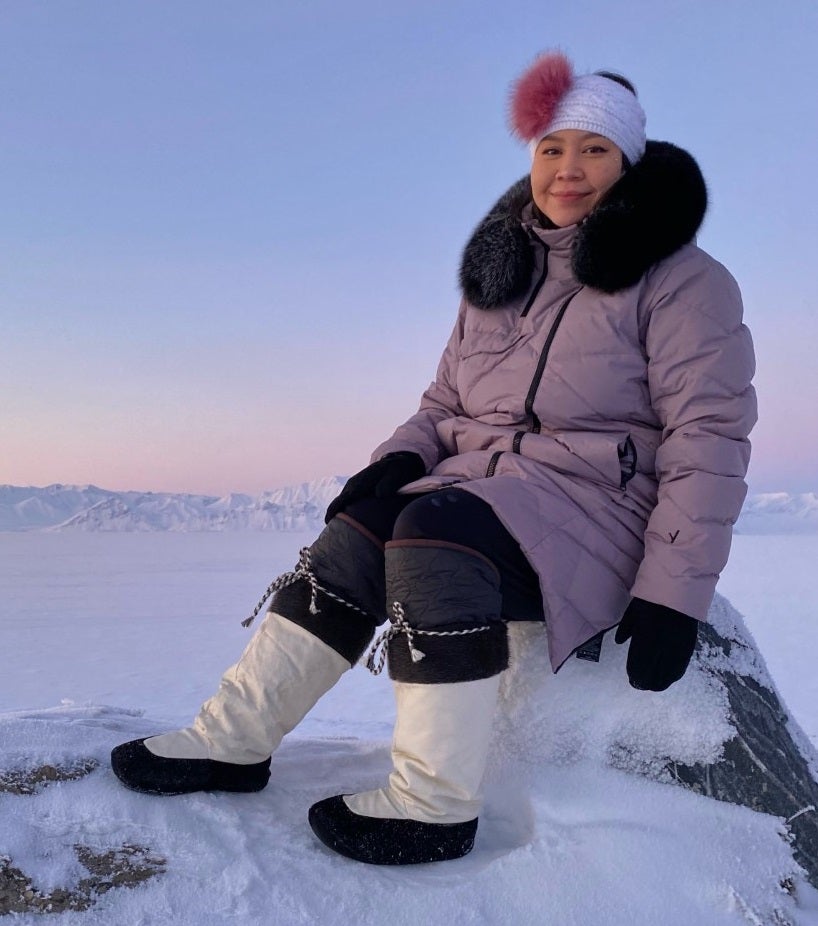
Ms. Andersen moved on in life. However, in Winter 2022, I was asked to co-adapt and co-instruct an Inuit-indigenized version of the Memorial University distance course, Chemistry in Everyday Life. This course was for Inuit students attending the Iqaluit Campus of the Nunavut Arctic College. Among the gifted students in the class was Rosalina Naqitarvik (Fig. 3), who grew up in the High Arctic community of Ikpiarjuk, ᐃᒃᐱᐊᕐᔪᒃ (Arctic Bay). Thus, in addition to having a knowledge-base in science and in Inuit culture, she brought a perspective from a very different part of the Inuit Nunangat (homelands). Together, we constructed some more broadly-based articles on aspects of Inuit culture to provide a second part of the series.
Figure 3: Rosalina Naqitarvik in Mittimatalik, ᒥᑦᑎᒪᑕᓕᒃ (Pond Inlet), Nunavut. Credit: Rosalina Naqitarvik
In contributing my chemistry expertise to this series, I acknowledge that none of it would have been possible, but for the contributions and enthusiasm of my two co-researchers and co-authors: Chaim Christiana Andersen and Rosalina Naqitarvik – my thanks and admiration. I also wish to state my infinite respect for the life and culture of the Inuit peoples of Inuvialuit, Nunavut, Nunavik, Nunatsiavut, and NunatuKavut, and of those Inuit beyond the boundaries of their homelands.
References
1 Rayner-Canham, G.; Taylor, R.; Lee,Y.-R., Making Chemistry Relevant to Indigenous Peoples. Chem 13 News, February 2016.

Fall 2022 Special Edition Acknowledgements
We would like to acknowledge the following individuals whose teamwork and dedication made this project possible.
Production team
Professor Bill Power, Guest Editor
Kathy Jackson
Victoria Van Cappellen
Editorial team
Leanne Racicot
Laura Ingram
Julie Shikaze
Nilay Guler
Alex DeGagne
Design by Creative Services, University of Waterloo
Cristina Jones
Heather Bettridge
Printing by Simpson Print, Bloomingdale, Ontario
Rob Payne and the Simpson Print team
Sponsors
University of Waterloo’s Department of Chemistry and Faculty of Science
NSERC Promo Science fund
The Authors
Of course, the greatest tribute should go to the authors, Geoff Rayner-Canham, Chaim Christiana Andersenand Rosalina Naqitarvik, whose excellent work we hope this issue properly reflects and supports: Thank you.