The research brief provides an overview of Plaisance, Doody, Gonnerman, & McCright (2026) published in Studies in History and Philosophy of Science. This research brief is also available to download as a PDF.
Executive summary
- Several prominent scientists seem to assume philosophy is not relevant to their work, and many philosophers of science assume that scientists simply aren’t interested in their field. We tested these assumptions with a survey of over 2,000 tenure-system scientists and engineers.
- Our results tell a very different story: across every measure, scientists and engineers expressed far more affinity toward philosophy of science than anecdotes suggest: 77% said philosophy of science has a beneficial influence on their academic field, while less than 4% viewed its influence negatively.
- Yet respondents perceived their peers to hold less positive views: only 39% believed most colleagues in their field view philosophy of science positively, and 17% believed their colleagues view it negatively. This misperception may itself function as a barrier to engagement.
- Interest in engagement is widespread. Nearly 70% of respondents had either collaborated with a philosopher of science (9.3%) or expressed interest in doing so (60%), and over half had already engaged with a philosopher of science in some way—most often through informal, dialogue-based interactions.
- The take-away: the dismissive pronouncements of a few famous scientists do not represent the broader scientific community. There is real receptivity on the science side of the philosophy–science divide—and a promising path for those who are willing to engage.
Background and motivation
Some of the most famous voices in science have been dismissive toward philosophy of science. Stephen Hawking declared philosophy “dead,” Richard Feynman characterized philosophers of science as perpetually outmatched by scientific questions, Lawrence Krauss called philosophy of science “the worst part of philosophy,” and developmental biologist Lewis Wolpert claimed the field has “contributed zero to the understanding of the scientific process.”
Philosophers have often taken such anecdotes at face value and assume that scientists view philosophy as useless or even antagonistic to science. Indeed, a recent survey found that philosophers of science perceive a ‘lack of interest from scientists’ as a major barrier to engagement (Plaisance et al., 2021).
Decades of work on cognitive biases shows that striking, memorable examples can disproportionately shape our sense of how common certain attitudes really are, suggesting that the negative comments featured above can have an outsized impact. But a handful of vivid quotations is not evidence about a community of hundreds of thousands of researchers. So, rather than extrapolating from these anecdotes and adding to the list of arguments for why philosophy of science should matter to scientists, we asked an empirical question: how do scientists and engineers actually view—and engage with—philosophy of science and its practitioners?
Methods
We administered a standardized online survey to a probability-based sample of tenure-system science and engineering faculty at 54 major research universities (27 in Canada, 27 in the US). Ultimately, over 2,000 scientists and engineers responded, spanning the biological and life sciences, physical and earth sciences, computer and information sciences, engineering, and selected social and behavioral sciences. We designed our survey instruments to capture attitudes toward philosophy of science at three levels: as an intellectual activity, as an academic field, and as a community of scholars one might engage with.
Because a survey including questions about philosophy of science could easily attract only those who care about it, we took several steps to minimize selection bias: we described the study as research on collaboration among scientists and engineers (without mentioning philosophy); we included several questions before introducing “philosophy of science”; and when we did introduce it, we simultaneously asked participants for their views about history of science, sociology of science, and science education.
Findings: Scientists value philosophy of science more than is generally assumed
1. Scientists value philosophy of science activities—whether or not they are labeled as such
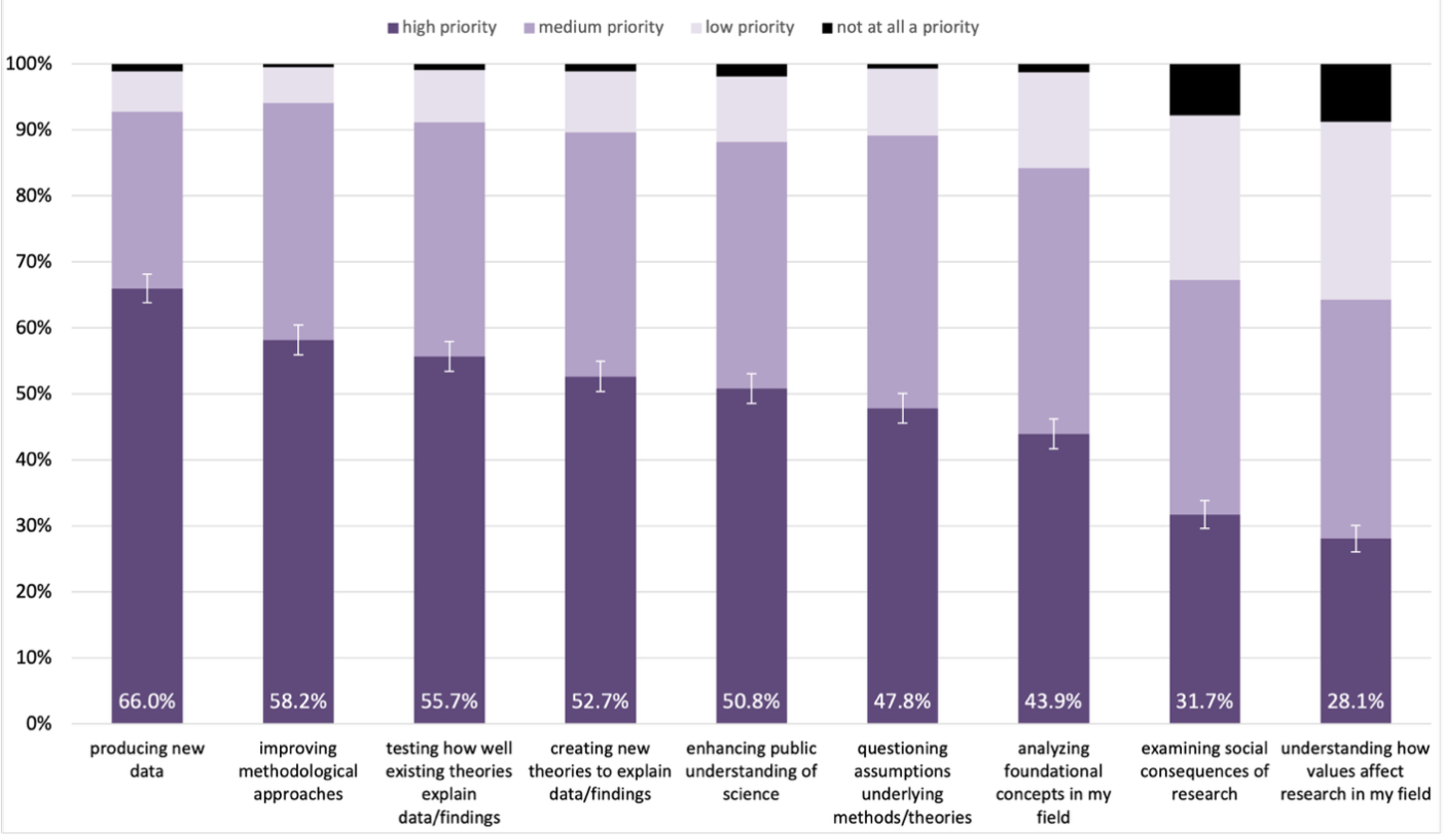
We first asked respondents how much of a priority various research activities should be in their field without labeling any of them as “philosophy of science.” Unsurprisingly, most respondents rated typical scientific activities, like producing new data (66%), as high priorities. But activities characteristic of philosophy of science fared better than the above anecdotes might predict. Nearly half of respondents said that questioning assumptions underlying methods and theories (48%) and analyzing foundational concepts in their field (44%) should be high priorities, and over 80% rated these activities as at least a medium priority. Even the most explicitly philosophical items—examining the social consequences of research and understanding how social and ethical values affect research—were rated a medium or high priority by roughly two-thirds of respondents. In short, many scientists and engineers find considerable value in the kinds of work philosophers of science do, even when it isn’t labeled as such.
2. Personal sentiment is more positive than perceived sentiment
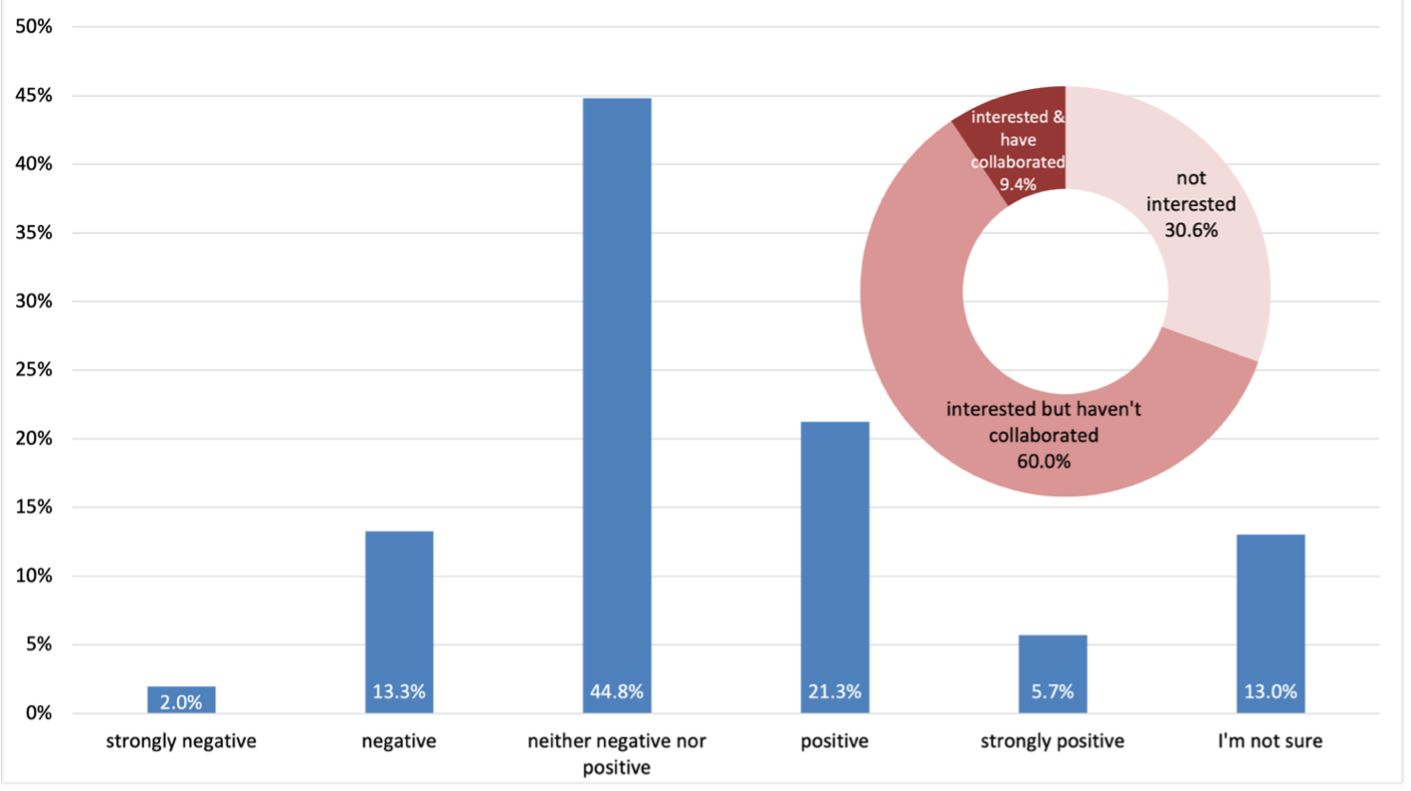
When we asked participants how they viewed the influence of philosophy of science on their field, 77% assessed it as somewhat or highly beneficial, 19% were indifferent, and only 3.6% viewed it negatively (with a mere 0.4% calling it “harmful”). Given the negative anecdotes described above, this level of positivity was higher than we anticipated. The most striking result, however, came from comparing respondents’ personal views with the views they attributed to their colleagues. Only 39% thought their peers viewed the influence of philosophy of science positively, while 44% characterized peers as indifferent and 17% believed their peers held negative views. Respondents who believed their views were more positive than those of their peers outnumbered the reverse by eleven to one. The most common response pattern was, “I think it is somewhat beneficial, but most of my colleagues are indifferent.” If these respondents are even roughly representative, this widely shared assessment of one’s peers is a misperception—one plausibly fueled by the outsized voices of a few eminent skeptics.
3. Interest in collaboration is high, but largely untapped
Interest in working with philosophers of science was higher than we expected: 60% of participants said they were interested in collaborating with philosophers of science and another 9.3% had already done so. We also asked participants how they thought most of their academic peers viewed such collaborations: only 27% believed their peers held positive views. In the image below, we show personal interest in philosophy-science collaboration (doughnut) and perceived field views of philosophy-science collaborations (bars). Again, personal interest was higher than perceived interest. These findings should be encouraging news for philosophers of science who want to collaborate with scientists but worry the interest isn’t mutual. At the same time, this interest is largely untapped: respondents were much more likely to express interest in collaborating than report having done so.
4. Informal engagement is already widespread
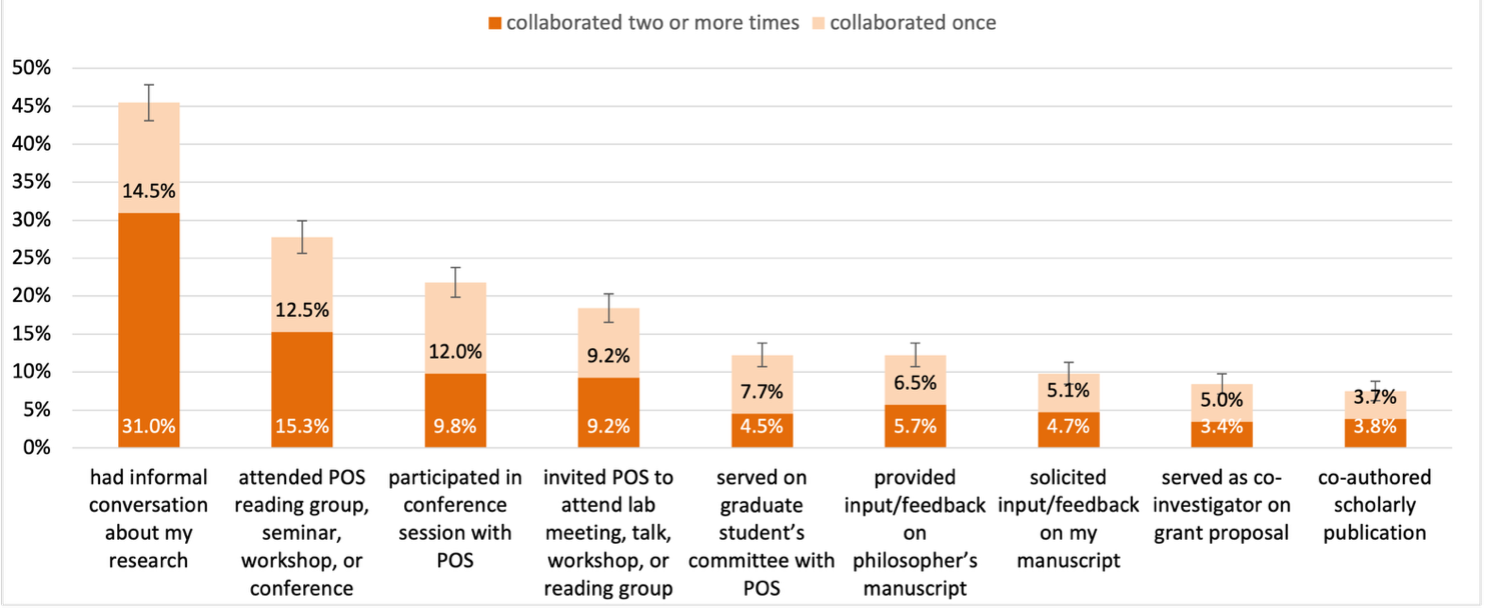
Although only 9.3% of respondents had formally collaborated with a philosopher of science, more than half (54%) had informally engaged with a philosopher of science in some way. Dialogue-based activities were the most common: having an informal conversation about their research (46%), attending a philosophy of science reading group, workshop, or conference (28%), participating in a conference session with a philosopher of science (22%), or inviting one to a lab meeting or talk (18%). More time-intensive, text-based activities—such as serving as co-investigator for a grant proposal (8%) or co-authoring a publication (8%)—were rarer, as one would expect. Given how few philosophers of science there are relative to the large communities of scientists and engineers, we consider these levels of engagement remarkably high.
What these findings mean for philosophy-science collaborations
Across four lines of evidence—valuing philosophical activities, assessing the field’s influence, expressing interest in collaboration, and actually engaging with philosophers of science—our results paint a consistent picture: most scientists and engineers regard philosophy of science positively, and the loudly dismissive stance of a few prominent figures is the exception, not the rule.
The gap we saw between respondents’ own views and the views they attribute to their peers suggests that we ought to correct this misperception, as scientists who privately value philosophy of science may hesitate to engage if they believe their colleagues will be dismissive, especially where those colleagues hold gatekeeping power over promotion, publications, and grants. Yet, these findings suggest that most other scientists and engineers are more receptive than is typically assumed, which is encouraging for those who wish to collaborate, especially since our other research has shown that collaborating with philosophers can have significant benefits for scientists and engineers. For those who still worry about facing opposition from colleagues, informal research conversations offer low-stakes opportunities to engage in interdisciplinary exchanges with less risk of professional friction.
Philosophers of science who want to engage scientific communities should also take seriously the receptivity demonstrated here, but they may also wish to use informal interactions as a starting point. As we discuss elsewhere, these interactions can lay the groundwork for more formal collaborations.
Read the full paper
Our published paper offers a detailed account of survey findings and discusses several methodological contributions to empirical philosophy of science. The supplementary materials include the full text of our survey questions and break down results by disciplinary family.
If you’re interested in what makes philosophy–STEM collaborations so beneficial—and what stands in their way—see our companion briefs on Plaisance & Doody (2026) and Doody & Plaisance (2025).
Suggested citation for this brief:
Plaisance, Kathryn S., Sara Doody, Chad Gonnerman, and Aaron M. McCright. Moving Beyond Anecdotes: How Scientists and Engineers Actually View Philosophy of Science. The Collaboratory, University of Waterloo 2026. https://uwaterloo.ca/collaboratory/research-brief-moving-beyond-anecdotes