
The winter semester was a busy and exciting time in our lab. We completed a major upgrade of our dilution refrigerator, significantly expanding its experimental capacity.
With the help of undergraduate student Allen Matthew, we installed a Radiall cryogenic switch featuring a patented RAMSES™ latching mechanism that eliminates excess heat generation inside the fridge and prevents unwanted temperature drifts.
Cryogenic switch
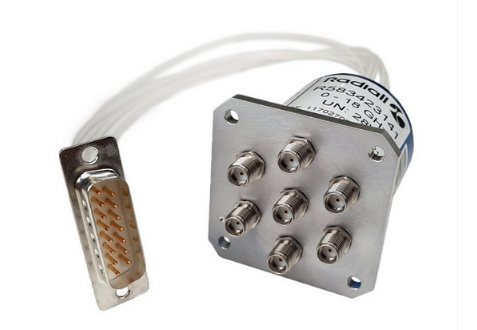
Radiall cryo-switch with DB15 input and seven RF outputs, including a central latching line.
Radiall cross-section
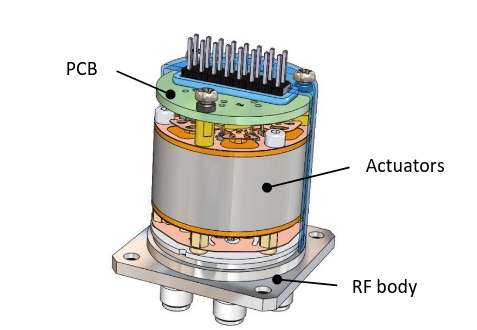
Cross-section of Radiall RAMSES SP6T switch.
RAMSES latching system
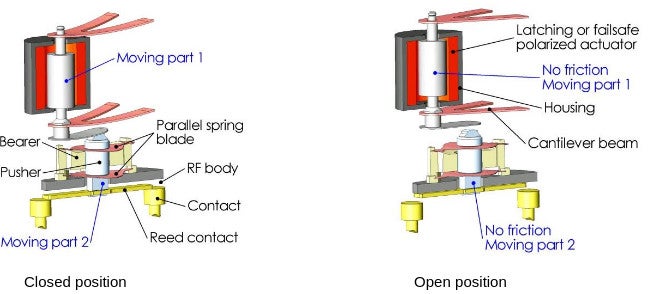
Schematic illustrating the switch in its closed (on) position (left) and opened (off) position (right).
The Radiall switch has a metal case and is installed on the mixing-chamber plate of our dilution refrigerator. The control signal enters through a DB15 connector, and the outputs are seven SMP connectors. Inside the case, the device is made of three main parts: a PCB, a set of attenuators, and the RF switching body.
The attenuator section contains strong magnets that move the internal latching elements. Thanks to very good shielding, the device forms an Faraday cage, which means that almost no magnetic field leaks out. This is important because even small magnetic fields could disturb sensitive measurements in our experiments. The strong magnets also allow the switch to operate with very little electrical power - only about 1 mW produces a force of around 800g on the actuator pins. Using such low power is beneficial in a cryogenic environment, as it does not warm up the refrigerator.
The way the device works is fairly straightforward. The magnets rotate the actuator cylinders, and a cantilever beam attached to the actuator follows this movement. This motion is passed on to a parallel-spring blade, which pushes a small “pusher” piece up and down. As the pusher moves, it raises or lowers the reed contact, which decides whether the SMP connectors are connected and which RF lines are active.
Source: Radiall, Technology Guide for Cryogenic RF switches (2023)
We also introduced a new dual-sample holder, which supports two devices simultaneously and uses wire bonds for sample connection. The package, made by Noah Gorgichuk, greatly improves the reliability and flexibility of our cryogenic setup.
Sample-holder assembled
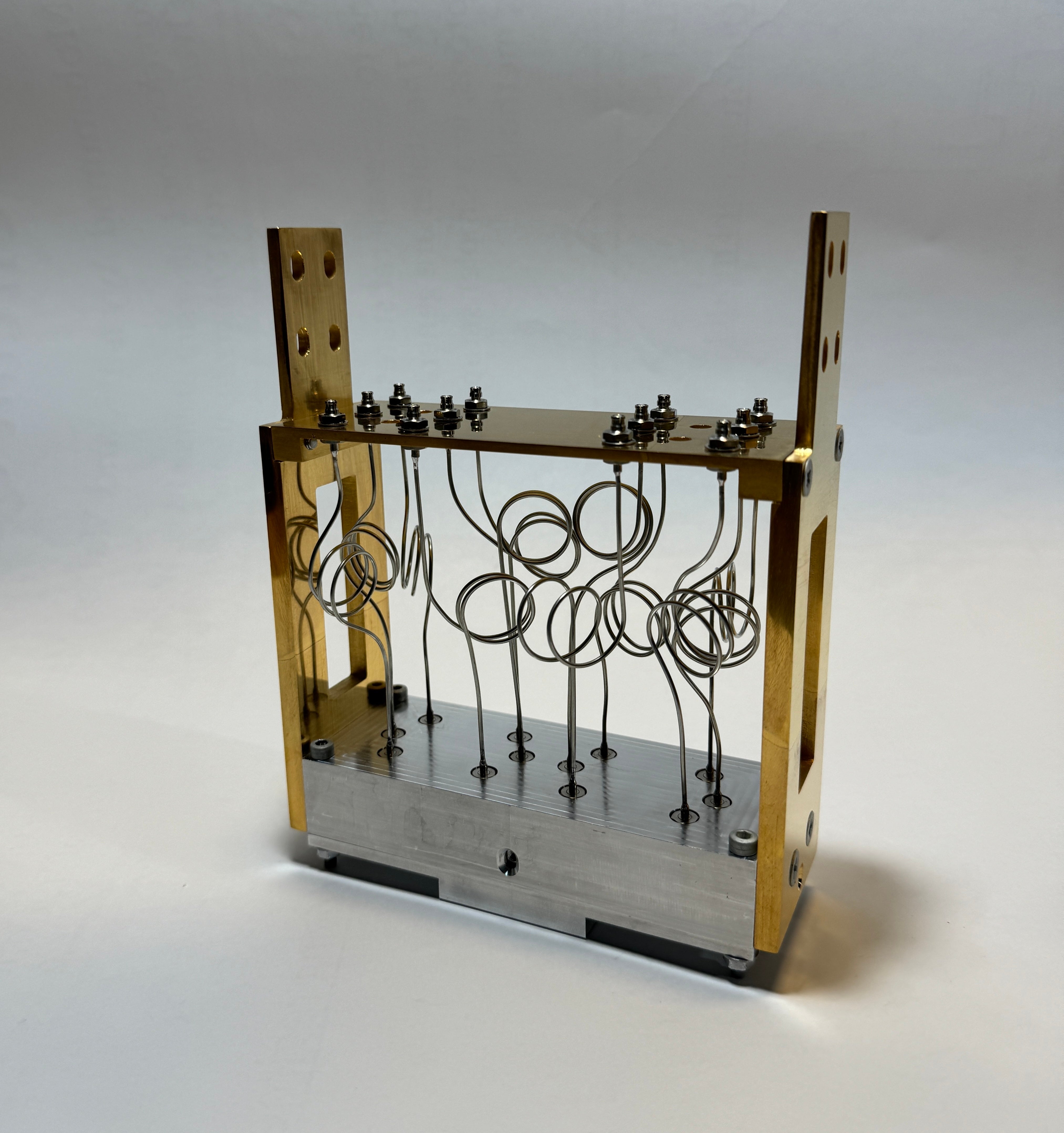
Assembled sample holder featuring 12 lines for signal input and output, supporting two independent experiments within the experimental setup.
Sample-holder disassembled
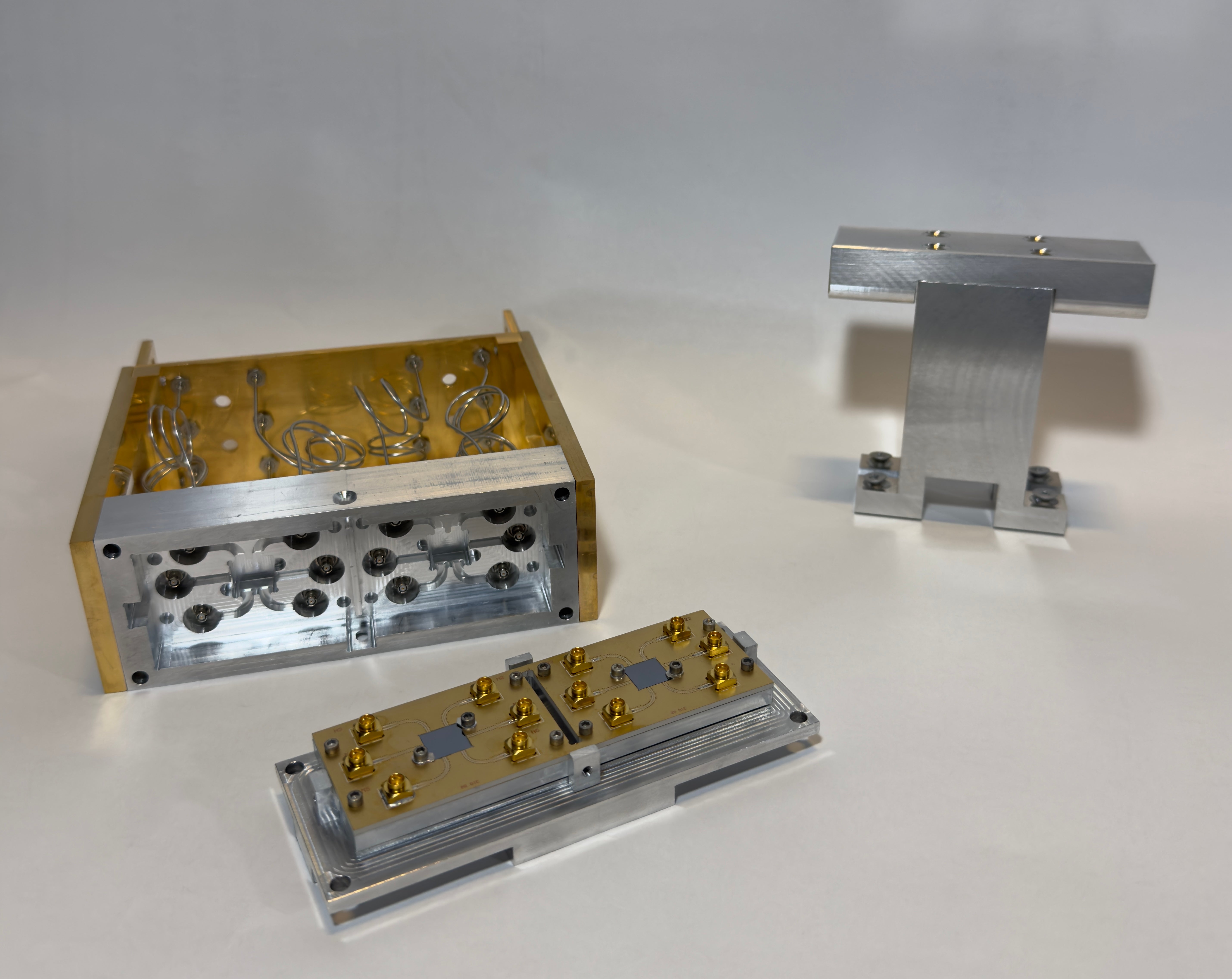
Disassembled sample holder showing the cavity for a superconducting device and the metal handle in the background used to attach the base to the body of the double-sample package.
The project required extensive in-house wiring work, including manual soldering of SMP connectors, preparing twisted-pair lines for the cryo switch, and integrating additional components for signal mixing and filtering, such as custom-made Quantum Microwave low-frequency bias tees and IR filters.
Beyond enhancing the system itself, the process accelerated our understanding of the hardware we rely on and provided valuable hands-on experience in cryogenic instrumentation. While the work is not yet complete, we are now in the final stages of the upgrade. With most of the challenging integration behind us, we expect that the upgraded dilution refrigerator will be ready for operation soon, enabling the next phase of experiments in our lab.