Study Details
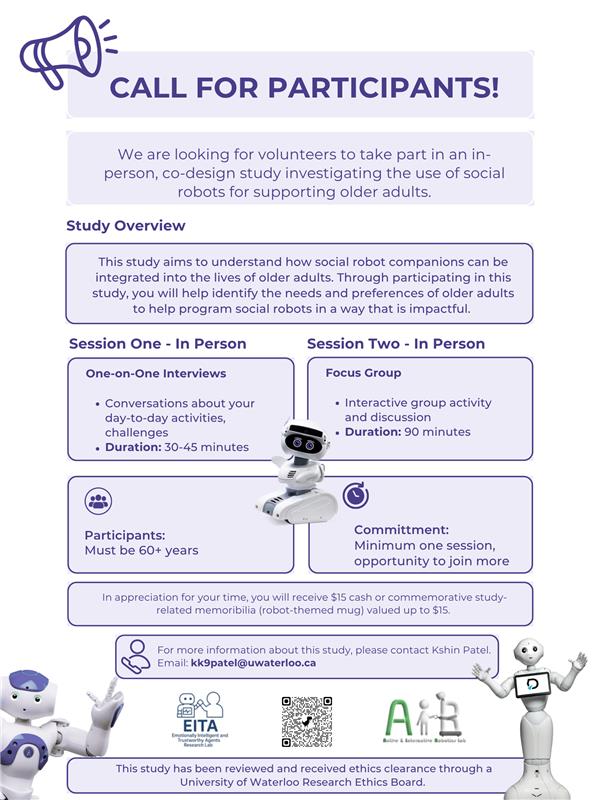
Project title: Enhancing Older Adult Support with Social Robots
Funding: Graham Seed Fund (GSF)
Principal Investigators: Dr. Moojan Ghafurian & Dr. Yue Hu
Student Investigator: Kshin Patel
Research Collaborators: Aderonke Saba (Project Manager), KW4 Ontario Health Team, Matilda Kress (Community Programs Manager), Sunnyside Home, Region of Waterloo
You are invited to participate in a research study focused on developing and evaluating social robots designed to assist older adults in their daily lives and healthcare needs. Before you agree to take part in this study, it is important for you to understand what you will be asked to do. Please read the information below and decide whether or not you wish to participate. Feel free to ask us any questions about the study, or any part of this form that may not be clear.
Research Purpose
The purpose of this study is to explore user preferences and potential applications of social robots in supporting older adults. We aim to understand which daily activities you may find challenging and how social robots could provide meaningful assistance within a health monitoring aspect. Your feedback will help guide the design and functionality of these robots to ensure they align with user needs.
We are specifically interested to ask about tasks that you feel a social robot could help you with. We are investigating the type of activities and scenarios where the use of different robot capabilities might provide meaningful assistance in your life. Each session will be led by one or more members of our research team who will audio and video-record interactions during sessions for future evaluation within the scope of the current study. This will include analysis of participant verbal responses during sessions. Your name will not be shared, images containing your face will be blurred (unless you consent otherwise), and your responses will be anonymized if any audio or visual data is used in presentations or publications.
Procedure
You will be invited to take part in two sessions. The first session is a short interview (approximately 30-45 minutes) where you will be asked general questions about your day-to day activities and any challenges you may experience. You will then be invited to take part in a structured session that includes a general introduction to social robots, a simple card sorting activity, and a guided group discussion. The session will be approximately 90 minutes, including a short break, and is designed to explore your perception of how social robots might support your health and daily routines. You will be shown images of different types of robots (no physical robots will be used) and asked to share your thoughts and preferences in an open, conversational setting. You will also be asked to provide basic demographic information, including your age and gender. All sessions will be recorded for analysis. You will also have the opportunity to participate in future sessions should you indicate interest.
Foreseeable Risks and Potential Benefits
The risk of experiencing any discomfort by taking part in this research is low, but you may find it challenging to describe some of the activities and difficulties you encounter in your daily routines. Sessions may become tiring and cause fatigue for you. Focus groups have an inherent limit to confidentiality as the other participants in the group may not keep what was said in the focus group confidential, despite being asked to. The researchers will keep information confidential and will ask that all the participants do so, but we cannot guarantee this.
This study will provide important information that will help in the design of an assistive robot that can help older adults when facing daily challenges. Additionally, your participation in this research can benefit others in the future.
Use of Research Findings and Communication
The findings from this research may be used for academic publications, policy recommendations, and further product development. Demographics data collected including age may be used to further analyze and group data from the research study. Data may also be used for presentations and public discussions. Any data used will be kept anonymous and no identifying information will be disclosed. Aderonke Saba from the KW4 Ontario Health Team (KW4H) and Matilda Kress from the Region of Waterloo, who are collaborating on this study, may also have access to anonymized data to support recruitment within scope of the current study, analysis and knowledge mobilization related to the project. Participants will have access to a summary of the results upon request.
Follow-Up Contact for Future Research
With your permission, we may contact you for follow-up sessions or participation in related projects. Agreeing to follow-up contact does not mean you are required to participate in future sessions or related projects. You may choose to withdraw your consent for contact at any time.
Participation and Withdrawal
Your participation in this study is completely voluntary, and you can stop at any point that you wish. If you do decide to continue with the study, you will be asked to sign this consent form and you will receive a copy to keep. Even if you do consent, you can withdraw from the study at any time without any consequence. We will remove your responses and discard the data if you wish. However, certain information collected prior to withdrawal, such as audio/video recordings in which the other participants are present, will be retained and cannot be withdrawn once collected. If you have any questions or wish to withdraw from the study, please contact: Kshin Patel at kk9patel@uwaterloo.ca.
Right to Decline Answering Questions
You may decline to answer any question(s) you do not wish to respond to, and this will not impact your participation in the study.
Data Management
Your data will be securely stored in locked cabinets in the office of Dr. Moojan Ghafurian (to which only she has access). Anonymous data (not containing your name) will be encrypted and stored on the principal investigators’ computer for analysis. All computers are password protected. Your identity will be kept confidential. Anonymized data may be published publicly in the future. Anonymized data will be stored for a minimum of 7 years. If you wish to leave the study at any point, you can choose to remove your data from the study. However, video recordings prior to your withdrawal, in which other participants are present, cannot be removed.
Will I receive anything for participating in the study?
You will receive renumeration in the form of cash, or an item of your choice (valued up to $15) for participating in this study. Items include commemorative study-related items such as a mug with pictures of different social robots as seen throughout the study. The renumeration amount may be taxable. It is your responsibility to report this for income tax purposes, if required.
This study has been reviewed and received ethics clearance through a University of Waterloo Research Ethics Board (REB #47168). If you have questions for the Board, contact the Office of Research Ethics, toll-free at 1-833-643-2379 (Canada and USA), 1-519-888-4440, or reb@uwaterloo.ca.