


In March, Conrad Grebel University College and the Grand Philharmonic Choir were honoured to welcome Sir James MacMillan, one of the world’s foremost living composers, as the 2016 Rodney and Lorna Sawatsky Visiting Scholar. Sir James MacMillan is a Scottish composer and conductor most known for his sacred choral works. MacMillan’s lecture on March 1, entitled “The Spiritual in Music,” was both engaging and thought-provoking.
MacMillan is an eloquent—and occasionally humorous—speaker. He drew on a vast range of references, both musical and literary, to explore the relationship between the spiritual and the arts. An overarching theme of the lecture was the place of religious works in an increasingly secularized culture, and the question of whether using material rooted in religion limits the scope of the work or hinders innovation in the art form. MacMillan, along with many others, argues against this view; quoting poet Michael Symmons Roberts, “the relationship between creative freedom and religious belief is far from limiting. Most of these writers and composers would argue on the contrary that their religious faith was an imaginative liberation.”
An example of this was English poet William Blake. MacMillan spoke of Blake’s work and the criticism of it from other writers such as T. S. Eliot, who believed that Blake’s rejection of tradition and the invention of his own religious ideas, “was a distraction from the vocation of writing original poetry.” Quoting Eliot, “the concentration resulting from a framework of mythology and theology and philosophy is one of the reasons why Dante is a classic, and Blake only a poet of genius.”
MacMillan went on to discuss the current culture in which the religious framework is often rejected. One of the most interesting parts was his discussion of English composer Edward Elgar. MacMillan spoke of the frequent downplaying of Elgar’s religious beliefs and the public’s reluctance to acknowledge his Catholic upbringing in order for his music to be more palatable and “safe” for British audiences.
MacMillan concluded with highlighting parallels between music and spirituality. Music, which many refer to as the most spiritual of the art forms, can have transformative powers and has the ability to change people’s lives.
MacMillan welcomed questions from the audience after the lecture, which prompted the discussion of topics such as the frequently reported death of classical music, the relationship between ethics, morality, and classical music, and even the problematic term “classical” music itself.
As a music student, it was exciting to hear the insights of this renowned composer and conductor, especially in the links he drew to material studied in classes at Grebel. For example, MacMillan made several references to the spiritual nature of music by twentieth-century composers such as John Cage, particularly his famous 4’ 33”. This piece, in which the performer is instructed to not play their instrument and let there be four minutes and thirty-three seconds of silence, was originally called Silent Prayer. Though it can sometimes be hard to identify in more modern, experimental music, many of these composers never gave up their “search for the sacred.”
In addition to his lecture, MacMillan met with faculty and students, and spent much of his time in rehearsals with the University of Waterloo Chamber Choir, the Grand Philharmonic Choir, and Choir 21. The week culminated in a joint concert with these groups featuring MacMillan’s music, conducted by MacMillan himself.
Listen to the lecture at grebel.ca/sawatsky
Nicole Simone is a fourth-year student pursuing a Joint Honours Major in Music and Systems Design Engineering.
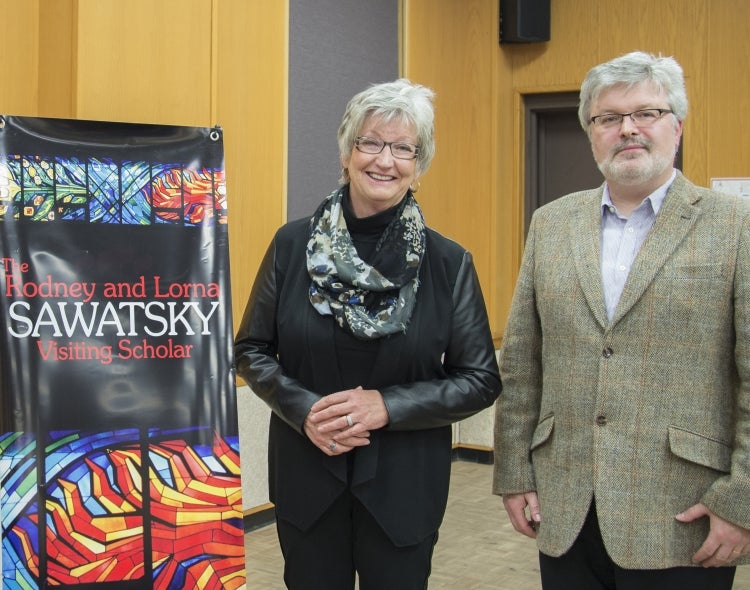
The Rodney and Lorna Sawatsky Visiting Scholar Lecture was established in 2004 to honour Rodney’s tenure and Lorna’s involvement at Conrad Grebel University College. Above, Lorna Sawatsky stands with Sir James MacMillan.

