


Reflecting on Conrad Grebel University College’s history of fostering connections in the community through choral music, it won’t be surprising to hear that after graduation, many alumni become involved in choral music in their community at some level—whether they are singing, accompanying, or directing.
Grebel’s first music professor, Helen Martens, established the Inter-Mennonite Children’s Choir in 1967. Since then, Grebel music profs have continued to direct choral music ensembles in Waterloo Region: Ken Hull leads Spiritus Ensemble, Mark Vuorinen directs the Grand Philharmonic Choir, and Professor Emeritus Len Enns leads Da Capo, which actually began as a way for Chapel Choir members to continue singing with Len after graduation.
We caught up with four alumni from across North America who have a passion for leading community choral music. Watch out—their stories may make you want to run out and join a choir!
LYNN MCRUER
Lynn McRuer (BA ’95 Music and Psychology) can’t think of any experience in her life that didn’t involve music. “Music is in my soul!” she explained. “It enriches and enlivens our day-to-day living. It lets one express every human emotion, from laughter to tears. Music is like breathing; without it, we perish.”
Indeed, Lynn has fed her soul by working with many community groups over the years, including The Hoot, Glen Morris UC church choir, the North Dumfries Children’s Choir, Waterloo Region High School Choral Festival, Kaleid, and more. “There is no better thing I can imagine than making music with one’s family and one’s community. It’s hard to be in conflict when you are singing or playing.”
When reflecting on the value of community music, Lynn believes that it enriches the society in which we live, allowing for expression of common emotions and the sharing of new perspectives. “Making music together allows us to feel emotion with others in a way that does not threaten our self-image. It gives individuals an opportunity to become one voice in a creative and vital way. I hope community music-making allows us to be kinder, gentler people with sensitivity towards our differences and awareness of our similarities.”
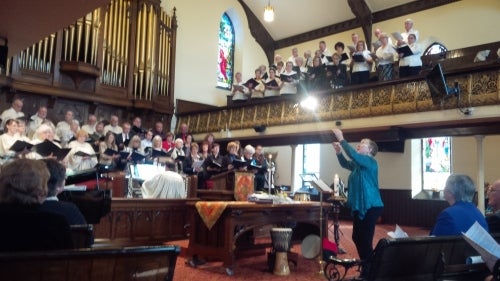
Showing her passion for local music, Lynn and her husband Bill Labron founded Lyrical Lines Education Network (LLEN), a registered charity, which builds community through the support and facilitation of accessible music experiences in Waterloo Region. Lyrical Lines has brought together hundreds of young students from many schools to sing with guest conductors and instrumentalists. It also provides choral experiences for young adults that include festivals, ensembles, and masterclasses, and plans a yearly Choral Symposium for conductors. LLEN brings people together through music making, allowing them to connect with new communities and thus building a stronger local and global community.
“Grebel opened me to new musical ideas and experiences. Studying with Bill Maust, Len Enns, and Ken Hull was a privilege. That music making, be it in the classroom or the choirs or at the piano, was influential in setting me on the course of music making in my world, my community. Their generosity in sharing their passion for making music touched my soul. I was inspired to want to do the same.”
As Lynn retires this year from her career in music retail as owner of Music Plus in Kitchener, she is contemplating starting a new community choir. “I feel profoundly changed when I make music in community, especially choral community. It is a deeply spiritual experience to make such music.”
www.lyricallineseducationnetwork.org
JANE RAMSEYER MILLER
Jane Ramseyer Miller (BA ’85 Psychology) grew up in a Mennonite community surrounded daily by four-part harmony. “Music is part of my DNA,” she explained. “When I arrived at Grebel I had no idea what I wanted to study but I had some kind of message in my brain that it wasn’t practical to be a musician unless I was a teacher. I had no interest in teaching so I picked a really practical major—Psychology!” At Grebel, Jane studied music theory, conducting, and voice, and sang in the choir. Looking back, she realized that she had more music credits than psychology credits when she graduated, and that should have clued her in about where her real vocation lay.
After Grebel, Jane was hired by the Mennonite Church to create the Service Venture program, aiming to get Mennonite youth involved in service and learning projects. “When my partner and I got married,” explained Jane, “it turned out the Mennonite church no longer was interested in my skills, and I lost a vocation that I had really enjoyed. It was a painful few years to figure out where I would work in the world.”
After moving to Minnesota with six Grebel friends living in intentional community, Jane begin doing some community organizing and worked for Habitat for Humanity and then Christian Peacemaker Teams. “I had been involved in Peace and Conflict Studies at Grebel and volunteered with the Victim Offender Reconciliation Program in Kitchener. Those skills were very valuable in community organizing and working in situations of conflict. Both Grebel and my family valued community and justice work so it was a natural fit and passion.”
Jane kept music as a hobby, until she was asked to conduct a church choir. “I learned as I went and found that my ear and my instincts were strong.” Next, Jane got a part-time job as the music director for One Voice Mixed Chorus (Minnesota’s lesbian, gay, bisexual, transgender and allies chorus.) “I soon was conducting four choirs including a neighbourhood children’s choir and a feminist women’s chorus.” At the age of 40, Jane went back to school and got a master’s degree in choral conducting.
Through working as Artistic Director for One Voice Mixed Chorus for 20 years, Jane has discovered that collaborating with other arts organizations in her community makes for very interesting outcomes. Thanks in part to her strong community organizational skills, Jane has helped to build the choir into a large non-profit chorus. “We now have 3 full-time staff, 125 singers from ages 15 to 78 and we sing for over 10,000 people in a year.” In addition, Jane started a program called OUT in Our Schools where she does a two-month residency in public schools and then the singers from One Voice take a day off work to sing with the students in those schools. “It is very powerful for my singers to be out in a school setting and for the students to get to sing along-side LGBT adults.”
“I program concerts that address current issues, and that educate and challenge listeners. We have a large number of individuals who identify as transgender who have joined the chorus and 30 percent of the chorus are straight allies. Last year we programmed a concert exploring gender and gender stereotypes and worked with students in exploring their own gender expression and identity. Some of my favorite collaborations have been with a women’s prison choir, a youth spoken-word ensemble, a puppet and mask theatre company, a women’s cancer centre and a Minnesota recycling program!”
Reflecting on her time at Grebel, Jane remarked that “Grebel gave me a place to write and perform creative work, serve on committees, play many practical jokes, organize to my heart’s content, volunteer, sing, compose and make great friends. All of those things have contributed to my work as a musician, but more importantly to the way that I do my work in the world.”
STEPHANIE MARTIN
Calling herself a “dual citizen,” Stephanie Martin lived at Grebel in 1981-82 as she worked on a BMus degree at Wilfrid Laurier University. She remarked on how well the Grebel kitchen staff took care of her as she spent long hours practicing organ and harpsichord before coming back “home” well after mealtime hours.
“The College has grown and changed a great deal since I was a student, but music making is an enduring and treasured activity for Grebelites,” noted Stephanie. “It would be a great benefit for every person to sing in a choir—any kind of choir—it doesn’t have to be one that is performing at a dizzying level. Just getting together and singing camp songs around a fire is a fantastic human experience everyone should be able to enjoy.”
After graduation, Stephanie taught a History of Music course at Grebel for about 15 years, conducted the Chamber Choir and University Choir while the College’s regular professors were on sabbatical, and directed Ontario Mennonite Music Camp. She credits her experience teaching at Grebel as instrumental in setting her on the teaching path she took, leading to a position as a full-time professor at York University in Toronto.
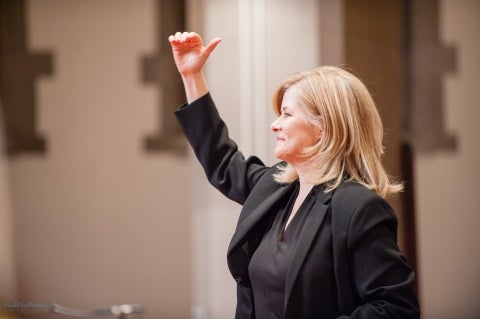
Stephanie has conducted Pax Christi Chorale in Toronto for 20 years and will be retiring from this role next spring. Singing with a full orchestra, this Mennonite and Brethren in Christ choir that includes many Grebel alumni is known for presenting dramatic choral masterpieces, performing with passion, conviction, and heart. “We try to present traditional repertoire with a twist,” explained Stephanie, describing the way that the choir has incorporated theatre, lighting, and dance into their oratorio performances.
“Choirs have been my life’s glue,” observed Stephanie. “It’s a sticky activity that binds people together in a very special way. Choir people commit to each other. We commit to not let down the team. We breathe together. We work hard and create something beautiful. We take something strange and unknown, and through disciplined practice, we unpack it, polish it, and share it with others. We understand the importance of working as a team, of persevering when things get tough; of bringing everybody up to their greatest potential.”
As she looks forward to spending more time composing music, Stephanie heard her choral symphony premiered in April as part of Laurier music’s 40th anniversary.
DUFF WARKENTIN
Never intending to pursue a career in music, Duff Warkentin (BA Fine Arts and Music ’78) arrived at Grebel already possessing a Bachelor of Church Music from Canadian Mennonite Bible College in Winnipeg. With that experience, Duff made a great TA for music prof Len Enns in his first year of teaching at Grebel. Duff sang in both choirs at Grebel, as well as with the Wilfrid Laurier Singers. “I still well remember singing the Bach motet Komm, Jesu, Komm in the Grebel chapel,” reminisced Duff.
After graduating, Duff became the music director at Rosthern Junior College in Saskatchewan in 1979-82, and then again from 1987-92 after completing a MMus in Choral Conducting at the University of Regina. He also taught at Westgate Mennonite Collegiate in Winnipeg, was Choral Artist in Residence in two Saskatchewan communities, and spent two years as term choral director/instructor at the University of Saskatchewan.
As a highlight in his career, Duff recalls premiering Len Enns’ Psalm Cyklus with the mass choir of the Canadian Association of Mennonite Schools in 1990. “Len came to Saskatchewan that year, and worked with my choir from Rosthern Junior College. Wonderful!”
Eight years ago, Duff was looking for a more regular paycheque, so he began work at Case New Holland. “It is completely non-musical, regular hours, good benefits package, and it pays the bills and allows me to pursue music as an avocation.”
It seems like community opportunities gravitate towards Duff. He loves directing the Station Singers of Rosthern, a non-auditioned community choir of between 45 and 75 singers. With this choir, he emphasizes that everyone’s contribution is important, regardless of ability, experience, or training. Duff conducts the choir at his church, Nutana Park Mennonite Church in Saskatoon, and his involvement with the Saskatoon Symphony Orchestra choir has been growing. He will be conducting the Saskatchewan Youth Choir in the coming year, a program of the Saskatchewan Choral Federation.
“Our communities, small or large, need cultural activities to thrive,” explained Duff. “Life is so much more than making a living. Culture makes a life. The late Robert Shaw spoke of choral singing as essentially creating community. The whole is greater than the sum of the parts. We need each other to realize the beauty of choral music. We breathe together. We listen to each other. We support each other. We appreciate each other. It is magical, it is mystical, and it can’t be explained, only experienced.”

