Gardening by the numbers
Math alumni transform their lawn into food forest
When Math alumni Adarsh Mehta (BMath ’98) and Jeff Jenner (BMath ’84) moved to a new property in the spring of 2025, they treated the parched lawn surrounding their home as a blank canvas. In its place, they envisioned an ambitious ecological project: not simply a garden, but a thriving ecosystem teeming with plants that would support wildlife, feed their family and bloom beautifully through the seasons.
This “food forest” vision offered a way to align their lifestyle with their values. As owners of a renewable energy consulting business, they already prioritized sustainability, but they wanted to shrink their ecological footprint even further.
While they stress that the garden will take at least seven years to mature, in just two seasons they’ve already witnessed a remarkable transformation. The landscape has come alive. Pollinators buzz above bright flowers, birds nest in newly planted trees and their three children roam the garden happily, munching on vegetables and edible flowers and noticing every small change.
In August, Adarsh and Jeff walked us through their food forest. They shared the inspiration behind the garden, their systems-thinking approach to gardening, their collaboration with ecological landscape designer Gilles Lapointe and tips for anyone hoping to try something similar.


What was once lawn is now a diverse tapestry of plants, almost all of which are edible.
The vision takes root
The inspiration for the food forest emerged from a convergence of concerns—not just sustainability, but also food security in the wake of the pandemic.
Adarsh: When we moved, this lawn was a completely blank slate. We needed to do something. I wanted a garden that I didn't have to work at too much. Now, here's the thing: it is a lot of work right now. But after about seven years or so, there'll be more balance. And I won't need to worry too much about the pests and certain weeds.
We were already in touch with Gilles Lapointe from a previous project and knew he had been working on a sustainable ecosystem for a large nursery. That gave us a connection to someone with experience thinking about how a landscape can work as an ecosystem.
COVID also made us think differently about resilience. We thought, ‘Wow, this is going to happen again.’ We wanted to understand how to grow our own food and become less dependent on outside systems. We wanted to create a garden with a lot of edible plants, not just pretty flowers.
We’re not doing this to be commercial and we’re not necessarily doing it to save money. We’re doing it to learn, so that if things ever become difficult, we’ll know what to do. Ultimately, we’re trying to create a net-zero, self-sustainable property.”

Hibiscus moscheutos in bloom beside a sentinel apple tree, Malus domestica.

Agastache Foeniculum, a flower native to Ontario, attracts tons of butterflies and bees throughout the summer and into fall.

Freshly picked onions cure on a wire rack.
Discovering mathematics in nature
In addition to feeding the family, the garden offers endless opportunities to learn about—and marvel at—the natural world. Perhaps no plant better exemplifies this relationship than Lamb’s Quarters. Commonly known as wild spinach, the plant’s leaves are more nutrient-dense than kale, and Adarsh and Jeff use them to make a delicious dip. But they noticed something else about the leaves—a pattern that looked oddly familiar.
Adarsh: The leaves don't grow at simple fractions around the stem, and they don't grow directly opposite each other. Each new leaf sits about 137.5 degrees around the stem from the last one. That’s the golden angle, which comes from the golden ratio, 1.618. The reason for that is that if they grew directly above or opposite each other, they'd shadow one another. To maximize photosynthesis, nature created a system where leaves rotate around the stem. That way, they don't overlap, so every leaf gets maximum light and water.

Lamb's quarters, or Wild spinach, is very nutritious and exhibits the golden angle in its leaf arrangement.
Math doesn’t just show up in the leaves; it also shapes how Adarsh and Jeff plan the garden. They see it as a complex system with inputs, outputs and feedback loops. Keeping that system in balance is key to its sustainability.
Adarsh: We think of it as a system. We knew the edible plants were also going to attract a lot of pests. So we created a water feature to attract toads and birds to deal with the pests. Our son has enjoyed finding toads on our property, and I’ve enjoyed having fewer slugs and snails because of the toad. But then what happens when I have too many birds? They're going to start eating all the berries also. So maybe I need a predator for those little birds. This is starting to happen naturally, as our property is being frequented by a hungry hawk.
Sue Ann Campbell (Professor of Applied Mathematics at University of Waterloo) would say, 'Well, that's a dynamical systems problem,' because you need to create some predator-prey balance. There are tons of predator-prey models in mathematics. I'm not using the models, but it's that kind of thinking that we’re using to create balance.

A winding water feature, with water pumped from a rain barrel, flows beneath a bridge made from reclaimed railway ties.

Jeff built the greenhouse using salvaged materials, including old doors, windows and railway ties.
Watching the next generation grow
When they first began working on the garden, Adarsh and Jeff were primarily focused on shrinking their carbon footprint and improving food security. But, as the garden has come to life, it has brought them joys in ways they didn’t anticipate. Perhaps chief among these is watching their children interact with the plants and wildlife.
Adarsh: The other day I harvested some carrots, washed them and scrubbed them, and my daughter was sitting at the kitchen table happily eating one. I had the biggest smile on my face. Seeing the kids enjoy what's growing here and appreciate what the property produces has been one of the most rewarding parts of the project.
What's been even more surprising is realizing how much they've learned along the way. I didn't realize how much attention my son had been paying over the last two years. At a botanical scavenger hunt recently, he could identify more plants than most of the adults. That was a really gratifying moment because it showed me that all this experimenting and all this time spent outside together is having an impact.

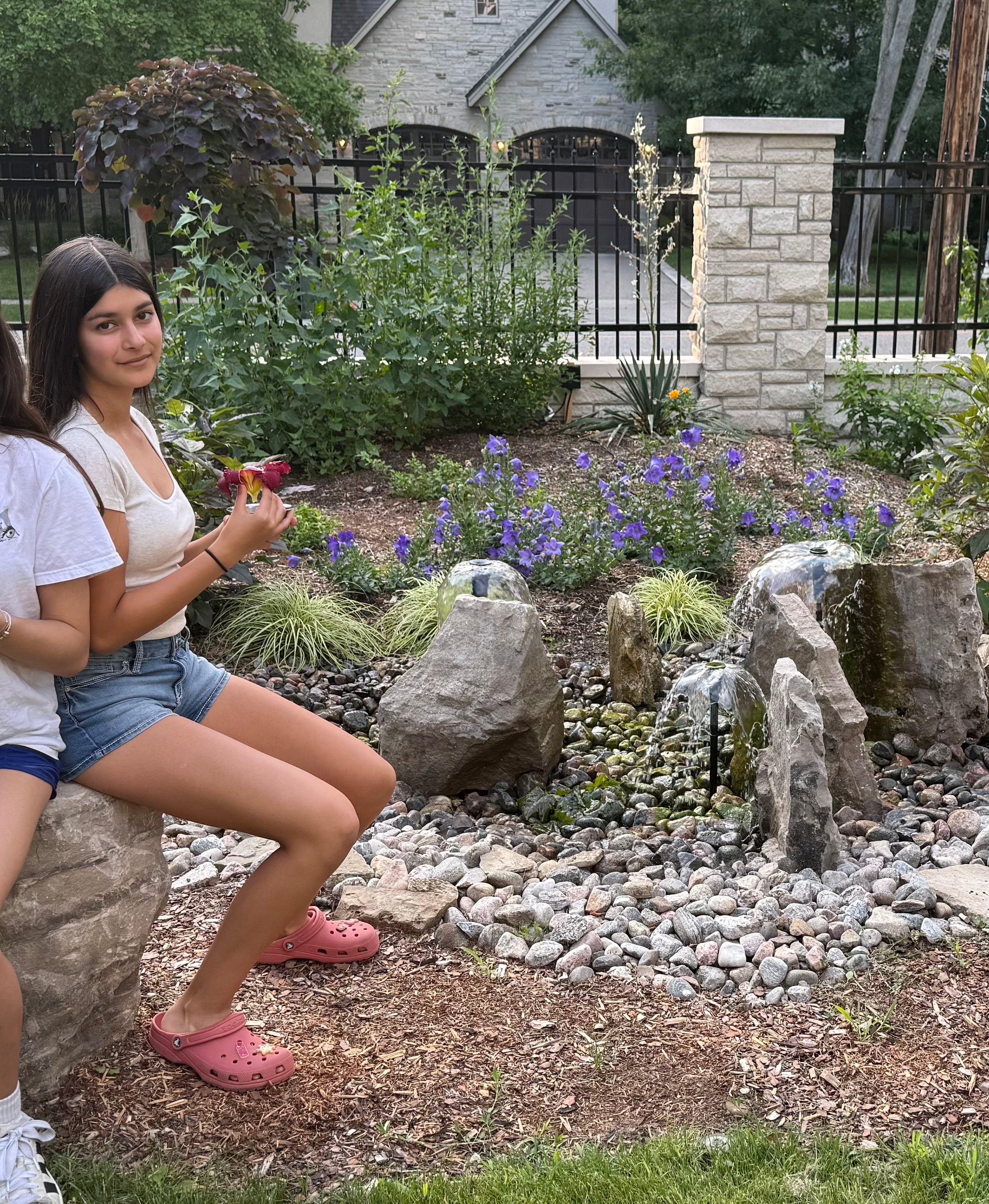
Adarsh and Jeff’s youngest daughter Nyra enjoys a Phlox bloom.

Adarsh and Jeff's eldest daughter Milaan enjoying the garden.

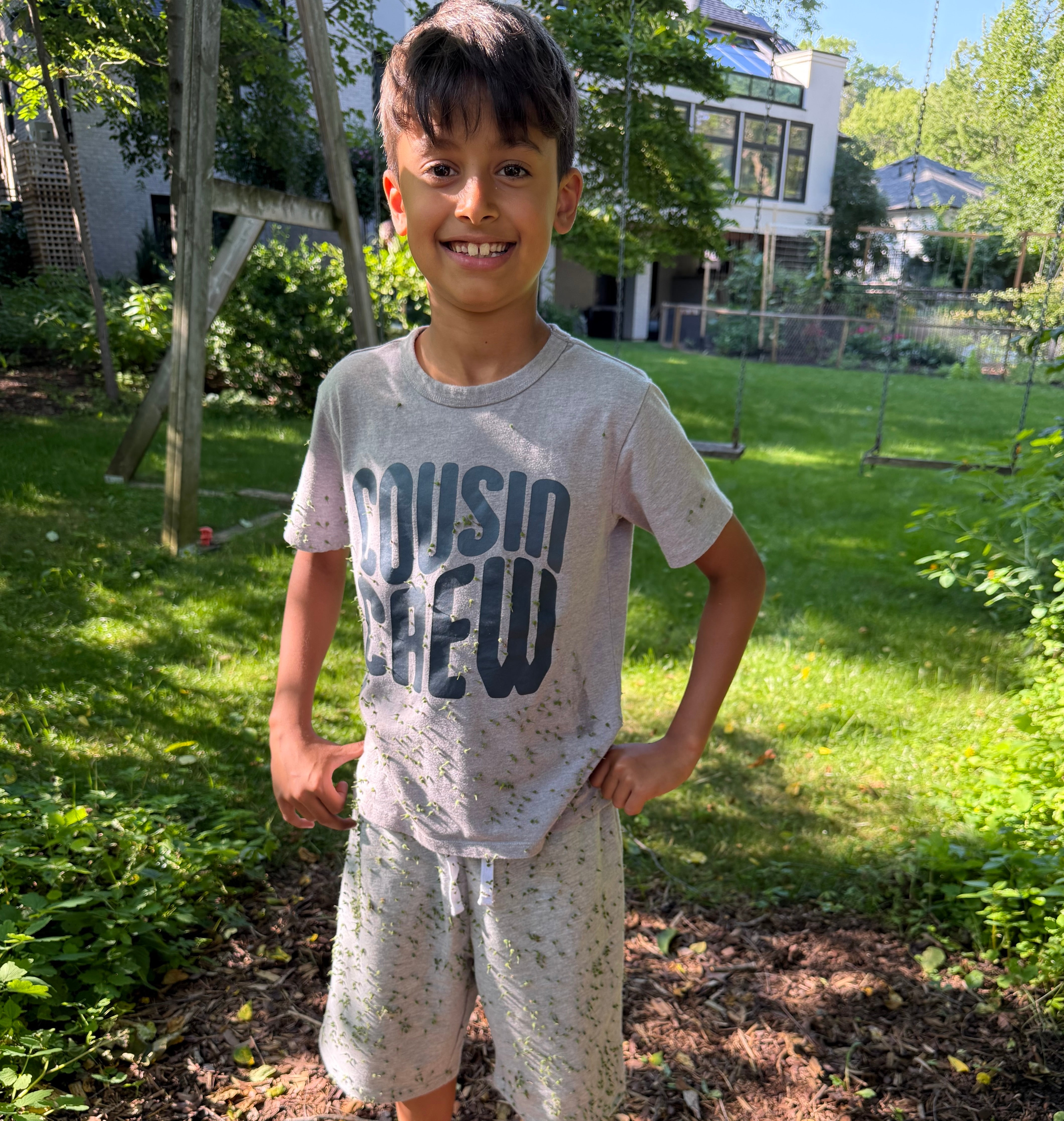
Adarsh and Jeff’s son Keval covered in burrs after an afternoon of weeding.
Sustainable in more ways than one
For Adarsh and Jeff, nurturing a thriving ecosystem is their backyard is only one piece of the equation. Nearly everything about their new house has been engineered to move them towards carbon neutrality, from the geothermal heating and cooling system to the rooftop solar panels that supply most of their power.
Jeff: The house uses a geothermal system for both heating and cooling. Ten loops run about 200 feet underground, where the temperature stays around 13°C all year. In summer, the cool fluid from underground cools the house. In winter, there’s still enough of a temperature difference between the outside air and the ground to make heat. It replaces a conventional furnace and air conditioner.
The solar panels are 19 kilowatts and take care of about two-thirds of our total energy. In addition, two large rain barrels with a capacity of 1000 litres each, provide alkaline water for the drip irrigation system engineered by Jeff.

Solar panels provide two-thirds of the house's total energy consumption.
Advice for starting your own food forest
We ended up our tour by asking Adarsh and Jeff what advice they’d give to those who aspire to a food forest but are unsure where to start.
Adarsh: Be patient. This doesn’t happen overnight. There is a lot of good information on the internet, so you don’t have to learn everything from scratch. I read about companion planting and soil—what different plants need. Some research and a thoughtful start really help.
What makes this a food forest is the combination of the vegetable garden and the rest of the environment – tall trees, mid-layer trees, shrubs, water features, ground cover, healthy soil, a mycorrhizal network underground. Bringing in pollinators and having intentional flowering plants is also very important to start with.
Jeff: It's simple to get started—and then you can build it as complex as you'd like. You don't have to do everything at once. Start with one garden bed, start with a few plants, see what works. Then the next year you add a little more, and the year after that a little more. Each year becomes a little bit more complete.

Their new gate pays homage to their renewable energy consulting business.

A salad Adarsh and Jeff created entirely from plants grown on the property.