Message from the Associate Dean of AI
The future of AI research at Waterloo
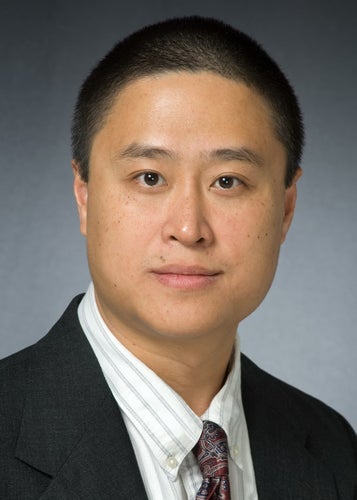
As the first Associate Dean of AI Strategy in the Faculty of Mathematics, I’m thrilled to introduce this special AI-focused issue of E‑Ties. As AI transforms society, Waterloo stands at a crossroads: we have the history, expertise and interdisciplinary strength to shape the technology’s future, but doing so requires renewed focus and collective ambition. In this message, I want to share where we stand today, where we are headed and how our alumni community can work together with students and researchers to achieve shared goals.
The Waterloo Faculty of Mathematics has always been known as a technology pioneer. Whether it was developing compilers for early supercomputers, authoring cryptographic protocols to secure our digital communications or building the information retrieval techniques that powered the world’s first major web search engines, we’ve consistently worked at the forefront of the defining technologies of our era.
Now, in AI, the Faculty of Mathematics has again staked out a leadership position, with research strengths in key fields, including cryptography, natural language processing, optimization and quantum computing. Yet, despite this expertise, there is more work to be done, both to raise the profile of existing research and to build on our strengths by attracting new talent. Indeed, this will be a major focus of my new role.
Building on strong foundations
I feel confident the Faculty can succeed in our ambitions in large part because we start from such strong foundations. First, we are distinct: we bring together academic units in applied mathematics, combinatorics and optimization, computer science, pure mathematics and statistics and actuarial science in a standalone Faculty–the only mathematics faculty in North America.
Those who created the Faculty recognized that these disciplines had much to say to each other. Now, in the age of AI, our connections across disciplines are an advantage. AI is, at its core, mathematical and progress in this field often requires computer scientists, mathematicians and statisticians to work together closely.
Secondly, as I’ve mentioned, the Faculty is already at the forefront of many fields of AI. Sometimes, these strengths fly under the radar, focused in specialized areas that don't always capture the media attention typically reserved for the latest chatbot models. Despite this, they are crucial to the future of the field. Let me give two examples:
- We have researchers in applied mathematics, such as Dr. David Del Rey Fernández and Dr. Jun Liu, who work on AI and dynamic control systems. These are mathematical techniques used to manage and control complex systems that change over time—like aircraft, robots, power grids or autonomous vehicles. Our researchers work directly with airlines to solve difficult problems involving partial differential equations (PDEs), which are used to model things like airflow, turbulence, fuel efficiency and flight dynamics. This work is crucial to building a safer, more reliable and sustainable aviation system.
- We also have leading expertise in theoretical AI. This is critical because, despite the rapid ascent of LLM chatbots, we are held back by a fundamental shortcoming: even those who build neural networks lack an understanding of how and why they work. Much of modern AI development relies on trial-and-error experimentation—an approach that is inefficient and expensive, and that often prevents smaller companies from competing. Moreover, if we do not understand why these systems work, it becomes difficult to predict when or how they may fail, introducing significant risks. Our researchers, such as Dr. Shai Ben-David, Dr. Aukosh Jagannath and Dr. Yaoliang Yu, are addressing this gap by developing principled, theory-driven understanding of AI systems.
These are just two areas, but they serve to illustrate the impressive range of expertise in AI, from applied to theoretical.
The future: A new initiative to unite the brightest minds in AI
How do we build on these strengths and increase our role in shaping the AI of the future?
There are many plans in the works, but there’s one I’m very excited to share with our alumni audience today, a new Waterloo Lecture Series on the Foundations of AI. This initiative will unite distinguished external fellows, industry partners and our own researchers for semester-long programs of public lectures and seminars. By focusing each series on a specific theme—such as computer vision, cybersecurity and privacy, or uncertainty quantification—we can showcase the rigorous work being done here.
Furthermore, these sessions will serve as the basis for new topics courses, giving our students the invaluable opportunity to learn directly from world-leading experts in emerging fields. It is a vital step toward attracting top talent and developing tomorrow’s AI innovators.
How you can help
Waterloo’s leadership in foundational AI depends on the commitment of our community, and our alumni play an important role, whether by hiring our co-op students, volunteering, making generous gifts or simply inspiring through example.
To strengthen our capacity in foundational AI, we now need flexible forms of support—support that gives researchers the freedom to pursue the biggest, most ambitious questions. Though this type of work often sits upstream of applications, it can ultimately have the greatest long-term impact.
If you are interested in championing the Lecture Series or other AI initiatives, please reach out to me at mu.zhu@uwaterloo.ca or to Alexandra Lippert, Director of Math Advancement, at allippert@uwaterloo.ca.
Lastly, I hope you enjoy this issue of E‑Ties. We are highlighting the most exciting recent AI news to come out of the Faculty, including an update on the new Future of Work Institute, research on using AI to accelerate drug discovery and new work to verify the safety of AI-driven systems. And please read our Mathematics 4 update for updates on construction, new information about the Green Room and a student's project to recreate M4 in Minecraft.
Warmest regards,
Mu Zhu
Associate Dean, AI Strategy
Professor, Statistics