
What makes art Mennonite?
What makes art Mennonite? This question doesn’t have a straightforward answer. In 2020, Magdalene Redekop wrote a book called Making Believe: Questions About Mennonites and Art. In a book review for Mennonite Life, Rachel Epp Buller noted that Redekop addresses this question in her book, asking “What is Mennonite art? Who is a Mennonite artist? Does a Mennonite artist self-identify or is there some inherent shared quality to art created by those of Mennonite heritage?”
Grebel’s art collection reflects the multiple possibilities that can define Mennonite art. As part of the on-site Mennonite Archives of Ontario, Grebel collects works of art that contribute to a greater understanding of Mennonite history and culture with emphasis on Ontario themes or artists. Some art at Grebel depicts Mennonite life from the past, both locally and globally. Some art uses traditional Mennonite techniques and symbols to ask questions on contemporary themes. Other works in the collection were created by artists who were Mennonites (either ethnic or religious) but might not necessarily reflect overt Mennonite themes. Visitors may notice the variety of ways that artists address their own questions of heritage, faith, identity, and community.
Comprising quilts, sculptures, paintings, and photographs, most of the collection was donated to the College or commissioned on behalf of Grebel. Additions to the collection are considered by an internal art committee. While some of Grebel’s art pieces are stored in the Archives or in offices, much of it is accessible to be viewed by the public during regular business hours (Monday-Friday, 9:00 am-6:00 pm). This a guide to the easily accessible pieces and includes the primary details available about the art and artists, as well as the location of the works (although the locations may change without notice).
For more information about the Self-Guided Mennonite Art Tour, contact:
Jen Konkle, Marketing and Communications Manager
jkonkle@uwaterloo.ca | 226-339-6830
Grebel Spaces: Atrium | Academic Wing | Library Landing | Library | Fourth Floor | Dining Room | Chapel
Begin your tour by making your way to Conrad Grebel University College at 140 Westmount Road North in Waterloo, Ontario. From the main parking lot, ascend the steps toward the main entrance. The tour starts at the top of the stairs.
Bloom
Jo-Anne Harder
Metal sculpture, 2014
Location: Outdoors at top of the main Grebel entrance stairs from the parking lot
Perched at the top of the main Grebel entrance stairs, this sculpture features outstretched petals rooted in a strong foundation. The corroded textured surface reflects on the past while the more polished ‘reaching’ pieces explore what lies ahead. This sculpture celebrates the seeds planted during the career of Professor Emeritus Arnold Snyder, who taught History and Peace and Conflict Studies at Conrad Grebel from 1985-2011.
Jo-Anne Harder, hailing from the Fergus/Elora area, works mainly with abstract, free-standing, welded, and steel sculptures. She is drawn to the “inherent beauty and unique qualities of the metal itself” and in spite of its strength, she is always surprised by its flexibility. Contemporary architecture, prehistoric shapes, music, the landscape, and the people that surround her endlessly influence Harder’s life and work.
Enter the main doors. Welcome to Grebel! You will find the following pieces of art in the John E. Toews Atrium.
Progress Pride Flag Quilt
Alina Balzerson
Fabric, 2022
Location: Main foyer
Created by Alina Balzerson, this quilt celebrates Grebel's 2SLGBTQIA+ students, faculty, staff and alumni, reflecting the College's commitment to create a community where all find belonging and inclusion.
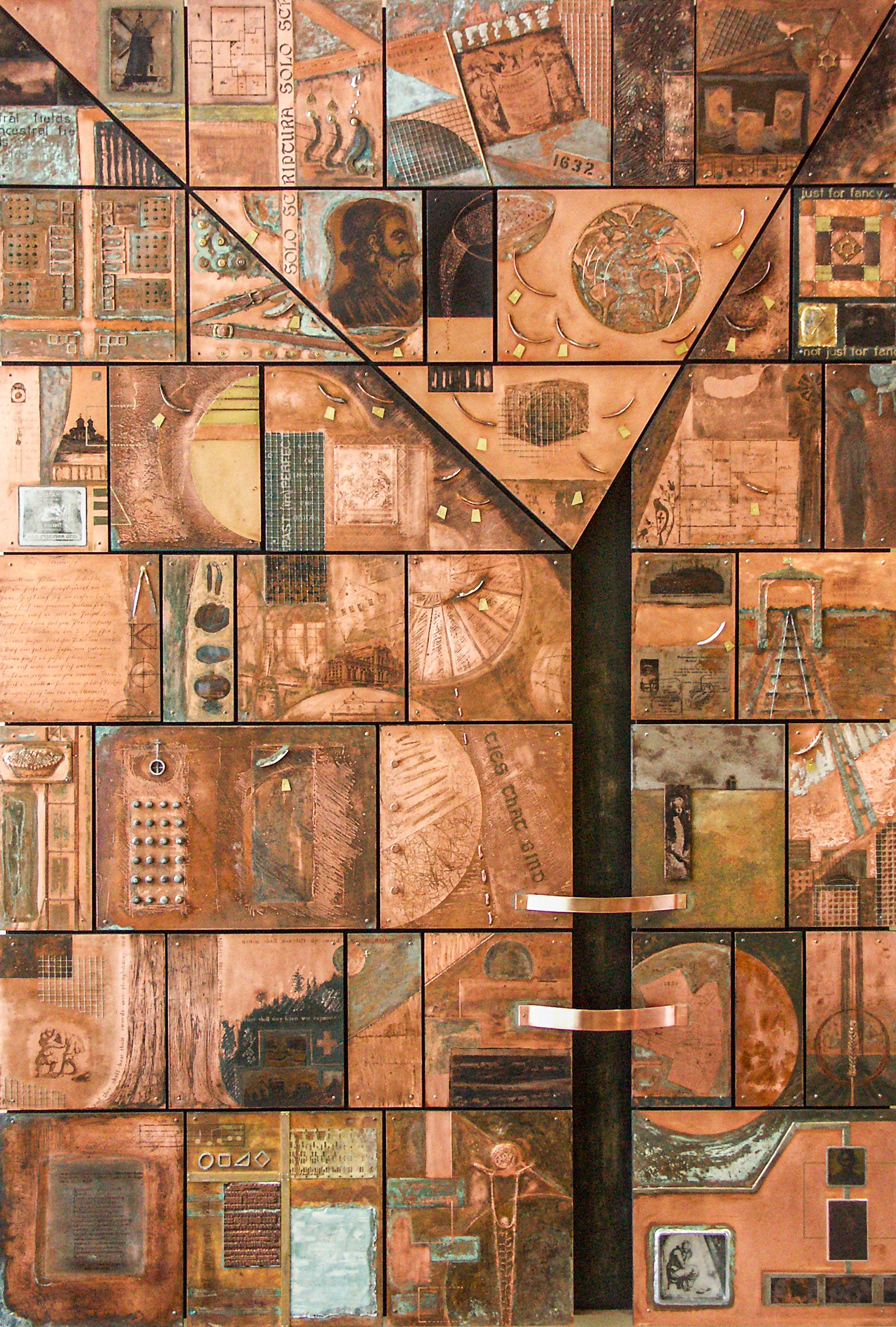
Ties that Bind
Jo-Anne Harder
Copper and brass on wood, 2003
Location: Atrium
This sculpture reflects on 500 years of Mennonite community, persecution, migration, and settlement, and explores notions of place, memory, and identity. Filled with symbols and blurred images of landscape, religious and cultural life, family, work, and education, the piece examines a psychology of separation along with a gradual assimilation and engagement between Mennonites and the world. This masterpiece was presented to Conrad Grebel University College in November 2003.
Details about the many images in the sculpture are available in a brochure beside the sculpture.
Four Serigraphs
David Peter Hunsberger (1950-)
Location: Atrium
David Peter Hunsberger, a 1976 graduate of the University of Waterloo’s Fine Arts program, works as an artist in Waterloo. Hunsberger specializes in serigraphs, handmade prints created using stencils, ink, and silkscreens. The imagery in Hunsberger's art is inspired by his fascination with nature. Individual wildflowers, forest floors, shorelines, rivers, rapids, forest interiors, and panoramic landscapes have all provided inspiration for him. In 2015, Hunsberger donated five serigraphs to Grebel that depict landscapes of the Waterloo area, including “Schneider’s Woods.”
Crosses
Woldemar Neufeld
Copper and brass, 1973
Location: Atrium (Look up!)
Crosses is an abstract metal sculpture comprising a large copper ring enclosing an intricate cluster of square brass pipes. This large hanging sculpture is a unique feature of Grebel’s substantial Neufeld collection and was donated to the College in the late 1980s.
Tree
Sara Cressman
Fabric, 2023
Location: Atrium
As each year passes, our lives are filled with more instances of both grief and joy and more beginnings and endings. This quilt was designed and created by Sara Cressman to represent those different parts of life simultaneously. It was the 2024 Feature Quilt at the New Hamburg Mennonite Relief Sale, and it was donated to Grebel in memory of Gladys Cressman, Richard Cressman, and Chris Cressman.
Proceed beneath the Tree quilt and turn left down the second-floor Academic Wing.
Henry Pauls (1904-1995) Collection
Henry Pauls was born in the village of Chortitza, Ukraine where, as a young man, he trained to enter the teaching profession. The violence of the late 1910s and early ‘20s interrupted this career path and pushed Pauls to migrate with other Mennonites to Saskatchewan with his parents and five siblings in 1923. Near Sonningdale, Pauls and his wife Sara Hildebrand developed a mixed farming operation before moving to Leamington in 1949 to cultivate tomatoes, tobacco, strawberries, and asparagus.
After his retirement in 1987, Pauls wed an intensifying desire to record the memories of his youth in Ukraine with a long-standing interest in painting. Over the remainder of his life, he produced around one hundred original works documenting elements of Russian Mennonite community life in Ukraine and in Canada. The National Archives (Ottawa), the Mennonite Heritage Centre (Winnipeg), and Conrad Grebel University College each hold about one quarter of the artist’s complete body of work.
Location: Second floor Academic hallway
-
Sunday Morning at Chortitza Mennonite Church, 1981
-
My First Lesson in Mennonite History
Woldemar Neufeld (1909-2002) Collection
Watercolour and pen and ink, oil on board, colour lino cut, print
Woldemar Neufeld was born to a family of industrialists in Waldheim, a small village in the Mennonite Molotschna colony in Ukraine. His father, who encouraged Neufeld’s artistic talents as a child, was executed by Soviet soldiers in 1920. Four years later, Neufeld joined his mother, stepfather (then under state surveillance), and siblings in migrating to Canada, arriving in Waterloo by train in late December 1924. Over the next eight months, he billeted in the home of Swiss Mennonite farmers west of the city.
By the late 1920s, Neufeld had begun training for his lifelong project as a painter and documentarist, responding especially to the built environment close to his home in southern Ontario and farther afield. Early in his career, Neufeld came into contact with leading Canadian artists, from Homer Watson to members of the Group of Seven. His work passed through a number of styles, from the vividly realistic to the coolly abstract. Although he never abandoned oils, Neufeld produced a substantial body of watercolours and block prints. The majority of Conrad Grebel University College’s collection of Neufeld’s work, focused principally on local subjects, was acquired through purchase from the artist in 1974 and 1980. Pieces have also been received from donation by the artist or others.
Location: Second floor Academic hallway
-
Lutheran Church, Bridgeport, 1946
-
The Old Floodgates at Silver Lake, ca. 1968-72
-
Amish Meeting House, 1940
-
West Montrose Covered Bridge, 1947
Peter Goetz (1917-2007) Collection
Watercolour on paper
Peter Goetz, son of Henry and Justia Goetz, was born in Slavgorod, Russia and immigrated to Canada in 1929. Peter attended Kitchener Collegiate Institute where he met his future wife, Helena Warkentin. They had two children. During World War II, he served at an Alternative Service work camp in British Columbia. While working as an accountant with B.F. Goodrich, he attended art classes at Waterloo College (now Wilfrid Laurier University) and the Doon School of Arts where he studied with Frederick Varley of the Group of Seven and joined the Kitchener-Waterloo Society of Artists. He travelled widely with his exhibitions.
His work is in the collections of Queen Elizabeth II, the City of Waterloo, the Kitchener-Waterloo Art Gallery, the London Regional Art Gallery, the National Club in Toronto, the Universities of Guelph, Waterloo, and Wilfrid Laurier, Conrad Grebel University College, and many private homes. The Goetz family donated 16 original watercolours and one of his sketchbooks to the College in 2009. The College subsequently framed these paintings. One additional framed painting, "Gathering at the Meetinghouse," was donated in 2010 by Gerald Toogood. "The Village Novgorod" was donated by Jon Cooperman in 2022.
Location: Academic wing hallway
-
Maple Sugar Pails
-
April
-
Elmira Mill
-
Sunday Morning
-
Red Barn
-
Barn Raising
-
Linwood Mennonite School
-
Old Kitchener Market
-
Buggies and Silos
-
Schneider House
-
Waterloo County
-
Blair Field
-
Maple Sugaring
-
Summer Lane
Pennsylvania German Mennonite Homestead
M. Hofstetter
Watercolour on paper
Location: Academic wing hallway
This image of a Mennonite homestead in the winter was a gift given to Grebel in 1990 by Lorna Bergey and family. It is a depiction of pioneer Jacob Y. Shantz’s homestead near Haysville, Ontario, between 1837 and 1880. Nothing is known about the artist.
Return to the entrance of the Academic Wing and take the stairs or elevator up to the third floor. Pause at the catwalk to take in the Mennonite Archives of Ontario exhibit.
What They Carried: The Archives of Russlaender Mennonite Immigrants
Location: Mennonite Archives of Ontario Gallery, third floor catwalk
From 1923-1930, 21,000 Mennonite immigrants from the Soviet Union ("Russlaender") arrived in Canada seeking respite from war and turmoil. Many stayed in Ontario. They carried what most immigrants carry: portable reminders of home and family, recipe books and other forms of practical knowledge, songbooks to sustain faith and culture. They carried painstakingly-acquired documents vital for the crossing of borders. Less tangibly, they carried experiences of grief and loss along with feelings of trepidation and anticipation, from which new stories would grow.
Archival gallery exhibits change approx. every two years. Visit the website for more info on archival exhibits.
Hildebrandt’s Flour Mill, Einlange
Henry Pauls
1981
Location: Mennonite Archives of Ontario Gallery, third floor catwalk
Encounters Along the Grand
Judy Gascho-Jutzi
Fibre art, 2011
Location: Mennonite Archives of Ontario Gallery, 3rd Floor (look up!)
This pictorial slice of history depicts the early contact between Mennonite settlers and Indigenous peoples along the Grand River. Commissioned by the Mennonite Historical Society of Ontario, this quilt hung in several church and community locations around Waterloo Region before its installation at Conrad Grebel University College in 2014.
Go up the ramp and enter the Milton Good Library. Walk straight to the end of the library and turn left.
Photography Collection
David L. Hunsberger (1928-2005)
14 Photos
Location: Milton Good Library – 9 photos along front wall, 5 in a corner of the stacks
David L. Hunsberger was the son of Noah and Minnie Hunsberger. Noah was the minister at Erb Street Mennonite Church for many years. When David was 14, they moved to St. Jacobs, where David lived for 55 years. In 1956 he married Katherine (Kate) Nafziger; they had three sons and one daughter. He was a professional photographer in the village for most of those years. The family donated nearly 5700 photographs and negatives in 2005. Hunsberger’s full collection is available to search online in the Mennonite Archival Information Database.
In 2015, Archivist-Librarian Laureen Harder-Gissing curated a photo exhibit featuring a select number of David L. Hunsberger's iconic photos, entitled “Taking Community from the Farm to the World.” This exhibition of David L. Hunsberger’s photographs provided glimpses into the experiences of community within one particular group of people: Ontario Mennonites in the 1950s and 1960s. For 40 years, Hunsberger and his camera were present at special occasions and ordinary days in the lives of Waterloo Region Mennonites. His work offers glimpses into community life in the 1950s and 1960s: barn raisings, shared meals, fellowship, and play. Taken during a time of transition for Ontario Mennonites, these photographs testify to bonds of faith, hope, and love, and to a renewed commitment to peace and community.
Continue moving left and head into the stacks section of the library. As you move around the circumference of the Library, you will find a multitude of art.
Woldemar Neufeld (1909-2002) Collection
Watercolour and pen and ink, oil on board, colour lino cut, print
Location: Milton Good Library sitting area
-
Georgian Bay Dock, 1934
-
Shingle Factory, Vancouver, 1937
-
Dock at Perry Sound, 1934
-
Homestead at Georgian Bay, 1934
-
Buildings Along the Grand River, 1933
-
Snow Fences, 1935
Location: Milton Good Library stacks
-
Barns in Heavy Snow, Bridgeport Road, 1934
-
Sunlight and Shadow, St. Jacobs, 1933
-
Untitled (field and stream)
-
Waterloo Town Hall, 1947
-
Albert and Duke Street, Waterloo
-
Jacob H. Janzen Residence, ca. 1968-72
-
Kuntz Brewery, ca. 1968-72
-
Willison Hall (Waterloo Lutheran College and Seminary), ca. 1968-72
-
Farm Buildings, 1937
-
White House on a Windy Day, 1935
-
The Janz Farm, 1937
-
Central School, ca. 1968-72
Henry Pauls (1904-1995) Collection
Location: Milton Good Library stacks
-
Die Buch-Leute/The Book-People, 1993
-
Farmstead in Rosenthal, 1975
-
Peter Hildebrand Writing His Memories
-
A Sunday Afternoon, 1978
-
Boy and Nightingale
-
Mother Understands
-
A Sunday Afternoon: The Grandparents, 1980
Peter Goetz (1917-2007) Collection
Watercolour on paper
Location: Milton Good Library stacks
-
Gathering at the Meetinghouse
-
Sunday Service
Donald Schildroth (1927-2013) Collection
Oil on canvas
Location: Milton Good Library Stacks
-
The Bargain Hunters
-
Come and Worship
-
The Bus Stop
Born and raised in Kitchener, Donald Schildroth always had a passion for art and photography. Following a career at Uniroyal he retired to Victoria, B.C. In 1992, the year of his 65th birthday, he decided to do 65 paintings as "an expression of the lifetime of fond memories I have of roaming Waterloo County with a camera and trying to capture the simple rural and village Spirit that the Mennonite tradition inspired."
Schildroth donated 5 paintings to Conrad Grebel University College in 2011. The collection consists of five framed oil paintings and a photocopy of an album containing photographs and artist statements for all his paintings. Most of his work focuses on traditional Mennonite life and scenes in Waterloo County.
Conestoga Moving
Murray Pipher (1933-2015)
Acrylic
Location: Milton Good Library stacks
This painting depicts a Conestoga wagon pulled by four horses travels along the Rouge River. It was commissioned by the York Chapter of the Pennsylvania German Folklore Society of Ontario.
Murray Pipher was a painter rooted in the landscapes and heritage of Markham, where his family settled in 1801. Born in Lemonville and educated in Stouffville, he spent nearly all his life in the community he loved. After retiring from a career in advertising and sales promotion in 1999, he returned to painting following a 40-year pause. Working in acrylic on masonite and canvas, Murray captured the play of light and shadow on natural forms, offering fresh perspectives on familiar scenes. A keen observer of nature and local life, he left a body of work reflecting place and memory.
Cressman Family Tree
Oil on board
Alson Bauman and Sybilla Bowman
Location: Milton Good Library Reading Room
Having searched far and wide for a “suitable tree,” Sybilla (Schweitzer) Bowman, granddaughter of Isaac S. and Barbara (Snyder) Cressman, engaged artist Alson Bauman to collaborate in this design. All 14 children of Isaac Cressman and his two wives (who were also sisters) are represented, including one adopted son. Their homestead was known as Cressman’s Woods, now part of Homer Watson Park along the Grand River. This family tree invokes Psalm 1:3: “They are like trees planted by streams of water which yield their fruit in its season and their leaves do not wither. In all that they do, they prosper.” Immigrant trees like this one celebrate growth and rootedness in a new land. Recently, Canadians have become more aware of how this land was often unjustly taken from Indigenous peoples, adding an unsettling dimension to the pioneer family tree.
As you leave the Library, pass by the information desk for a few more pieces of art.
Hagey Mennonite Church
F. Grove
On Canvas
Location: Milton Good Library corridor
At its earliest location, the Preston congregation was known as the Bechtel congregation and Benjamin Eby made reference to a Bechtel meetinghouse built in 1824. The congregation then became known as Hagey's until it moved to Preston. This congregation was in the oldest Mennonite settlement in Waterloo County. The first settlers, Joseph Schoerg and Samuel Betzner, arrived in 1800 from Pennsylvania and settled on the Grand River three miles west of the Hagey Church. For the first number of years worship services were held in homes. A union meeting house was built as early as 1814. The first church at the Hagey location was built in 1842.
Tremaine’s Map of the County of Waterloo, Canada West, 1861
Gordon C. Eby fonds, Mennonite Archives of Ontario
Location: Milton Good Library corridor
This map of Waterloo County from 1861 includes landmarks, buildings and lot demarcations along with the names of settlers. Teacher and genealogist Ezra Eby used this map in Waterloo County classrooms. His Biographical History of Waterloo Township was a foundational work of local history and genealogy. Christian Eby, a traditional healer and Ezra’s brother, used the map to locate his clients. The children of Foster and Mary Eby (grandchildren of Gordon C. Eby) donated and provided for the conservation of this map with the generous assistance of Conrad Grebel University College, several donors, and the Waterloo Regional Heritage Foundation. Original ownership is attributed to teacher and genealogist Ezra Eby (1850-1901).
The Village Novgorod
Peter Goetz (1917-2007)
Watercolour on paper
Location: Milton Good Library information desk
Mennonite Woman
Siegried Haase (1916-1996)
Oil
Location: Milton Good Library information desk
Siegfried Haase was born in Pomerania. He studied fine arts and graphics in Berlin before becoming a war artist during the Second World War. Born into a Lutheran family, he converted to Catholicism in 1953. He immigrated to Canada in 1952 and taught at the Nova Scotia College of Art and Design from 1964-1982. He spent time in the Cambridge, Ontario area in the 1970s before moving there in 1984, and in 1985 he opened a studio in Kitchener. In 1989, he moved to Ottawa. During and after his lifetime, he has been recognized as a Canadian artist of national prominence.
This painting entitled "Mennonite Woman" was donated to Grebel by Haase’s daughter. In it, a woman in a black dress sits serenely in front of a black kitchen wood stove. Behind the stove are two large windows and a brightly coloured wall.
Leave the Library and return to the staircase or elevator. Go up to the fourth floor – the Kindred Credit Union Centre for Peace Advancement. Enjoy the exhibit in the Gallery and if Room 4224 is empty, you can view the Harder pieces.
Tending Tomorrow, Picturing Today
Location: Grebel Gallery, Centre for Peace Advancement, fourth floor
Tending Tomorrow, Picturing Today features photography by Ndagire Brendah and quotes by Leah Reesor-Keller, author of Tending Tomorrow: Courageous Change for People and Planet. The exhibit hopes to inspire viewers to reflect on the interconnection between humans and the natural world, challenging dominant Western ontological understandings of social and natural world hierarchies to imagine flourishing futures for people and the planet. This exhibition of photography and prose is an opportunity to critically observe the impact of our actions on the natural world and re-examine our relationship with the environment and each other.
New Fraktur Collection
Meg Harder
Ink and gouache
Location: Room 4224, Centre for Peace Advancement
-
We Are Vessels
-
In the World, Not of the World
-
The Parking Lot
Meg Harder is a Mennonite female artist who explores bioregional themes through a variety of media including works on paper, projection, installation, and social choreography. Harder received her BA in Fine Arts from the University of Waterloo, which included six months of study and studio practice at Bazellel Academy of Art in Jerusalem, and her MFA from the University of Guelph. These ink and gouache drawings were donated to Grebel in 2019.
Harder's work, New Fraktur, draws on the Mennonite tradition of fraktur art, a highly imaginative, densely detailed, and symbolic illuminated folk art practiced historically in the Waterloo Region. This work aims to carry forward the aesthetic sensibilities and fantastical elements of fraktur while expanding its visual vocabulary and narrative potential. This is achieved through the integration of appropriated archaic and highly abstracted symbols, pattern, and motifs found within Mennonite visual culture with newly imagined imagery that engages with contemporary themes and interests (e.g. bioregional and local culture, feminist and queer theory). These works aim to disrupt problematic (e.g. colonial, Christian, and patriarchal) narratives, resist any ultimate interpretation, and create space to reimagine historical and future realities in the Grand River Watershed.
The Grebel Archives also hold River Cycle, a 20-ft illuminated scroll composed of 34 individually illustrated panels. Collectively, they depict a reimagining of the biblical flood myth as an epic cyclical narrative of creation and destruction of a civilization along an infinite river of time, reframing the myth within the context of contemporary climate change, migration, the Grand River Watershed, and the colonial legacy that persists there. This major work is viewable by appointment only.
Return to the second-floor Atrium and proceed toward the Dining Room. Head to the fireplace lounge.
We Are All Engines of Joy
James Paterson
Moving wire sculpture, 2022
Location: Lounge area in the dining room
James Paterson builds ambiguous machine-like objects from steel wire and mixed media. While studying Fine Arts at the University of Waterloo, Jim was under the tutelage of Nancy Lou Patterson, creator of Grebel’s Chapel windows and the founder of the Department of Fine Arts at UWaterloo. Jim is also a Grebel alumnus. “We Are All Engines of Joy” unifies the University of Waterloo’s six different faculties, with musical symbols, Grebel’s iconic peaked roof, ploughshares, and agrarian windmills. The artist’s goal is to show sheer revelry, joy, and celebration of who we are at our best and the good things in life we share together.
From the fireplace, take the first left to exit the dining room, turn right in the hallway (not the stairwell), and enter the student lounge on the left. Walk to the left of the mailboxes.
Grebel Lights
Margaret Gissing
Acrylic on canvas
Location: Student Games Lounge
This painting by Fine Arts student Margaret Gissing was a gift to the College from Student Council to celebrate Grebel’s 50th Anniversary. The abstract painting was inspired by the Chapel's stain glass windows and the architecture of the residence rooms, two spaces within the college defined by their windows. The colours of the chapel windows cascade into beams of continuous light, given structure by the beams of a place that has been home for so many students over 50 years. Community is an important part of Grebel's mission. In that way, the cascade also reflects a macro view of the people who are part of that story: each colour shift a piece of the spectrum that community is made of, each a light of their own. The title Grebel Lights, plays on the term "Grebelite", which also describes residents and attendees of the College.
Leave the lounge and return to the Dining Room. Ascend the staircase in the Dining Room (or take the elevator) to the Chapel Foyer. You may enter the Chapel if it is not in use. Please be respectful of this space.
Stained Glass Windows
Nancy-Lou Patterson
Stained glass, 1963
Location: Chapel
Grebel's striking stained-glass windows were designed to symbolically reveal the story of the life and faith of Mennonites and their Anabaptist forebears.
They were designed by local artist, professor, writer, scholar, teacher, novelist, and poet Nancy-Lou Patterson, who passed away in 2018. Her paintings, drawings, calligraphy, stitchery and stained-glass window designs can be found in churches and public and private collections in Canada, England and the United States. As well, her mythopoeic drawings and illustrations have been exhibited widely and published in many books and journals. She wrote on native, Mennonite and ethnic art, and about fantasy and mythopoetic art and literature. She taught the University of Waterloo's first Fine Arts course, and in 1968 she founded the Department of Fine Arts, twice serving as Department Chair. Patterson's family recently sponsored an exhibit in the Grebel Gallery in their mother's honour.
All the symbols used in the Conrad Grebel Chapel windows are drawn from the natural world - fire, water, earth and growing things. The windows are divided into two parts. On the right hand entering the chapel and facing the chancel, is the group of windows representing the history of Mennonite faith and life in relationship to the world. The left-hand windows represent the history of Mennonite faith and life in relationship to itself. Each group of windows reflects the other and both point the viewer toward the true focus of attention in the chapel - the chancel, with its pulpit-lectern and cross.
Details about the images in the stained glass are available in the Chapel foyer. The artist’s original sketches of the windows can be viewed in the Mennonite Archives of Ontario by appointment.
Thank you for visiting Grebel! You can leave through the Chapel foyer doors or return to the main parking lot by going back down the stairs toward the Atrium.
Grebel Spaces: Atrium | Academic Wing | Library Landing | Library | Fourth Floor | Dining Room | Chapel
