Methods for sampling & identifying microplastics in wastewater
KEY INSIGHTS
-
Moving beyond counting particles: Counting microplastics alone does not show how much plastic is actually present. This research advances methods that measure microplastics by mass, which is more meaningful for understanding environmental and human-health risks.
-
Using artificial intelligence to identify plastics: The team developed PlasticNet, a deep-learning tool that automatically identifies microplastic types in complex wastewater samples. This reduces human error and improves consistency across large datasets.
-
Improving accuracy and transparency of measurements: New frameworks were created to account for material loss and uncertainty during sampling and analysis. These improvements lead to more accurate mass balances and a clearer picture of how microplastics move through wastewater treatment systems.
WHY THIS MATTERS FOR WASTEWATER UTILITIES
-
More reliable data for decision-making: Improved measurement accuracy helps utilities better understand how much microplastic is entering, moving through, and leaving treatment systems.
-
Stronger compliance and reporting: Standardized, mass-based methods support clearer reporting and readiness for future regulations on plastics and contaminants.
-
Better risk and investment planning: Knowing the true mass and fate of microplastics allows utilities to assess risks more realistically and prioritize upgrades or interventions where they will have the greatest impact.

RESEARCH PROCESS
The Parker Lab focused on improving how microplastics are measured in wastewater treatment systems, where particles are small, degraded, and difficult to identify accurately. Traditional approaches often underestimate pollution levels and make it hard to compare results across studies.
To address this, the team combined FT-IR imaging with deep learning to identify and quantify microplastics by count, volume, and mass. They also developed methods to account for uncertainty and recovery losses during analysis, which improves the reliability of reported results.
These advances support more realistic assessments of microplastics fate in wastewater treatment and provide a stronger foundation for risk-based decision-making.
RESEARCHER PROFILES

Prof. Wayne Parker
Professor of Civil and Environmental Engineering, University of Waterloo: Expert in wastewater treatment, environmental systems analysis, and microplastics measurement methods.
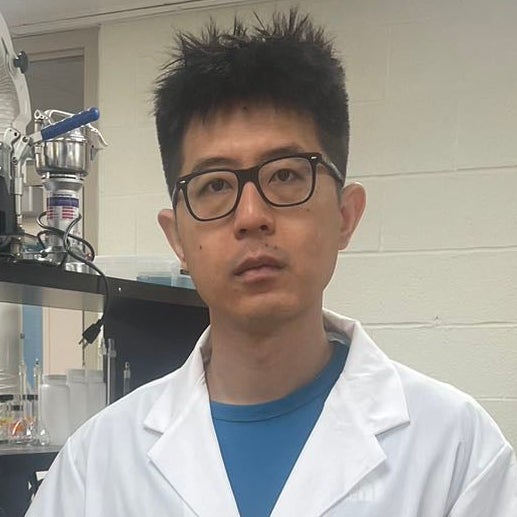
Frank Zhu
PhD Researcher, University of Waterloo: Led the development of mass-based microplastics measurement methods for wastewater systems, integrating FT-IR imaging, deep learning, and uncertainty analysis. Developer of PlasticNet.
Collaborators and partners
This work has supported follow-up proposals with partners including AECOM (Water Research Foundation) and Western University (Environment and Climate Change Canada (ECCC)/NSERC), demonstrating strong interest from both applied and policy-focused organizations.
KEY PUBLICATIONS
Zhu, Z., Parker, W. (2025). Implementing Differential Recovery Corrections Enhances Accuracy of Mass Balances on Microplastics in Wastewater Treatment. Water Research, 271, 122912.
Zhu Z., Schmidt P., Parker W., Emelko M. (2024). A Framework to Quantify Uncertainty in Microplastics Concentrations in Wastewaters and Sludges Incorporating Analytical Recovery Information into Data Analysis, Analytical Chemistry, 96(16), 6245-6254.
Zhu, Z., Parker, W., Wong, A. (2024). Microplastic Mass Quantification using FPA-Based FT-IR Imaging. Environmental Engineering Science, 41(11), 490–498.
Zhu, F., Parker, W., Wong, A. (2023). Leveraging Deep Learning for Automatic Recognition of Microplastics via FPA micro-FT-IR Imaging. Environmental Pollution, 337, 122548.