Electromyography-based Biometrics for Secure and Robust Personal Identification and Authentication
Researchers: Ashirbad Pradhan, Linus Elhert, Jone Junone Kim, and Judy Lee Woo
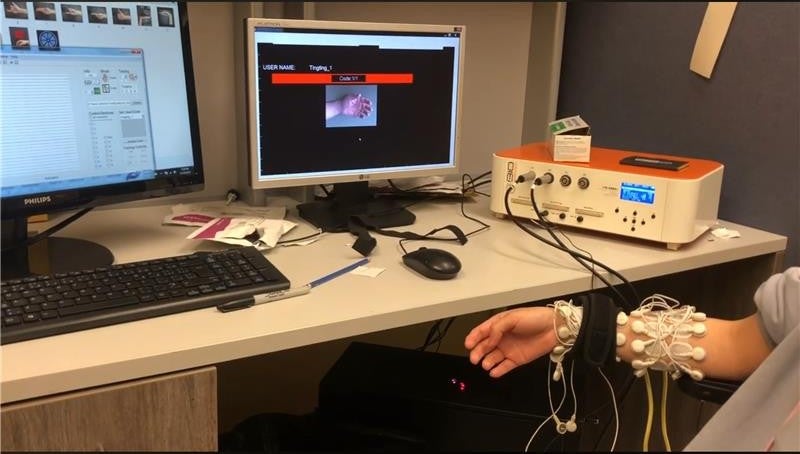
EMG-based biometrics currently face major challenges, including datasets too small for robust biometric evaluations and a lack of multi-day data. To overcome these limitations, our lab performed a large-scale wrist EMG data was collected during hand gestures across multiple sessions, resulting in the release of the GRABMyo and GRABMyoFlow datasets from 63 participants over three distinct days. In our exisiting studies, Novel EMG biometrics were investigated by collecting one of the first large-sample, multi-day EMG databases, with systematic comparisons of time and frequency-domain processing for authentication and identification.
Ongoing efforts now target enhanced biometric performance (e.g., lower error rates) and multi-day robustness through advanced deep learning models that learn user-specific and session-invariant features. Currently, generative adversarial networks (GANs) are incorporated into an anomaly detection framework to identify impostors versus true users, while domain adversarial neural networks (DANNs) are implemented for transfer learning to boost multi-day robustness in wearable EMG applications.
Publications:
- A. Pradhan, N. Jiang, S. Woo, J. He, and J. Tung, “Convolutional Feature Engineering for Cross-day Personal Identification using Wrist Electromyography,” 2025 47th Annual International Conference of the IEEE Engineering in Medicine and Biology Society (EMBC), pp. 1–6, Jul. 2025, doi: https://doi.org/10.1109/embc58623.2025.11253237.
- A. Pradhan, J. He, and N. Jiang, “Multi-day dataset of forearm and wrist electromyogram for hand gesture recognition and biometrics,” Scientific Data, vol. 9, no. 1, Nov. 2022, doi: https://doi.org/10.1038/s41597-022-01836-y.
Novel Exposure Monitoring for FAIS Prevention in Sport: Identifying High-risk Hip Motions in Soccer
Femoroacetabular Impingement Syndrome (FAIS) is a mechanical hip disorder characterized by abnormal contact between bones of the hip joint, often causing pain and impaired function. FAIS is also linked to early-onset osteoarthritis in young athletes. While the causes are not fully understood, participation in high-impact sports during youth is thought to increase risk. Current monitoring methods rely on imaging and clinical tests that are often limited in sensitivity and specificity. This research uses wearable sensors and machine learning to quantify and classify complex hip motions during soccer movements. By developing and validating IMU-based systems against gold-standard motion capture, we aim to identify high-risk movements and characterize hip motion patterns in real-world athletic settings. This approach lays the foundation for personalized training and injury-prevention strategies, with potential applications across sports involving dynamic, multi-planar movements like those in soccer.
Kinematic Analysis of Martial Arts-based falling techniques
Researchers: Arshak Petrosyan
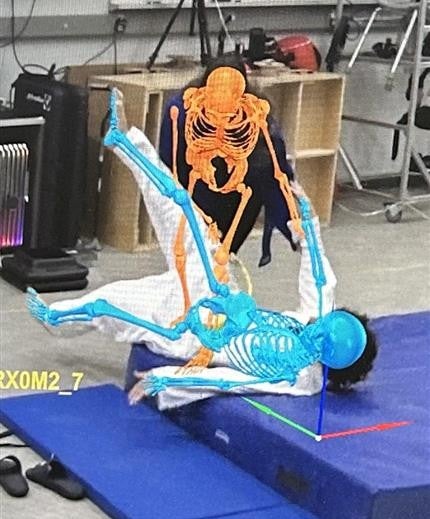
Judo is a martial art consisting of standing wrestling where the practitioner's goal is to throw their opponent on their back while avoiding being thrown themselves. An integral part of the sport is breakfalling, or “ukemi”, which acts as the core method of injury prevention for the practitioner. Analysis of ukemi is expected to facilitate key breakfall patterns, and elucidate mechanisms of injury prevention. However, traditional methods of examining biomechanics of human movement are inappropriate for examining judo. Human movement research is typically conducted using optical marker-based motion capture systems, such as Vicon or Qualisys, which presents issues with occlusions when collecting data with a partner and injury risk when performing falls on the stiff markers. Furthermore, tight clothing is recommended with optical marker-based motion capture to minimize noise/artifacts. Transitioning to markerless collection technology would allow for safer and more efficient collections, as well as the potential to collect data in traditional training gear (a judogi). Current work examines how markerless technology interacts with the judogi clothing condition, as well as how markerless technology performs for capturing falling movements when compared to traditional marker-based methods.