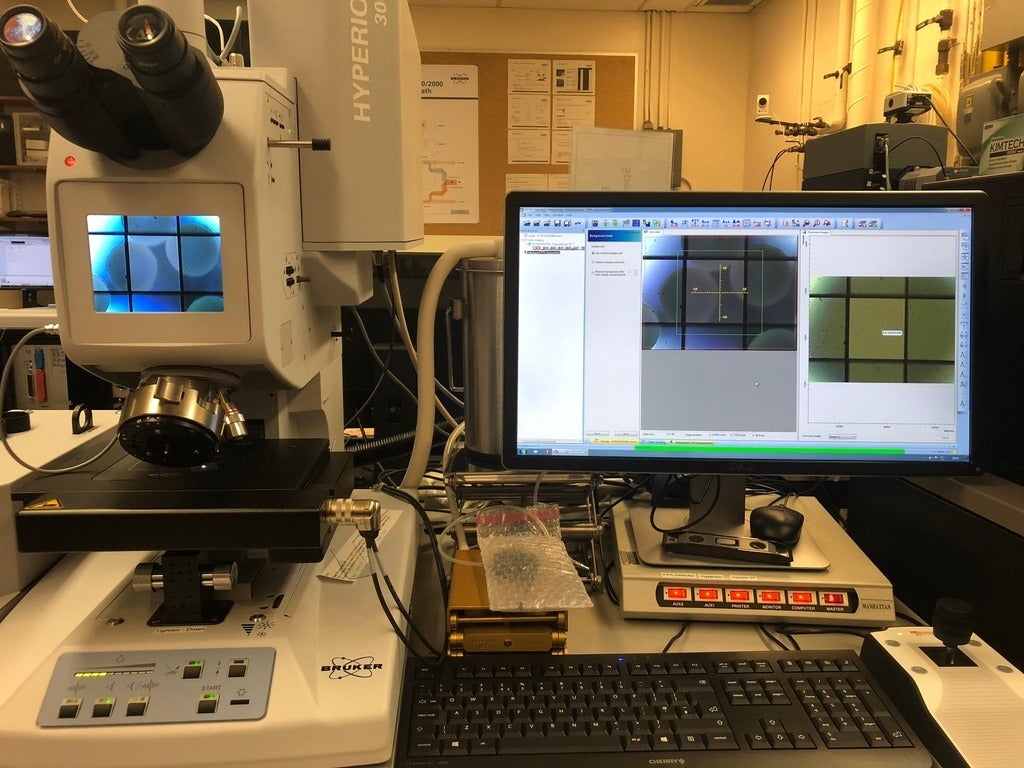
Using AI to find microplastics
Researchers use AI to identify toxic substances in wastewater with greater accuracy and speed
In April this year, the University of Waterloo’s Faculty of Engineering Outreach team launched a free community outreach program called Travelling STEM. Over the summer, the pilot program visited Indigenous communities across Ontario to share exciting STEM (Science, Technology, Engineering and Math) possibilities with youth from kindergarten to grade 11 in their home communities.
Hack the North, the largest collegiate hackathon in Canada, celebrated its 10th anniversary at the University of Waterloo with more than 1,000 students from around the world.
Organized by students for students, the annual event involves participants converging on campus to spend 36 intense hours creating innovative technologies through collaboration and mentorship.
Engineering an epic event
An international mix of nine talented, engaged and curious engineering students recently gathered at the University of Waterloo to tackle a big, messy and complex issue — housing. More specifically, how to build 47,000 homes in a way that is sustainable and kind.
Expanding upon its long legacy of excellence, the Department of Management Sciences at Waterloo Engineering has undergone an official name change to better encapsulate the unit’s distinctive, interdisciplinary approach to education within the engineering field.
The introduction of the department’s new name – Management Science and Engineering (MSE) – follows more than a year of discussions, meetings and town halls with students, faculty, staff, alumni and senior engineering faculty leadership.
Whenever Osose Itua gets on a plane, she’s awestruck by its power to lift off and fly. Her well-travelled childhood from Nigeria to Malaysia to Canada, impressed upon her the wonders of transportation and fuelled her desire to become an engineer.
Curious about how trains, planes and cars work, Itua thought she’d study mechanical engineering. But in her investigation of various universities and their degree programs, she came across mechatronics engineering at the University of Waterloo and something just clicked.
If you’ve walked through a shopping mall or watched a big game on TV lately, you’re sure to have seen an ad touting the benefits of 5G cellular networks. While the ads make claims about having the fastest network or making our lives better, most of us still have a lingering question — what, exactly, is 5G anyway?
As automobile manufacturers continue their pivot to electric vehicles (EVs), the days of the internal combustible engine are ending — and sooner than you think. In Canada, the sale of new gas-powered vehicles will end in 2035. South of the border, the U.S. is set to end the sale of new gas-powered light vehicles as early as 2025.
For many car owners, their next purchase will be an EV. But as many current EV owners know, the environmental benefits of battery-powered cars come with a tradeoff.
It’s that moment that every entrepreneur dreams of the realization that you’ve not only created a product that would help solve a genuine problem but that it’s unique in the marketplace. For nanotechnology engineering alums Khanjan Desai (BASc '13) and Chong Shen (BASc '13), that inkling happened in their fourth-year capstone course, as they were tackling the challenge of keeping windshields frost-free.
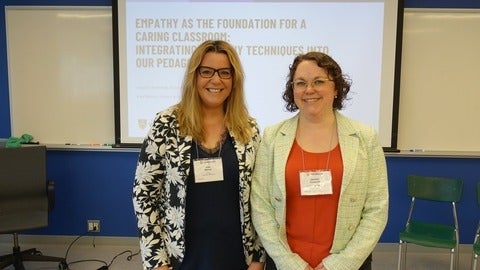
Teaching and learning in engineering and other STEM disciplines can sometimes seem to be impersonal, in the sense that the subject matter is highly technical, and the focus is often on demonstrating discrete competencies.
Yet for Dr. Jennifer Howcroft and Dr. Kate Mercer, seeing the world through the eyes of students and empathizing with them is an essential pedagogical technique.
Howcroft is a lecturer in the Department of Systems Design Engineering and Mercer is a librarian and sessional instructor who teaches in the Department of Systems Design Engineering.