Tiny camera revolutionizes hip and knee surgery
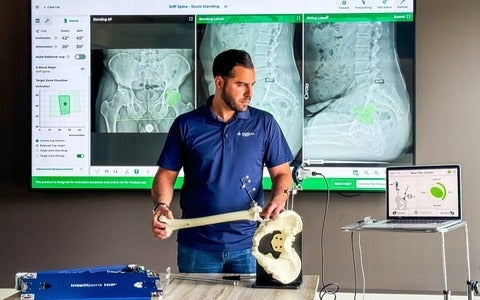
Local Waterloo alumni have developed a global medical breakthrough that significantly improves patient outcomes in total joint replacement surgeries
For 17 consecutive years, the University of Waterloo has been recognized as Canada's top comprehensive research university — driven by a bold, multi-disciplinary approach and strong industry partnerships that turn ideas into impact.
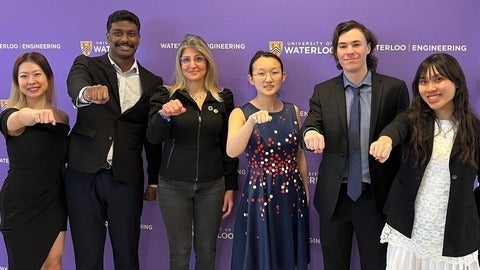
Dean Mary Wells pays tribute to the iron ring's 100 year legacy
U.S. President Donald Trump has launched an unprecedented tariff war against more than 180 countries – what I call “World War Trade” (WWT). I argue that from a competitive dynamics perspective, it’s a strategy that has some merit – for Canada.
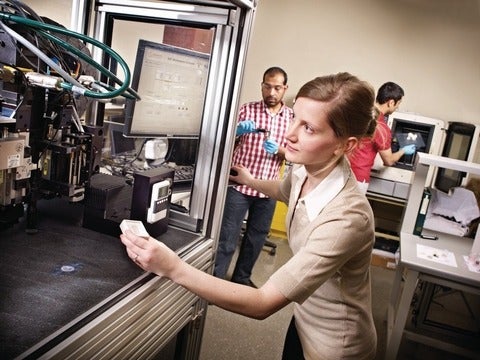
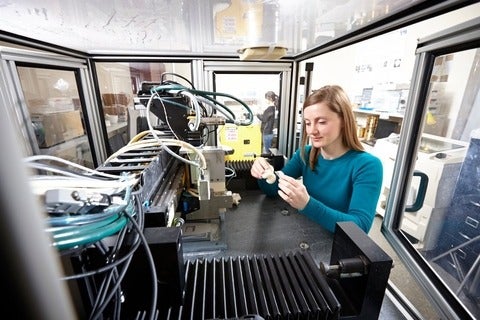
What began as a 150-square-foot windowless lab at the University of Waterloo in 2004 is today the Multi-Scale Additive Manufacturing (MSAM) Lab — Canada’s largest academic metal additive manufacturing (AM) facility. With a space spanning 15,000 square feet, equipped with more than $25 million in cutting-edge infrastructure, MSAM leads innovation in advanced manufacturing, developing the next generation of sustainable 3D printing technologies for industries worldwide.
For engineers across Canada, the Iron Ring is more than a piece of jewelry — it’s a symbol of responsibility, integrity and pride. Now in its 100th year, the Iron Ring ceremony is an important rite of passage for University of Waterloo Engineering graduates, reminding them of their duty to do good work that serves society.
Dr. Robert Jan van Pelt, a professor in the School of Architecture, is renowned for his research into the architecture and design of the Nazi concentration camps and gas chambers.
His research became public when he took the stand as the key expert witness in a notorious British libel trial that pitted British Holocaust denier David Irving against American historian Deborah Lipstadt. His testimony, portrayed in the 2016 film Denial, was a key factor in the verdict clearing Lipstadt of the claim of libel.
When Dr. Mihaela Vlasea’s (BASc ’08, PhD ’14) high school teacher encouraged her to apply to Waterloo’s inaugural mechatronics program, she didn’t imagine that less than 20 years later, she’d be a renowned expert in additive manufacturing (3D printing).
“I didn't really know what mechatronics was, and there was nothing to base my enthusiasm around at that time,” she says, “but I was really intrigued that Waterloo had put this together because every time they put a new program together, it skyrockets into success.”
In 2004, the Multi-Scale Additive Manufacturing (MSAM) Lab at the University of Waterloo was a small, 150 square foot, windowless space. Today, it has expanded to become the largest metal additive manufacturing (AM) academic research lab in Canada, with more than $25 million in infrastructure, and is one of the most comprehensive university-based metal AM facilities globally.
In 2004, the University of Waterloo’s School of Architecture moved from the Waterloo campus to a repurposed silk mill in Cambridge, Ontario, to expand its facilities. The school’s new location in the heart of historic Galt was supported by the City of Cambridge and local businesses who recognized its potential to revitalize the municipality’s downtown core.