Future-ready housing solutions start with future-ready talent
Waterloo co-op student applies engineering and tech skills at Caivan to support purpose-built housing and build land-development expertise
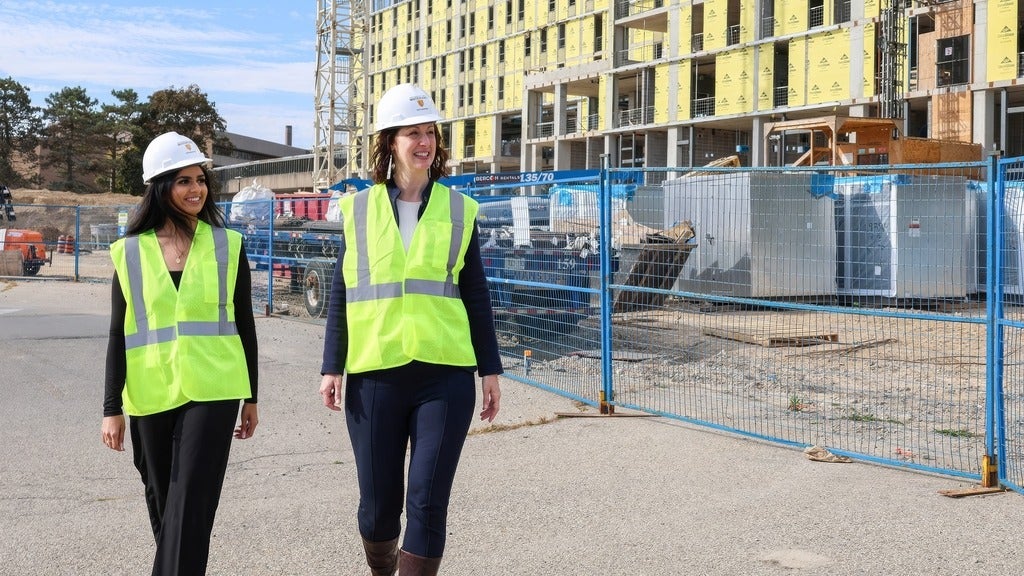
As affordable housing continues to challenge communities across Canada, University of Waterloo students and researchers are developing new skills and exploring innovative tools, policies and approaches to help build more resilient cities. Among them is fourth-year civil engineering student Thomas Fulton, who spent his last co-op work term at the Ottawa headquarters of Ontario-based real-estate developer and founder of the Future Cities Institute (FCI) at Waterloo, Caivan, contributing to the planning, optimization and design of new residential communities.

Thomas Fulton
Co-op experiences like Fulton’s provide engineering students first-hand exposure to the construction and land-development sector, working with major builders, infrastructure constructors, engineering and planning firms as well as local and provincial government agencies. These opportunities prepare Waterloo students for roles in Canada’s evolving workforce while supporting initiatives that drive innovation and help strengthen housing supply and advance sustainable community development.
“It’s a completely different experience,” Fulton says, comparing his term at Caivan to previous co-ops. “You still use your engineering mindset and problem-solving skills, but from a new perspective. Instead of working for the client, you become the client and that really opens your eyes to what happens on the other side of the process.”
Caivan leverages advanced software tools and streamlined production systems to deliver customized homes at scale. The company is committed to modernizing building practices and accelerating the delivery of new homes to improve housing supply and address affordability challenges across Canada.
From classroom theory to real-world land development
Fulton worked directly with Caivan’s land development team to create land use and housing configurations that will form the foundation of future neighborhoods. He used optimization tools to evaluate various designs and produced concept plans that balanced profitability with the public interest. Much of his work involves computer-aided design platform used widely by engineering and architecture students where he drafted, modeled and refined two- and three-dimensional residential layouts.
Fulton recalls one of the earliest challenges he encountered at Caivan was realizing just how many constraints shape a concept plan before it ever becomes a design. Certain areas can’t have too many higher-density units, like townhouses, because each subdivision must still accommodate a required amount of on-street parking per unit. Once Fulton understood these limits, he could begin testing what is feasible and roll all the information into a pro forma, a financial analysis of the concept plan that outlines projected costs and profit from each lot.
“Street parking requirements are much easier to meet when you have low-density units [single houses], and it becomes harder as the density of housing increases, for example townhouses and rear lane townhomes,” Fulton says. “In the current market, townhouses are selling better, so it's a matter of getting as many into a plan as possible while still meeting the street parking requirements for a subdivision.”
Working at Caivan gave Fulton a clearer sense of the tangible impact of his work. His parking requirements analysis was done to prepare an Official Plan Amendment application. In this case, his work supported proposed changes to the concept plan, which is a level of impact he says is often less visible in other co-op roles.
Modernizing homebuilding through research and construction innovation
Waterloo’s commitment to preparing the next generation of talent extends beyond co-op. Through FCI, the University is collaborating with industry partners to accelerate innovation in housing, infrastructure and sustainable urban development.
One partnership is BUILD NOW, the largest affordable homeowner initiative in Canada, led by Habitat for Humanity Waterloo Region and brings together researchers, students and industry leaders to help accelerate the delivery of new homes through research, data modelling and community engagement. Caivan is among the industry collaborators contributing expertise to this work, while FCI scholars and co-op students like Fulton illustrate how academia, government and industry can work together to build more affordable, accessible and sustainable communities.
“Part of the issue with housing affordability is the lack of certainty in construction timelines, and the approvals process needs a much quicker turnaround so development can be approved, designed and ready for construction far faster than it currently is,” Fulton says.
He shares that Caivan’s Ottawa office operates a factory where they pre-build the wood framing for homes using modular methods, offering one solution to help address these timeline issues.
“To speed things up, Caivan is using modular building because it helps make housing less costly and it’s quicker to build. They can complete entire sections of a house frame in the factory and then ship them to the site. It’s a big innovation that really helps spur development.”
While he once assumed he would stay on the engineering side, his final co-op term opened Fulton’s eyes to the developer perspective. His experience at Caivan reaffirmed his interest in land development while giving him a deeper appreciation for the full process behind building communities. It reminded him why he was drawn to engineering in the first place — the simple inspiration of seeing structures rise from the ground and knowing he helped bring them to life.