A focus on equity

A doctoral candidate in the School of Planning and a graduate educational developer with the Centre for Teaching Excellence, McDougall has first-hand experience with learning disabilities.

A doctoral candidate in the School of Planning and a graduate educational developer with the Centre for Teaching Excellence, McDougall has first-hand experience with learning disabilities.
Industrial oil and gas mining activities across the boreal forest in North America have changed our northern landscape, resulting in a vast network of linear disturbances called seismic lines. These lines are narrow clearings that have removed trees and compacted the soil. They cut across peatlands and forests, and have led to changes in the vegetation and how these ecosystems function.
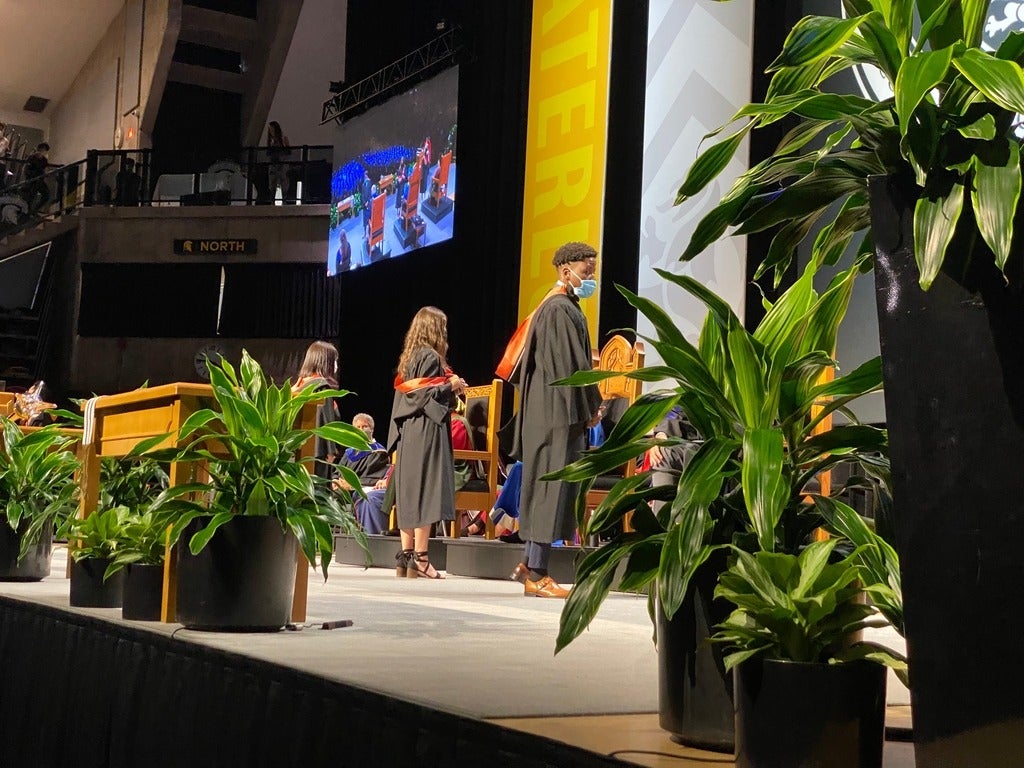
It was only a year ago that Raphael Anammasiya Ayambire celebrated his own graduation from the University of Waterloo. He first received his PhD in Planning before accepting a post-doctoral fellowship directly afterwards. Now a professor at the University of Manitoba, he returned to the University of Waterloo as a Faculty of Environment alumni speaker to congratulate the newest cohort on their achievements and recognize their success.
Waterloo professor is part of an emerging field that calls for establishing a governance framework for ocean-based climate interventions.
In advance of Earth Day, the Sustainability Office and others from the community are
After a six-year process, the leading world body for the assessment of climate change, the UN’s Intergovernmental Panel on Climate Change (IPCC), has released their final Synthesis Report that summarizes what we know about climate change and how to reduce greenhouse gas emissions. The key takeaway – we must act now to secure a livable future for all.
There is still one billion people with unreliable energy supply in the world, but Bayo Akomolafe is well equipped to address this gap. With 10 years of experience working in the power generation industry and his lived experience growing up in energy poverty in Nigeria, Akomolafe’s pursuit of creating affordable, reliable, and sustainable modern energy systems for developing nations is well fuelled.
The Ocean* is the largest of Earth’s systems that stabilizes climate and supports life and human wellbeing. Despite its vital role in our ecosystem, the Ocean has been gravely degraded and historically underrepresented within international climate change agreements. However, the tide is changing.


Dr. Daniel Scott
Professor, Faculty of Environment

Dr. Chris Fletcher
-Associate professor, Department of Geography and Environmental Management
-Member, Waterloo Climate Institute
-Member, Waterloo Water Institute
-Researcher with High-altitude Aerosols, Water Vapour and Clouds mission