Experiential learning crosses borders at bootcamp in India
High school students in Bengaluru, India, joined Waterloo faculty and staff to explore where AI helps and where human judgement matters most
Teams of high school students in Bengaluru had three minutes to convince a panel of Waterloo professors that their AI-powered solution could help feed more people and waste less food.
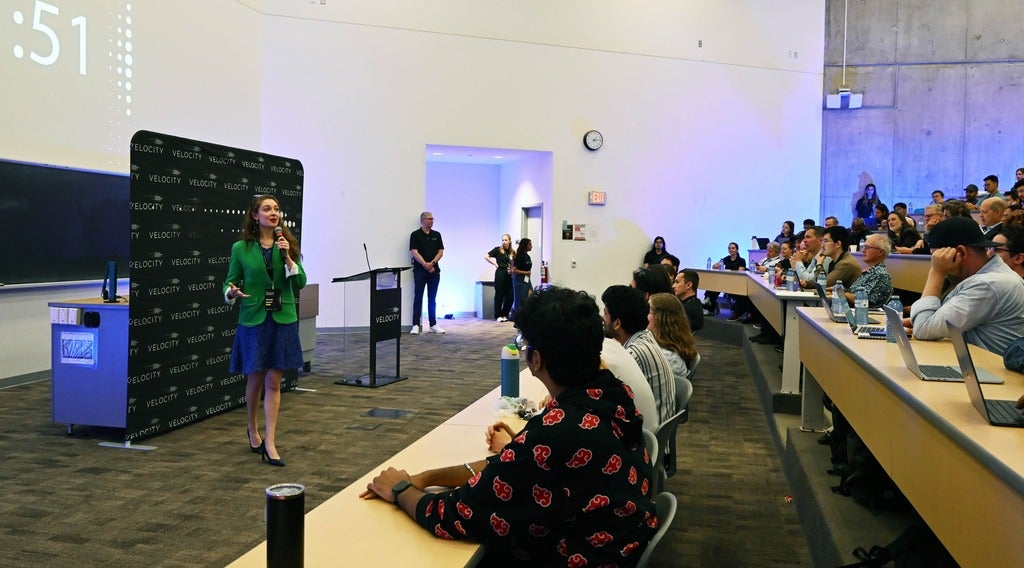
Waterloo faculty and staff travelled there to work with nearly 40 Grade 9 to 12 students from 22 schools on using AI with sound judgement. The three-day bootcamp, Innovation Compass: Bengaluru, ran from October 30 to November 1 at Kunskapsskolan School Bengaluru. It was hosted by Waterloo’s Faculty of Arts and its School of Accounting and Finance (SAF) in partnership with EduQuest, an India-based education consulting firm that runs student programs and conferences.
“AI can now do the base-level work,” says Dr. Adam Vitalis, Director of SAF. “So we have to help students build higher-level thinking skills faster, so they can interrogate, challenge and work with knowledge.”
In his sessions, Vitalis used a real-world case, whether McDonald’s should deploy AI voice ordering across its drive-thrus, to show students how to frame precise prompts, test AI’s assumptions and weigh its output before forming their own recommendation.
Dr. Anindya Sen, Professor of Economics and Associate Dean, Co-operative Education and Planning, Arts, raised the stakes with DashCart, a case about a food delivery company fighting off a new competitor, where every decision carried trade-offs between profits and carbon emissions.
“You can put all these figures into a chatbot and ask for the best decision,” says Sen. “But when you do that, you take away your thinking. Students are the human in the loop. They have to choose.”

Left to right: Adam Vitalis, Konrad Pawlak, Anindya Sen, and Trueman Laisram (all from Waterloo).
For student Rishit, testing different plans in the DashCart spreadsheet was a highlight. “It made me realise how many possible solutions exist beyond the first two or three ideas that usually come to mind,” he wrote afterward.
On the final day, teams competed in The Planet Hack. Working from the portfolio of a fictional global food company, each team used data on food waste, supply chains and seasonal trends to identify a problem, then used AI to build a solution that could work in local and global markets. The top three teams earned letters of recommendation from the faculty judging panel.
“Not only were the students incredibly engaged in the material, they were incredibly engaged with us,” says Clare Reid, Outreach Coordinator in SAF, who co-led the bootcamp with Samantha Bedard, Recruitment Coordinator in SAF. “From recommending places to visit in the city to one student inviting us for a meal at their family’s restaurant, the students were gracious hosts who put connection above everything else.”
For some students, the bootcamp was a string of firsts. One student who travelled from Vadodara on a scholarship counted a first solo flight and a first visit to Bengaluru, along with the “first time being in a room full of like-minded people with so much caliber and curiosity.”
Anupriya Bhatia was once where those students are. She grew up in New Delhi and first saw Waterloo present at a university fair at her high school. Choosing between schools in Singapore and Canada, she picked Waterloo for co-op. “I thought studying could be done anywhere, but studying with real application would be a great thing,” she says.
Now a third-year Accounting and Financial Management student and a Student Outreach Ambassador, Bhatia learned the value of judgement in her first case competition, where her team had three hours to decide what mattered most. “Using our judgement to decide where to focus became our tool for strategizing,” she says.
“With AI, things are changing so fast,” says Sen, who sees co-op and hands-on learning as key for students to keep pace.
For Vitalis, the exchange went both ways. “Judgement is shaped by where you stand, so the more perspectives in the room, the better the decision,” he says. “That’s why a global, diverse student community matters to us.”
What struck him most was how quickly the students moved from using AI to questioning it. “That’s exactly the skill we’re trying to build,” he says. “Anyone can ask AI for an answer. The students who will lead are the ones who know when to push back.”
For Rishit, the three days were just a start. “I went in expecting to learn a few new things about business and AI,” he wrote. “I came out with new perspectives and plenty of motivation to keep exploring.”