Future students

Monday, October 1, 2018

Failure is an option

by Carol Truemner, Faculty of Engineering

It was an idea a Capstone Design team felt not only had merit but could potentially give barbershop owners a run for their money: a haircutting robot.

Two years ago, four mechatronics engineering students started working on a design for a robot that would primarily give men’s haircuts. You’d put a toonie in a slot and walk away with a number two buzz cut or another style.

Monday, October 1, 2018

Unpacking important problems

by Carol Truemner, Faculty of Engineering

Larry Smith loves a good problem — a fitting attitude for the director of the University of Waterloo’s new Problem Lab.

The Waterloo economics professor, who has taught 20 per cent of all engineering alumni, believes in the “simple principle” that before you go to fix something, you need to fully understand the problem.

Monday, October 1, 2018

Upping the ante

by Brian Caldwell, Faculty of Engineering

Playing competitive online poker was so lucrative for Prem Kalevar (BASc ’12, Mechatronics) — earning him more than $400,000 in his last year of university alone — he considered turning his serious sideline into a full-time career.

But after watching classmates succeed as entrepreneurs and pursuing several business interests himself, including a student rental property and two technology startups, he opted to aim higher instead.

“I didn’t want to make my life about a card game,” he says.

Monday, October 1, 2018

7 engineering disruptors

by Brian Caldwell, Faculty of Engineering

From the design of the Waterloo Pump, which brought clean water to communities in developing countries, to the invention of the BlackBerry, which opened the floodgates for the ubiquitous smartphone, Waterloo Engineering students, graduates and researchers have made an indelible mark on the world.

And in a technological age that includes artificial intelligence, ever-faster wireless communications and soon-to-be-self-driving vehicles, that process of innovation and contribution is only accelerating.

Thursday, September 27, 2018

Stressing societal service is key to attracting female engineers

by Brian Caldwell, Faculty of Engineering

More young women are likely to go into engineering if it is promoted as a profession for well-rounded people with a desire to serve society, researchers at Waterloo Engineering have found.

Lukasz Golab sitting at a desk in DC

The results suggest that efforts to close the field’s gender gap should stress key reasons for women to pursue engineering in addition to the current approach of instilling confidence in their technical and academic abilities to succeed.

Friday, September 7, 2018

New system uses AI to detect potholes and other problems

by Brian Caldwell, Faculty of Engineering

Artificial intelligence (AI) technology may soon make it easier and cheaper to detect problems with roads, bridges, buildings and other infrastructure.

Systems design engineering professor John Zelek has developed artificial intelligence (AI) technology to automatically detect potholes and other road defects using photographs.

Friday, August 17, 2018

Reducing the time to diagnose and treat patients

by Megan Vander Woude, Faculty of Engineering

Seyed Hossein Mirjahanmardi talking on stage
Waterloo researchers in the Advanced Concepts Research Lab are developing a new method for medical imaging that could reduce the time to diagnosis.

Thursday, July 19, 2018

Developing a robotic companion with human-like dexterity

by Carol Truemner, Faculty of Engineering

A robot glides across a warehouse floor, picks up an object from a top shelf, boxes it and then carefully loads the wrapped package on a delivery truck – all in record time and without bumping into anything.

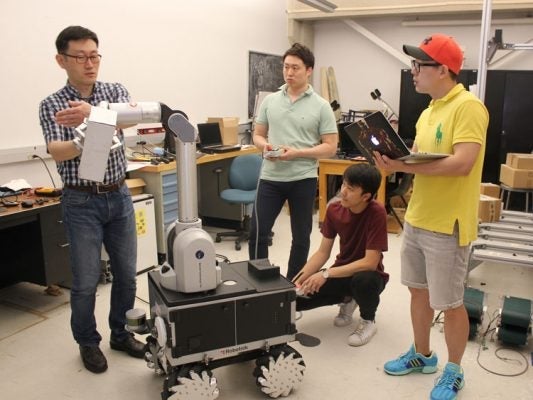
Soo Jean shows research work with his graduate students

Friday, July 6, 2018

Radar and AI could produce a prick-free glucose monitor

by Brian Caldwell, Faculty of Engineering

Researchers at Waterloo Engineering are developing new technology that would free people with diabetes from painful finger pricks to monitor their blood sugar.

A team led by professor George Shaker has combined radar and artificial intelligence (AI) to detect changes in glucose levels without the need to draw blood several times a day.

Thursday, June 21, 2018

New silicon breakthrough accomplishes the ‘impossible’

by Brian Caldwell, Faculty of Engineering

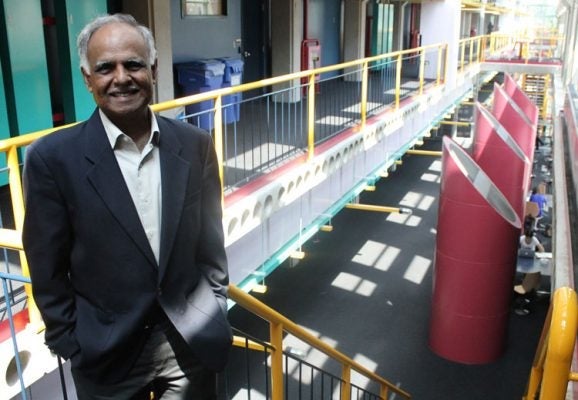
Selvakumar standing in on DC stairs on second floor
Researchers using powerful supercomputers and nanotechnology have discovered a way to generate microwaves with inexpensive silicon, a breakthrough that could dramatically cut costs and improve devices such as sensors in self-driving vehicles.